Interior Trim and Molding
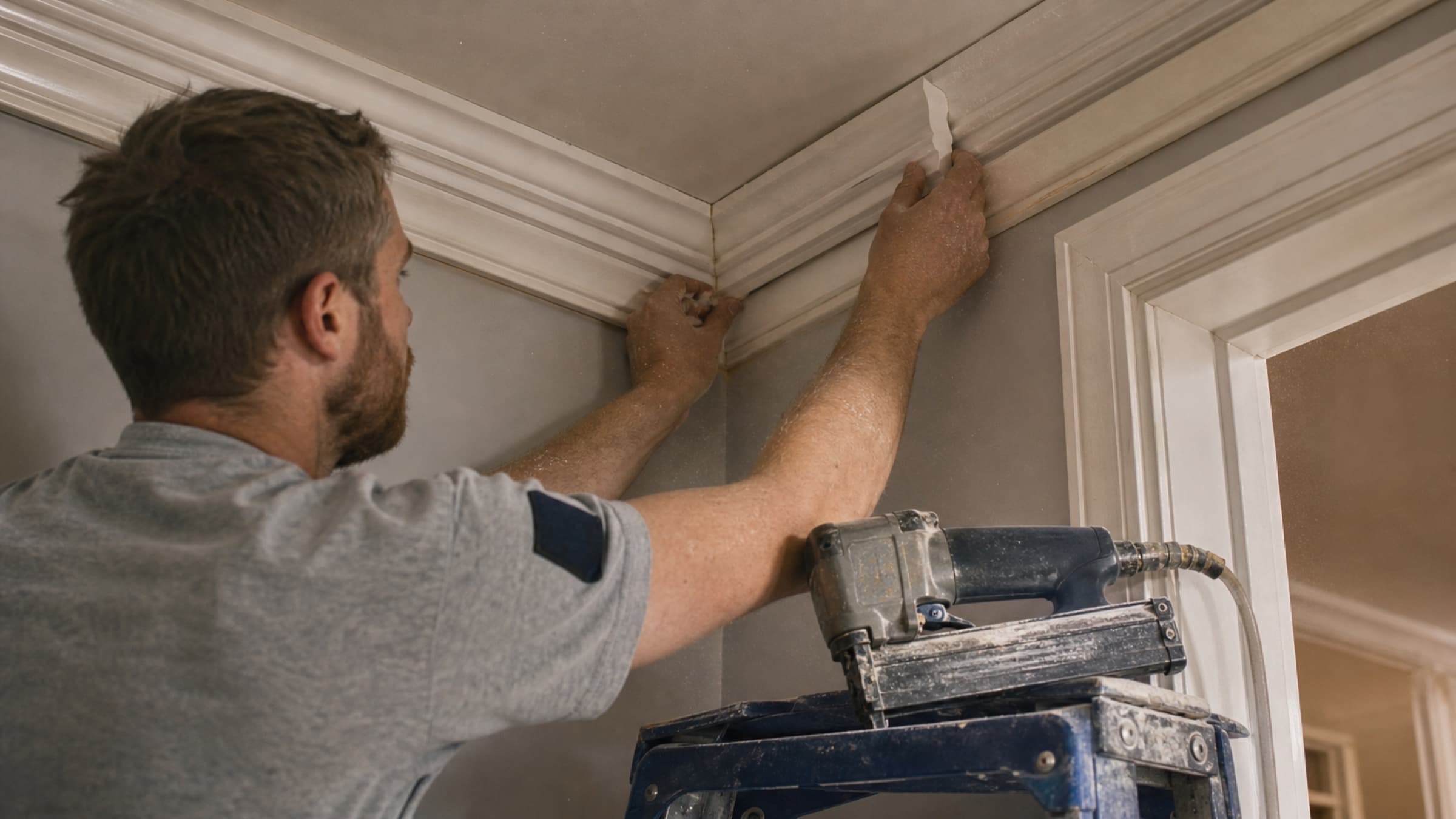
Crown molding, skirting, architrave, wainscoting and panelling, acclimatised in the house before it is cut and scribed to walls as built.
Is this an emergency?
No. Interior Trim and Molding is scheduled work and is not covered by our emergency service, which runs 24 hours, 7 days, including holidays. We will book you into an ordinary dispatch window rather than charge an emergency rate for a job that can wait for one.
About Interior Trim and Molding
Why we leave the material in your house first
Trim arrives at whatever moisture content the warehouse had. Your house is drier in January and more humid in August, and timber moves as it equalises.
Cut and fit material straight off the van and it will shrink over the following weeks. The visible result is joints opening up, most obviously at inside corners of crown and at skirting mitres, and it is the single most common complaint about trim work anywhere in this climate.
So we deliver the material several days before we cut it and let it sit in the room it is going into. It costs you nothing except a corner of a dry room, and it is the difference between joints that stay closed and joints you notice every time you walk past.
What it costs
This work is charged hourly against the published carpentry rate, and totals land between $480 and $9,500.
The bottom is a single room of simple base and architrave. The top is a whole floor of built-up cornice, wainscoting to a hall and stair, and a coffered ceiling.
Hourly is honest here because the variable is the house rather than the material. Two rooms of identical size can differ by a day depending on how true the walls are. We estimate the hours before starting and tell you as we go.
Trim work is not financing eligible. It sits below the financing minimum in most cases, and where a larger job clears it, financing applies to whole projects rather than to a trade item.
Corners are the job
A straight run of moulding is fast. Every corner is slow, and the price tracks corner count far more closely than it tracks linear feet.
Inside corners on crown are coped, not mitred. A coped joint has one piece run into the corner and the other cut to its profile with a coping saw, so the joint closes rather than opening as the timber moves. A mitred inside corner looks identical on the day and opens up by the following summer. It is faster to mitre, which is why plenty of installers do.
Outside corners are mitred, and on a wall that is not exactly ninety degrees they have to be cut to the actual angle rather than to forty-five. That means measuring every corner rather than assuming.
Profiles, and matching what is there
In an older Triangle house with distinctive original trim, adding new work that does not match reads as a mistake even to people who could not say why.
Matching means either finding a stock profile close enough, or having knives ground to run the original. The second costs more and is often worth it in a house with any architectural character. Bring us a short offcut of the original if you have one anywhere; a piece from the back of a cupboard is enough to copy from.
For a modern house, built-up profiles are usually better value than a single large moulding. A three-piece cornice made from stock components looks more substantial than a single piece of the same overall height and costs less in material, though more in labour.
Lead paint
Trim painted before 1978 may contain lead, and removing or sanding it disturbs that paint. This comes up constantly in Triangle houses of that age.
We hold the EPA Lead-Safe certification and we will use it: containment, controlled removal, and proper cleanup. It changes the method and the price, and we would rather tell you at the quote than after. Tell us the age of the house when you book.
Painting
We fill, caulk and prime as standard, because those steps are part of doing the carpentry properly and a decorator caulking someone else's trim rarely goes well.
Finish painting we will do if you want it, or leave primed for your decorator. Say which when you book, because it changes the schedule.
What is included
- Included
- Crown molding, single-piece and built-up cornice
- Skirting and base, including shoe and cap
- Door and window architrave, mitred or butted to plinth blocks
- Wainscoting, board and batten, and shiplap
- Coffered and beamed ceilings
- Picture rail, chair rail and panel moulding
- Removal and disposal of existing trim
- Filling, caulking and priming ready for paint
- Finish painting where specified
- Not included
- Whole-room repainting beyond the trim itself
- Drywall repair beyond making good where trim was removed
- Structural work of any kind
- Hardwood floor refinishing
- Lead paint disturbance without certified containment
- Brands serviced
- Metrie, Ekena Millwork, White River, Sherwin-Williams, Benjamin Moore
- Certifications
- NC General Contractor licence 78341, EPA Lead-Safe certified firm
- Permit required
- No permit is required for this work.
- Typical timeline
- One room in a day or two. A whole floor of crown and base runs three to five days, after several days of material acclimatising in the house.
What it costs
This is charged hourly against the published rate for this trade, within the total range below. We tell you the estimated hours before starting.
- Typical range
- $480 to $9,500
- After hours
- $150 between and , and on Sundays
- Financing
- Not availableFinancing starts at $3,000 and applies to projects rather than service calls.
What moves the price
- Linear feet, and how many inside and outside corners the run has, since corners are the slow part
- Profile complexity. A single-piece crown is quick, a built-up three-piece cornice is not
- Ceiling height, because anything above ten feet needs staging rather than a step ladder
- How far out of true the walls and ceilings are, which decides how much scribing and caulking is needed
- Whether existing trim has to be removed first, and whether it was painted before 1978
- Whether the work is primed and painted by us or left for a decorator
What affects any Cedarline price
- How old the equipment is, and whether replacement parts are still manufactured
- How accessible the work area is: a crawlspace or a second-storey roof takes longer than a garage
- Whether a permit and an inspection are required
- Material grade, which on a roof or a deck moves the total more than labour does
- Whether the visit falls outside dispatch hours
Before we arrive
- Clear furniture away from the walls being trimmed, and take pictures off them
- Say whether the house was built before 1978, since painted trim of that age needs lead-safe handling
- Note whether you want us to paint or to leave it primed for a decorator
- Allow space in a dry room for the material to acclimatise for several days before we cut
Typical timeline
One room in a day or two. A whole floor of crown and base runs three to five days, after several days of material acclimatising in the house.
Warranty
- Labour
- 24 months
- Parts
- 12 months
Two years on our workmanship, which covers joints opening beyond normal seasonal movement. Some movement in a Triangle winter is expected and is not a defect.
Questions
Carpentry questions
How long does custom cabinetry take?
Six to ten weeks of shop fabrication after you sign off the design, then two to five days on site to fit. From first visit to finished cabinetry is three to four months. There is no version of this where cabinetry appears in three weeks: the timber has to be selected and milled, carcasses and doors built, and the finish sprayed and properly cured before anything leaves the shop. If your date is genuinely immovable, stock or semi-custom cabinetry through a kitchen remodel is the faster route and we will say so.
What makes custom cabinetry expensive?
Timber species first, then whether the doors are inset or overlay. Painted poplar is the value option and a genuinely good one, because paint does not care what is underneath as long as it is stable; white oak and walnut are several times the cost. Inset doors sit flush within the frame, which looks considerably better and demands tolerances measured in fractions of a millimetre across a run that will move seasonally, so it costs more than overlay.
Can you reface my existing cabinets?
No. Where the carcasses are sound, refacing can be good value, but it runs on a different supply chain from the one we work in and we would be the wrong company to do it. We build new cabinetry in our shop and fit it, or we fit stock and semi-custom units as part of a kitchen remodel.
Why did the joints in my new trim open up?
Almost always because the material was cut and fitted straight off the van rather than acclimatised first. Trim arrives at whatever moisture content the warehouse had, and your house is drier in January and more humid in August, so timber shrinks as it equalises. We deliver material several days before we cut it and let it sit in the room it is going into. It costs nothing except a corner of a dry room and it is the difference between joints that stay closed and joints you notice every time you walk past.
What is a coped joint and why does it matter?
A coped inside corner has one piece run into the corner and the other cut to its profile with a coping saw, so the joint closes rather than opening as the timber moves. A mitred inside corner looks identical on the day and opens up by the following summer. Mitring is faster, which is why plenty of installers do it. We cope every inside corner on crown, and price tracks corner count far more closely than it tracks linear feet.
Can you match the original trim in my old house?
Usually yes, either with a stock profile close enough or by having knives ground to run the original. The second costs more and is often worth it in a house with any architectural character. Bring us a short offcut of the original if you have one anywhere; a piece from the back of a cupboard is enough to copy from, and it is far more useful than a photograph.
My door sticks in summer and swings free in winter. Should I plane it?
No. That is timber doing exactly what it should in North Carolina humidity, and planing it in summer gives you a door with a visible gap by winter. The usual real fixes are a longer hinge screw driven into the stud rather than just the jamb, a strike plate moved a few millimetres, or a hinge shimmed. That is a short visit and it is much cheaper than a replacement, and we will always try it first.
Should I get insert windows or full-frame replacement?
An insert if the existing frame and sill are sound, full-frame if they are not. An insert fits inside the existing frame: quicker, cheaper, less disruptive, keeps your trim inside and out, and loses a little glass area. A full-frame replacement takes everything back to the rough opening, costs more and means new trim, and it is the only way to get the flashing detail properly right. If the sill is soft, an insert is a way of hiding a problem rather than fixing one.
What will I find under the carpet on my stairs?
It is genuinely a gamble, and worth knowing before you commit. In many Triangle houses, particularly builder-grade ones from the 1980s onward, the treads under carpet were never intended to be seen: construction-grade softwood, often with a plywood riser, held down with staples and adhesive, and gouged. Sometimes what comes up is beautiful and needs sanding and finishing; often it needs new treads. We survey first and price both outcomes separately so you can decide with the information.
My banister is loose. Is that a big job?
Usually smaller than it feels, and the cause is nearly always the newel post rather than the balusters. A newel fixed only to the tread has nothing to resist a sideways push, and once it moves the whole run feels unsafe. Fixing it properly means anchoring into the framing, which sometimes means opening the skirt board or working from below. That fixing is what our five year joinery warranty is really about, because a balustrade that feels solid on handover and loose in two years was fixed to the wrong thing.
Can rotten trim be repaired, or does it need replacing?
Three options, and choosing between them is most of the skill. A splice cuts the rotten section back to sound timber and scarfs a new piece in, which is cheaper than replacement and keeps the original profile. Epoxy consolidation hardens softened fibre and is right for something irreplaceable like an original turned column, and wrong for a length of stock casing. Full replacement is right when more than about a third has gone or the piece carries load.
Will the rot come back after you repair it?
It will if the water is still getting in, which is why our quote names the cause rather than just the repair. Timber does not rot on its own: something is keeping it wet, usually a gutter overflowing or discharging behind a fascia, a roof detail with no flashing, a sill with no drip edge, or a paint film that failed years ago. Where the cause is ours to fix we quote it alongside. Our two year warranty assumes the water has been dealt with, and we will not warrant a splice under a still-leaking gutter.
Common questions
How long is the arrival window?
Most visits carry a two hour arrival window, and roofing and construction visits carry three. We quote a window rather than an exact time because a trades crew genuinely cannot promise a minute, and we would rather be accurate than optimistic. We text you when the crew is on the way.
Is the diagnostic fee waived if I go ahead with the repair?
Yes. The diagnostic fee covers the technician's time and a written fault report, and it is waived when you approve the repair. Installation and replacement quotes carry no diagnostic fee at all, because nothing is being diagnosed on an estimate visit.
Is a slot confirmed as soon as I request it?
Not quite. A request is not a held slot. We confirm within 30 minutes during dispatch hours, and first thing the next dispatch day if you request outside them. The availability shown on the site reflects how full a day usually is rather than a live view of the dispatch board.
How can I pay?
We accept Visa, Mastercard, American Express, Discover, ACH bank transfer, and financing on qualifying projects. Payment is due on completion for service work, and on a staged schedule set out in the quote for larger projects. There are two payment methods we cannot take, which are covered in our billing questions.
What happens if I need to cancel?
Give us 24 hours notice and there is no charge. One call or one text is enough to reschedule, and we would much rather move you than charge you. Cancelling inside that window, or nobody being home when the crew arrives, carries a no-show fee.
What happens if nobody is home when the crew arrives?
There is a no-show fee, and it is the same figure as the late cancellation fee. It covers the slot another customer could have used and the crew's drive. If you are running late rather than absent, call us and we will usually wait or come back later the same day at no charge.
What actually happens on a service call?
A technician arrives inside the arrival window, diagnoses the fault, tells you the repair price before touching anything, and completes the work if you approve it. You get a written report either way. Nothing is added to the invoice without your approval first, and we do not carry out extra work while you are out of the room.
What are your hours?
The office is open Monday to Friday from 07:30, and Saturday mornings. Crews dispatch on a wider window, from 07:00 to 19:00 on weekdays and 08:00 to 16:00 on Saturday. There is no scheduled dispatch on Sunday. Emergency coverage runs 24 hours a day, every day, including holidays.
Do you cover my area?
We cover Raleigh, Durham, Cary and the wider Triangle, with coverage recorded city by city because it is not uniform. Most cities have every trade and no travel fee, two have a limited set of trades and a travel fee, one is emergency coverage only, and some adjacent zip codes are outside the service radius entirely. Enter your zip code on our service areas page for a definitive answer.
Do you work on commercial buildings?
No. We are residential only, including multifamily buildings up to four units. A four-unit building is the ceiling and it is a real one rather than a preference: our crews, our insurance and our licences are all sized for residential work. For anything larger, or for any commercial or industrial property, you need a commercial general contractor.
Do you install pool heaters, septic systems, or solar?
No to all three, and we will point you at the right trade for each. Pool and spa equipment sits under a separate licence, so you need a pool service company. Septic systems need a licensed septic contractor, and Wake County keeps a list of permitted installers. Solar needs a solar installer, though we will happily reroof around an existing array. We publish the full list of work we do not take on rather than making you ask.
Do you have Spanish-speaking technicians?
Yes, Monday through Friday. We do not staff Spanish-speaking crews at weekends. If you need one, ask when you book and we will schedule you on a weekday rather than send someone who cannot explain the work to you.
Are you licensed and insured?
Yes. We hold five North Carolina licences covering HVAC, general contracting, roofing, plumbing and electrical, and every licence number is published on our site rather than available on request. We carry general liability cover and workers compensation cover, and we are bonded. Certificates go to your adjuster or your HOA the same day you ask.
What warranty do you give?
Twelve months on labour and parts is the standard, and several services carry considerably longer. Roof replacements carry ten years on workmanship, repiping ten years, structural repair five years, and cabinetry five years. Manufacturer warranties on equipment run separately and are often longer still, and we register them in your name before we leave.
What if I am not happy with the work?
We come back and put it right at no charge. There is no time limit on a workmanship complaint about a repair we performed. Call the office rather than the crew directly, so it gets logged and scheduled rather than depending on one person remembering.
What should I do with my pets?
Secure them away from the work area before we arrive. This is genuinely for their safety rather than ours: crews prop doors open, carry sharp and heavy things through the house, and use tools that frighten animals. Tell us when you book if you have a dog that needs handling carefully, and we will note it on the job.
Do I need to be home?
For most visits, no, provided we can get in and reach the work. Inspections, maintenance visits and outdoor work frequently happen with nobody home. You do need to be there for anything where we will be quoting work, making decisions with you, or entering occupied rooms. We will tell you which yours is when you book.
What access do you need?
A clear path to the work area, clear parking for a van near the house, and unlocked side gates where the job is round the back. Roofing and outdoor work need the driveway, sometimes for a skip. If parking is difficult where you are, tell us when you book, because a crew circling for twenty minutes is time on your job.
What is the difference between emergency and scheduled work?
Two separate operations with separate rules. Scheduled work runs inside published dispatch hours, is booked into an arrival window, and carries the ordinary diagnostic fee. Emergency work runs around the clock on a fixed shortlist of eight services, targets a 90 minute response, and carries a call-out fee on top. Ringing the emergency line about something outside that shortlist does not upgrade it; you get booked into the next ordinary window instead. Our emergency questions list exactly which eight services qualify and set out what to do while you wait.
How long is a written quote valid?
Thirty days from the date on it. Beyond that we will re-price rather than honour a figure that no longer covers the materials, and material prices on roofing and lumber in particular move enough that a quarter-old quote is not meaningful. Re-pricing an expired quote is quick, because the survey work is already done.
Is a maintenance plan worth it?
It depends on how much work you expect to need. The plans bundle seasonal visits with priority dispatch and a standing discount on repairs, billed monthly, and the discount alone pays for the cheapest tier if you have one significant repair a year. If you rarely call anyone out, paying per visit is the better arithmetic and we will say so.
Is Cedarline Home Services a real company?
No. Cedarline Home Services is a fictional company used for demos. Every price, policy, licence number and phone number on this site is invented for that purpose, and none of it should be relied on as a real quotation or a real business record.
Related services
- Built-ins and ShelvingBookcases, window seats, mudroom benches and floating shelves, scribed to fit walls that are never quite square.
- Doors and WindowsInterior and exterior door hanging and window replacement, priced per opening and flashed so the wall behind stays dry.
- Custom CabinetryCabinetry designed for your room, built in our shop and fitted on site, with a six to ten week fabrication lead time.
- Wood Repair and RestorationRepair of rotten or damaged timber, inside and out, with the water that caused it dealt with rather than painted over.
Book a visit
Next available: monday,
Arrival window 2 hours. A request is not a held slot yet; we confirm it during dispatch hours.