Indoor Air Quality and Humidity Control
Whole-home humidity control, filtration and ventilation, fitted to your existing system.
Is this an emergency?
No. Indoor Air Quality is scheduled work and is not covered by our emergency service, which runs 24 hours, 7 days, including holidays. We will book you into an ordinary dispatch window rather than charge an emergency rate for a job that can wait for one.
If you have no heating or cooling at all, that is a repair and it is covered around the clock. Start with AC Repair.
About Indoor Air Quality
In this climate, humidity is the problem
Most indoor air quality marketing is about filtration. In the Triangle the thing that actually makes a house uncomfortable and causes real damage is humidity.
A house at 72F and 65% relative humidity feels clammy, smells musty, and grows things in places you cannot see. The same house at 72F and 48% feels comfortable. Air conditioning removes some moisture as a side effect of cooling, but on a mild humid day, which we get for months, the AC barely runs and the moisture stays.
That is why we start with a humidity assessment and written readings rather than selling you a filter.
What we fit
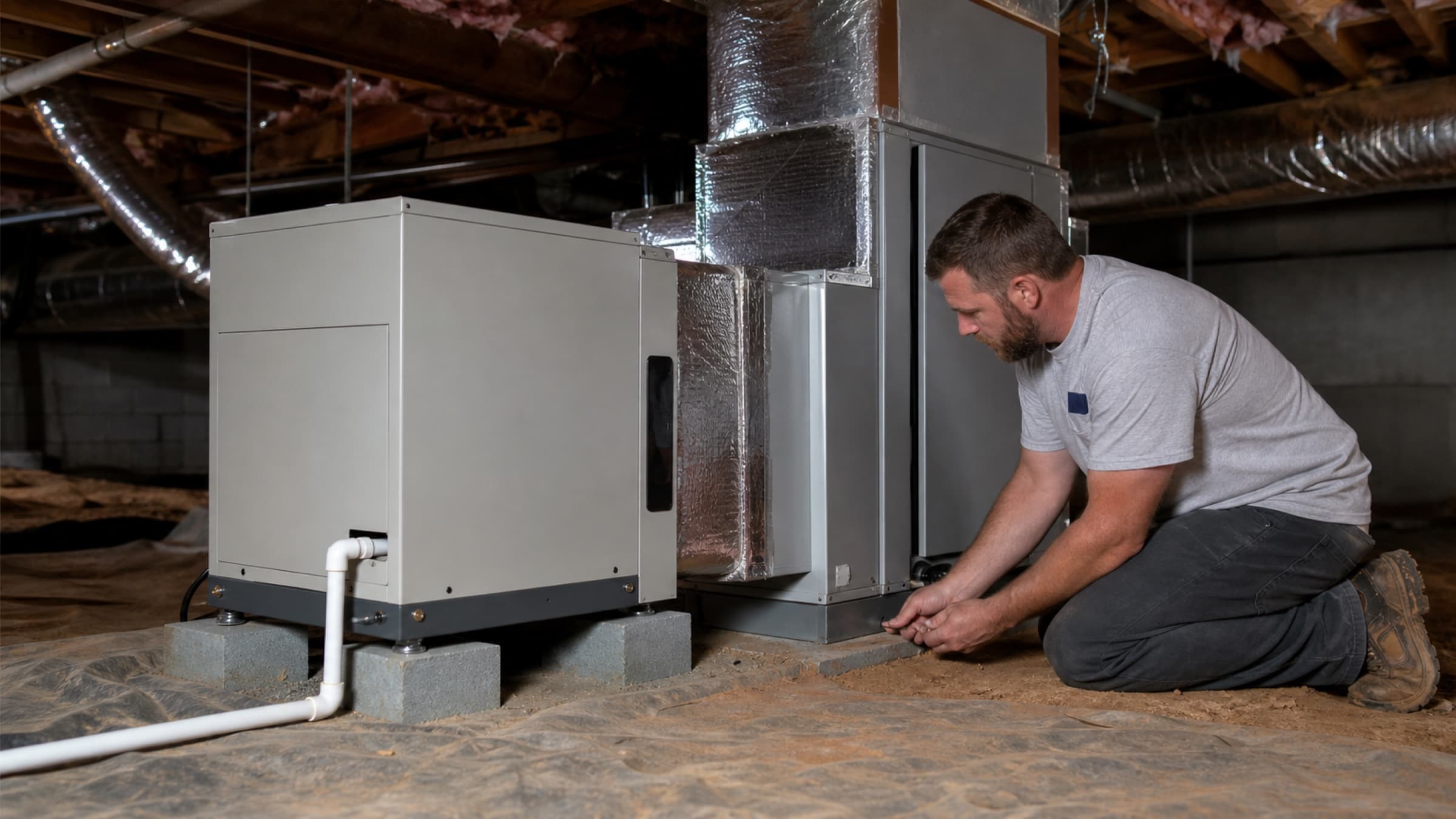
Whole-home dehumidifiers are the significant one. They tie into the ductwork and control humidity independently of whether the AC is running, which is exactly the gap described above. This is the single most effective thing most Triangle homeowners can do for comfort short of replacing the system.
Media filter cabinets replace the one-inch filter slot with a four or five inch pleated media filter, up to MERV 16. They filter far better and, because the surface area is larger, they restrict airflow less than a high-MERV one-inch filter does. Worth knowing: a dense filter in a thin slot makes a system work harder and can freeze a coil.
UV lamps at the evaporator coil keep biological growth off the coil itself. Honest framing: the evidence for whole-room air purification from a coil UV lamp is weak. Keeping the coil clean is real and worth having; curing your allergies is not what this does.
Fresh air ventilation with a motorised damper brings measured outside air into a tight modern house. Newer builds here are sealed well enough that stale air is a genuine problem.
What it costs
Flat-priced between $320 and $4,200, and you know the figure before we start because it is set by which equipment you choose rather than by what we find.
A media filter cabinet is at the bottom of that range. A whole-home dehumidifier with a new condensate line and a dedicated circuit is at the top. Indoor air quality equipment is not financing eligible on its own; fitted as part of a system replacement it folds into that quote, which is.
What we will not do
Mould remediation. If you have visible growth, you need a remediation contractor first. Fitting a dehumidifier into a house with an active mould problem treats the cause of the next one while leaving the current one in place, and we will say so rather than take the job.
Duct cleaning. We do not offer it. See ductwork and ventilation for why.
Radon mitigation, and anything involving asbestos or lead. All three need contractors licensed for that specific work.
This is scheduled work
Indoor air quality is not emergency-eligible. Nothing here is a same-night problem, and we will book you into an ordinary dispatch window.
Before we arrive
Clear access to the air handler and to any return grilles. Note which rooms feel damp or stuffy and at what time of day, because a pattern tied to the evening usually points somewhere different from one tied to running the shower. If you own a humidity meter, take a few readings first; it gives us a baseline before we add ours.
What is included
- Included
- Humidity assessment with written readings
- Whole-home dehumidifier supply and installation
- Media filter cabinet installation, up to MERV 16
- UV lamp installation at the evaporator coil
- Fresh air ventilation with a motorised damper
- Condensate pump and drain line where required
- Not included
- Mould remediation, which requires a specialist contractor
- Duct cleaning, which we do not offer
- Radon mitigation
- Asbestos or lead work of any kind
- Brands serviced
- Aprilaire, Honeywell, Santa Fe, Mitsubishi Electric, Carrier
- Certifications
- NATE certified
- Permit required
- No permit is required for this work.
- Typical timeline
- A filter cabinet is a half-day. A whole-home dehumidifier is one day.
What it costs
This is flat-priced, so you know the figure when you book. There is no diagnostic fee, because nothing is being diagnosed.
- Typical range
- $320 to $4,200
- After hours
- $150 between and , and on Sundays
- Financing
- Not availableFinancing starts at $3,000 and applies to projects rather than service calls.
What moves the price
- Which equipment. A media filter cabinet is a fraction of a whole-home dehumidifier
- Whether the equipment ties into existing ductwork or needs new runs
- Whether a condensate pump and drain line have to be added
- Electrical supply at the air handler, and whether a new circuit is needed
What affects any Cedarline price
- How old the equipment is, and whether replacement parts are still manufactured
- How accessible the work area is: a crawlspace or a second-storey roof takes longer than a garage
- Whether a permit and an inspection are required
- Material grade, which on a roof or a deck moves the total more than labour does
- Whether the visit falls outside dispatch hours
Before we arrive
- Clear access to the air handler and any return grilles
- Note which rooms feel damp or stuffy, and at what time of day
- If you own a humidity meter, record a few readings beforehand
- Secure pets away from the work area
Typical timeline
A filter cabinet is a half-day. A whole-home dehumidifier is one day.
Warranty
- Labour
- 12 months
- Parts
- 12 months
Equipment carries the manufacturer warranty separately, typically five years on a whole-home dehumidifier.
Questions
HVAC questions
My system uses R-22. Can you still service it?
Yes, with limits worth understanding. R-22 has not been produced since 2020, so every pound now comes from reclaimed stock and costs several times what R-410A does. We will recharge an R-22 system, but if it has a leak it will leak again, and on an older unit the arithmetic usually favours replacement within a season or two. We will tell you which situation you are in rather than sell you the same recharge every summer.
What is the difference between an AC repair and a tune-up?
A repair is for a system that has stopped working properly, and it starts with a diagnostic visit. A tune-up is scheduled maintenance on a system that is still working, and it is flat-priced with no diagnostic fee. If your air conditioning has already failed, book the repair. Booking a tune-up on a failed system only delays the actual fix by a visit.
Why does my heat pump blow cool air in winter?
That is usually normal. A heat pump delivers air at around 90 to 100F, which is warmer than the room but cooler than your hand, so it feels cool if you are used to a gas furnace at around 130F. As long as the house is holding its temperature, nothing is wrong. If the house is not holding temperature, or the outdoor unit is encased in ice that never clears, that is a fault and worth a call.
Do you offer duct cleaning?
No. We do not offer it and we rarely recommend it. For most homes there is no good evidence it improves air quality or system performance, and it is widely oversold. If you have a specific contamination problem, after a fire or a rodent infestation for example, that is a remediation specialist rather than us. What we do offer is duct sealing, which measurably reduces the conditioned air you lose into a loft.
Is a ductwork problem an emergency?
No. Ductwork is HVAC but it is not emergency-eligible, and we will not dispatch a crew overnight for it. A duct problem makes a house uncomfortable; it does not leave you with no cooling in a heatwave or no heat in a freeze, which is what emergency cover exists for. If you have no heating or cooling at all, that is a repair and it is covered around the clock.
How long should my system last?
Eight to fifteen years for most equipment in this climate, and Triangle systems land at the lower end of national figures because they run most of the year. A well-maintained heat pump reaching twelve years has done well. What shortens it most is being oversized, which makes the system cycle on and off rather than run steadily, and skipping maintenance so the coils stay dirty.
Should I get a bigger system than the one I have?
Usually not, and frequently the correctly sized replacement is smaller. Oversizing is the most common fault we find in Triangle homes: the system cools the air quickly, satisfies the thermostat, and shuts off before it has removed the humidity, leaving a house that is cold and clammy. We run a Manual J load calculation on every replacement rather than matching what was there, and we will show you the numbers.
My house is cool but feels clammy. What is wrong?
That is a humidity problem rather than a cooling problem, and it is the most common comfort complaint in the Triangle. Air conditioning removes moisture as a side effect of running, so on a mild humid day when the system barely runs, the moisture stays. A whole-home dehumidifier controls humidity independently of whether the AC is running, and it is the single most effective comfort improvement available on most Triangle homes.
How often should I change my filter?
Every one to three months for a standard one-inch filter, and every six to twelve months for a four or five inch media filter. In a house with pets or during heavy pollen weeks, closer to monthly. A blocked filter starves the system of airflow, which on a cooling system can freeze the coil and looks exactly like a refrigerant fault, so it is worth checking before you call anyone.
When is the best time to book a tune-up?
Late March through May for cooling, and September through October for heating. Two reasons: the dispatch board is not yet full of emergency no-cooling or no-heat calls, and a fault found in April is a scheduled repair rather than a miserable July evening. If you are on a maintenance plan we text you when a visit is due rather than leaving you to remember.
What happens if you find a cracked heat exchanger?
We shut the furnace down and red-tag it, because a cracked exchanger is a carbon monoxide risk and it cannot be safely repaired. That is not an upsell: a cracked exchanger on a furnace still under manufacturer warranty may be replaced free, and we will tell you if yours qualifies. If it does not, replacement is the only safe answer and we will quote it honestly, including the option of waiting until spring with temporary heat if the budget needs it.
Should I put in a mini-split or extend my ducted system?
A mini-split is the right answer for a garage conversion, a sunroom, an addition or a room the ducts never reached, and it is frequently cheaper than extending ductwork through a finished house. It is the wrong answer for replacing a working ducted system throughout a house purely to save money, because you end up with a head on the wall of every room. Extending the existing system only works if that system has spare capacity, which after a conversion it usually does not.
My power bill jumped without a cold snap. Why?
On a heat pump, that usually means the heat pump itself has failed quietly and the electric auxiliary heat strips have been carrying the house. They work, and they are expensive to run, so the house feels fine while the bill climbs. It is worth booking a heat pump service if your bill has risen without weather to explain it, because the fault has probably been there for weeks.
Common questions
How long is the arrival window?
Most visits carry a two hour arrival window, and roofing and construction visits carry three. We quote a window rather than an exact time because a trades crew genuinely cannot promise a minute, and we would rather be accurate than optimistic. We text you when the crew is on the way.
Is the diagnostic fee waived if I go ahead with the repair?
Yes. The diagnostic fee covers the technician's time and a written fault report, and it is waived when you approve the repair. Installation and replacement quotes carry no diagnostic fee at all, because nothing is being diagnosed on an estimate visit.
Is a slot confirmed as soon as I request it?
Not quite. A request is not a held slot. We confirm within 30 minutes during dispatch hours, and first thing the next dispatch day if you request outside them. The availability shown on the site reflects how full a day usually is rather than a live view of the dispatch board.
How can I pay?
We accept Visa, Mastercard, American Express, Discover, ACH bank transfer, and financing on qualifying projects. Payment is due on completion for service work, and on a staged schedule set out in the quote for larger projects. There are two payment methods we cannot take, which are covered in our billing questions.
What happens if I need to cancel?
Give us 24 hours notice and there is no charge. One call or one text is enough to reschedule, and we would much rather move you than charge you. Cancelling inside that window, or nobody being home when the crew arrives, carries a no-show fee.
What happens if nobody is home when the crew arrives?
There is a no-show fee, and it is the same figure as the late cancellation fee. It covers the slot another customer could have used and the crew's drive. If you are running late rather than absent, call us and we will usually wait or come back later the same day at no charge.
What actually happens on a service call?
A technician arrives inside the arrival window, diagnoses the fault, tells you the repair price before touching anything, and completes the work if you approve it. You get a written report either way. Nothing is added to the invoice without your approval first, and we do not carry out extra work while you are out of the room.
What are your hours?
The office is open Monday to Friday from 07:30, and Saturday mornings. Crews dispatch on a wider window, from 07:00 to 19:00 on weekdays and 08:00 to 16:00 on Saturday. There is no scheduled dispatch on Sunday. Emergency coverage runs 24 hours a day, every day, including holidays.
Do you cover my area?
We cover Raleigh, Durham, Cary and the wider Triangle, with coverage recorded city by city because it is not uniform. Most cities have every trade and no travel fee, two have a limited set of trades and a travel fee, one is emergency coverage only, and some adjacent zip codes are outside the service radius entirely. Enter your zip code on our service areas page for a definitive answer.
Do you work on commercial buildings?
No. We are residential only, including multifamily buildings up to four units. A four-unit building is the ceiling and it is a real one rather than a preference: our crews, our insurance and our licences are all sized for residential work. For anything larger, or for any commercial or industrial property, you need a commercial general contractor.
Do you install pool heaters, septic systems, or solar?
No to all three, and we will point you at the right trade for each. Pool and spa equipment sits under a separate licence, so you need a pool service company. Septic systems need a licensed septic contractor, and Wake County keeps a list of permitted installers. Solar needs a solar installer, though we will happily reroof around an existing array. We publish the full list of work we do not take on rather than making you ask.
Do you have Spanish-speaking technicians?
Yes, Monday through Friday. We do not staff Spanish-speaking crews at weekends. If you need one, ask when you book and we will schedule you on a weekday rather than send someone who cannot explain the work to you.
Are you licensed and insured?
Yes. We hold five North Carolina licences covering HVAC, general contracting, roofing, plumbing and electrical, and every licence number is published on our site rather than available on request. We carry general liability cover and workers compensation cover, and we are bonded. Certificates go to your adjuster or your HOA the same day you ask.
What warranty do you give?
Twelve months on labour and parts is the standard, and several services carry considerably longer. Roof replacements carry ten years on workmanship, repiping ten years, structural repair five years, and cabinetry five years. Manufacturer warranties on equipment run separately and are often longer still, and we register them in your name before we leave.
What if I am not happy with the work?
We come back and put it right at no charge. There is no time limit on a workmanship complaint about a repair we performed. Call the office rather than the crew directly, so it gets logged and scheduled rather than depending on one person remembering.
What should I do with my pets?
Secure them away from the work area before we arrive. This is genuinely for their safety rather than ours: crews prop doors open, carry sharp and heavy things through the house, and use tools that frighten animals. Tell us when you book if you have a dog that needs handling carefully, and we will note it on the job.
Do I need to be home?
For most visits, no, provided we can get in and reach the work. Inspections, maintenance visits and outdoor work frequently happen with nobody home. You do need to be there for anything where we will be quoting work, making decisions with you, or entering occupied rooms. We will tell you which yours is when you book.
What access do you need?
A clear path to the work area, clear parking for a van near the house, and unlocked side gates where the job is round the back. Roofing and outdoor work need the driveway, sometimes for a skip. If parking is difficult where you are, tell us when you book, because a crew circling for twenty minutes is time on your job.
What is the difference between emergency and scheduled work?
Two separate operations with separate rules. Scheduled work runs inside published dispatch hours, is booked into an arrival window, and carries the ordinary diagnostic fee. Emergency work runs around the clock on a fixed shortlist of eight services, targets a 90 minute response, and carries a call-out fee on top. Ringing the emergency line about something outside that shortlist does not upgrade it; you get booked into the next ordinary window instead. Our emergency questions list exactly which eight services qualify and set out what to do while you wait.
How long is a written quote valid?
Thirty days from the date on it. Beyond that we will re-price rather than honour a figure that no longer covers the materials, and material prices on roofing and lumber in particular move enough that a quarter-old quote is not meaningful. Re-pricing an expired quote is quick, because the survey work is already done.
Is a maintenance plan worth it?
It depends on how much work you expect to need. The plans bundle seasonal visits with priority dispatch and a standing discount on repairs, billed monthly, and the discount alone pays for the cheapest tier if you have one significant repair a year. If you rarely call anyone out, paying per visit is the better arithmetic and we will say so.
Is Cedarline Home Services a real company?
No. Cedarline Home Services is a fictional company used for demos. Every price, policy, licence number and phone number on this site is invented for that purpose, and none of it should be relied on as a real quotation or a real business record.
Related services
- AC MaintenanceA scheduled tune-up for an air conditioning system that is still working, to keep it that way through the season.
- Ductwork and VentilationWe seal, repair and replace ductwork, and fit bathroom and kitchen ventilation, to fix rooms that never get comfortable.
- AC InstallationWe size, supply and install replacement air conditioning systems, quoted after an on-site visit rather than over the phone.
- Thermostat InstallationWe supply and fit smart and programmable thermostats, wired correctly for your system rather than to a generic default.
Book a visit
Next available: today,
Arrival window 2 hours. A request is not a held slot yet; we confirm it during dispatch hours.