Patios and Paver Installation
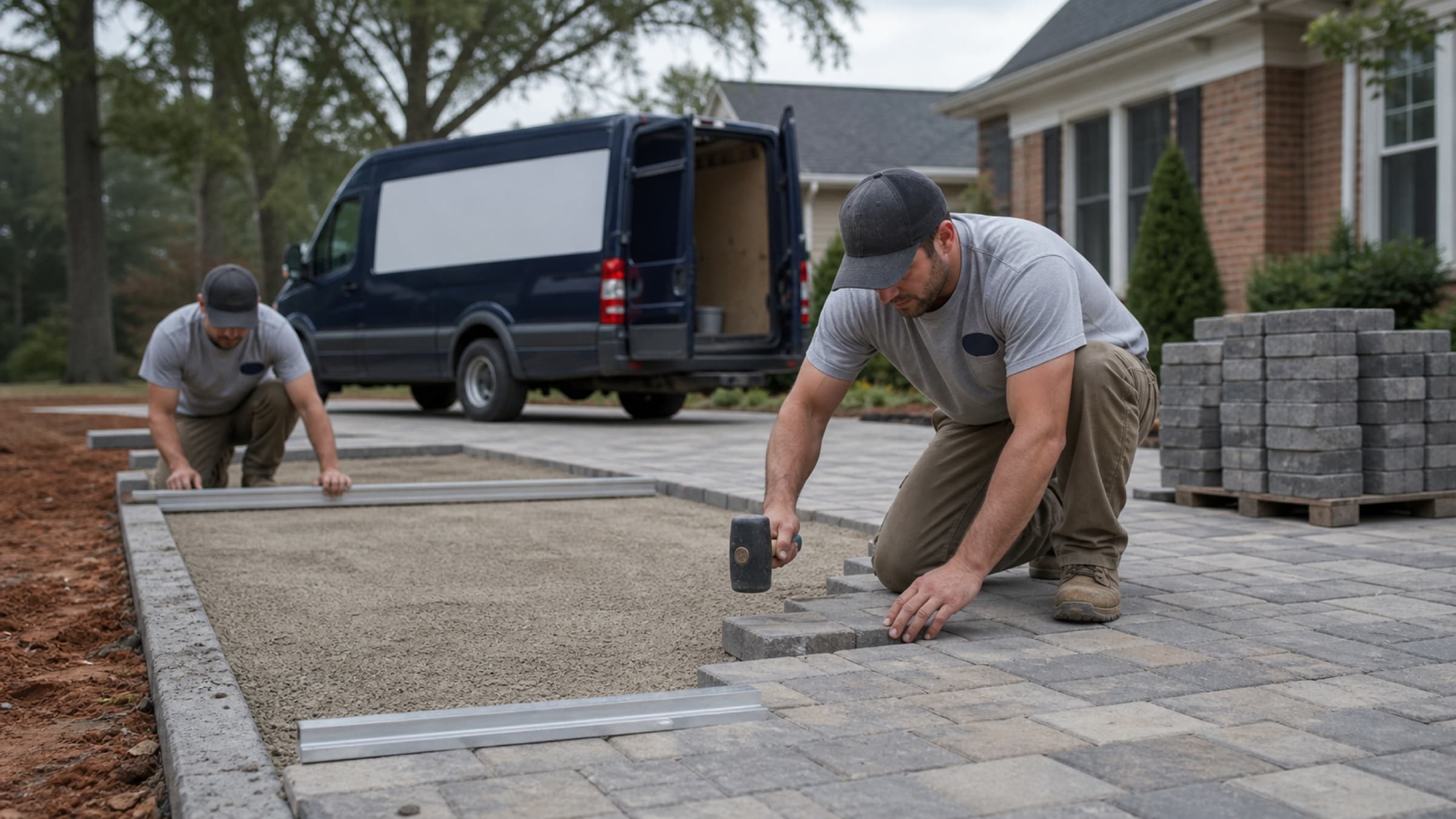
Paver patios, walkways and seat walls, built on a compacted base deep enough that Piedmont clay does not move them.
Is this an emergency?
No. Patios and Pavers is scheduled work and is not covered by our emergency service, which runs 24 hours, 7 days, including holidays. We will book you into an ordinary dispatch window rather than charge an emergency rate for a job that can wait for one.
About Patios and Pavers
The base is the whole job
Everything visible about a patio is the pavers. Everything that decides whether it is still flat in ten years is underneath them.
Piedmont clay is the problem. It holds water, it swells when saturated and shrinks hard in an August drought, and it does not drain. A patio laid on a shallow base over clay will move: the pavers dip where the ground settles, water pools in the dips, and the freeze-thaw cycles of a Triangle winter open the joints.
The fix is not exotic, it is just work. Excavate deeper than looks necessary, lay compacted aggregate in lifts with a plate compactor between each, and only then screed the bedding sand. Most of the labour in a patio quote is the part you will never see, and it is the reason our quotes are not the lowest when compared line by line against someone laying on two inches of sand.
What it costs
Most patios land between $6,500 and $38,000.
The bottom is a modest rectangular patio in standard concrete pavers on an accessible site. The top is a large natural bluestone terrace with seat walls, steps and a fire pit, on a site needing regrading and hand-barrowing.
Patios are financing eligible and clear the financing minimum. Both lender options are on our financing page.
Where the water goes
Second only to the base, and the thing most likely to cause a real problem rather than a cosmetic one.
A patio is an impermeable surface. Every square foot of it sheds water that used to soak in, and if the fall runs toward the house you have built a device for delivering rain to your foundation. In clay, with a crawlspace, that is how you get a damp problem that costs more than the patio did.
So every patio we build gets a deliberate fall away from the building, and where the site cannot achieve that by grading alone, a drainage detail: a channel drain at the house edge, or a French drain taking water to daylight. We assess this at the site visit and it is in the quote rather than discovered later.
If you already have a patio that drains toward the house, that is worth calling about.
Access decides more than you would think
A machine that can reach the back garden turns a week of barrowing into a day of excavation. A back garden reachable only through a three-foot side gate means every cubic yard of spoil out and every cubic yard of aggregate in goes by wheelbarrow, one at a time.
That is why we ask you to measure the narrowest access point before we visit. It is frequently the single largest variable between two otherwise identical quotes.
Material
Concrete pavers are the workhorse: consistent, wide range of colour and format, and the best value. Colour does fade over years of Triangle UV, more noticeably on strong colours than on greys.
Clay brick holds its colour permanently, because the colour is fired in rather than pigmented. It suits older Triangle houses particularly well and it costs more.
Natural stone, usually bluestone here, is the premium option. Every piece is different, cutting is slower, and it is the most labour-intensive to lay well.
Efflorescence, the white haze that can appear on new concrete pavers, is salts migrating out of the material. It is normal, it weathers off over a season or two, and it is not a defect. Worth saying now rather than in a phone call three weeks after handover.
What we do not do
Retaining walls over four feet are a structural specialty with engineering requirements. Pool decking and anything inside a pool enclosure is out of scope. Landscape lighting is electrical work, and a gas line to a fire feature is plumbing; we will build the feature and coordinate the trade, but the connection is not ours.
What is included
- Included
- Site visit, levels, drainage assessment and measured drawings
- Excavation to the depth the subgrade requires
- Compacted aggregate base laid and compacted in lifts
- Bedding sand screeded to grade
- Paver laying, cutting and edge restraint
- Polymeric sand jointing and final compaction
- Fall set away from the house, and a drainage detail where the site needs one
- Seat walls, steps and fire pits in matching material
- Removal and disposal of an existing patio or slab
- Reinstatement of disturbed turf at the edges
- Not included
- Retaining walls over four feet, which are a structural specialty
- Tree removal and stump grinding
- Pool decking and anything within a pool enclosure
- Electrical work for landscape lighting or an outdoor kitchen
- Gas lines to a fire feature, which is a plumbing service
- Planting and garden design
- Brands serviced
- Belgard, Techo-Bloc, Unilock, Pine Hall Brick, Pavestone
- Certifications
- NC General Contractor licence 78341, ICPI certified installer
- Permit required
- No permit is required for this work.
- Typical timeline
- One to three weeks on site depending on size, after a two to four week lead on material and scheduling.
What it costs
This is quoted rather than booked. An estimate visit is free and carries no diagnostic fee, and you get a fixed written quote at the end of it. The range below is what work of this kind usually costs, not a quote.$6,500 to $38,000
- After hours
- $150 between and , and on Sundays
- Financing
- Available from $3,000This work clears the minimum. See financing options.
What moves the price
- Square footage, and how much of it is straight runs versus curves and cuts
- Paver choice, from standard concrete through to clay brick and natural bluestone
- How much excavation the base needs, which the clay decides rather than the design
- Whether the site drains away from the house already or has to be regraded
- Seat walls, steps and fire features, which are built work rather than paving
- Access for machinery, since a back garden reachable only through a narrow side gate is barrowed by hand
What affects any Cedarline price
- How old the equipment is, and whether replacement parts are still manufactured
- How accessible the work area is: a crawlspace or a second-storey roof takes longer than a garage
- Whether a permit and an inspection are required
- Material grade, which on a roof or a deck moves the total more than labour does
- Whether the visit falls outside dispatch hours
Before we arrive
- Clear the area so levels can be taken across the whole footprint
- Note where water currently stands after heavy rain
- Measure the width of the narrowest access point to the back garden
- Find your plot survey if you have one, since it shows easements
Typical timeline
One to three weeks on site depending on size, after a two to four week lead on material and scheduling.
Warranty
- Labour
- 60 months
- Parts
- 12 months
Five years against settlement and against the base failing, which is the only failure mode that matters. Paver colour and efflorescence are material properties, not defects.
Questions
Outdoor and grounds questions
Does my deck need repairing or replacing?
The test is the frame. If the joists, beams, posts and ledger are sound, failed boards and a wobbly railing are a repair, and it is a fraction of the cost of rebuilding. If the frame is failing, no amount of new decking fixes it and putting fresh boards on it is money you will spend twice. Our survey tells you which in writing, and we quote a good many repairs for people who arrived expecting to be told they needed a rebuild.
What is the most important part of a deck?
The ledger connection where the deck attaches to the house, and it is invisible once built. It has to be through-bolted or fixed with structural screws into the rim joist, never nailed, and it has to be flashed so water running down the wall goes over it rather than behind it. An unflashed ledger rots the rim joist of your house, not just the deck, and by then it is a structural repair. It is the single most common point of catastrophic deck failure.
Is composite decking worth the extra?
Over about fifteen years, usually yes. Composite costs roughly three times pressure-treated in material and needs essentially no refinishing, where pressure-treated needs sealing every couple of years and in this climate that is a real commitment. Two honest caveats: composite gets noticeably hot underfoot in full Triangle sun, and the frame underneath is still timber, so the structure still ages even when the surface does not.
Why does refinishing my deck take several days?
Because timber has to be dry before sealing, and after washing that is typically two to three days in Triangle humidity. Sealing damp timber traps the moisture and the coating fails within a season, so the waiting is the job rather than a delay. Most of the labour is removing what is already there: a film-forming solid stain peels rather than fades and every flake has to come off before anything new goes on.
Can you reseal my composite deck?
No, and nobody should. Composite is not refinished: it does not take a stain and it does not need one. If someone has offered to reseal your composite deck they are selling you something that will not adhere. What composite decks do occasionally need is board replacement after impact damage, fastener correction and railing repair, all of which we do.
Why is one patio quote so much cheaper than another?
Almost always the base, which is the part you never see and the part that decides whether the patio is still flat in ten years. Piedmont clay holds water, swells when saturated and shrinks hard in an August drought. A patio laid on a shallow bed of sand over clay will dip, pool water in the dips, and open its joints through freeze-thaw. Doing it properly means excavating deeper than looks necessary and compacting aggregate in lifts, and most of the labour in an honest quote is that work.
Will a new patio cause damp against my house?
Not if it is built with fall away from the building, which every patio we build is. A patio is an impermeable surface, so every square foot sheds water that used to soak in, and if the fall runs toward the house you have built a device for delivering rain to your foundation. Where a site cannot achieve fall by grading alone we include a drainage detail, a channel drain at the house edge or a French drain to daylight, and it is in the quote rather than discovered later.
There is a white haze on my new pavers. Is that a defect?
No, it is efflorescence, which is salts migrating out of the concrete. It is normal on new concrete pavers, it weathers off over a season or two, and it is not covered as a defect because it is a material property rather than a fault. Clay brick does not do it, and natural stone rarely does, which is one small reason people choose them.
Can you just rebuild my fence on the old post positions?
Only once we know the old positions were right. Fencing generates more disputes than any other outdoor work, and almost all of them trace to nobody checking the boundary. Old fences were frequently built a foot inside the line or a foot over it, and rebuilding on the same posts perpetuates whichever it was. The plot survey is the record. If you do not have one and the line is not obvious, you need a surveyor before you need us, because we do not establish boundaries and will not guess at one.
Why do fences lean here?
The posts, essentially always, and rarely the panels. In Piedmont clay a post has to go below the frost line and resist the leverage of a tall privacy panel acting as a sail in a storm. Set too shallow and clay that swells and shrinks seasonally will heave and lean it. Corner and gate posts take loads the line posts do not, so they need to be larger, deeper and braced. A gate that drops within a year is a gate post treated like a line post.
Does your lawn care program include mowing?
No. The program covers treatments, aeration and overseeding across seven visits a year; the mowing is yours or your mowing service's. There is a practical reason as well as a commercial one: treatments work best on a lawn mowed two to three days before rather than on the day, and coordinating that is easier when the two are separate.
Can I start the lawn program in spring instead of February?
You can, but you will miss the most valuable application of the year. The February visit puts down pre-emergent, and crabgrass is either stopped before it germinates or it is not stopped at all. By the time you can see it in June the window has closed until next year. A program starting in April is a program missing its most important visit, and we will tell you that rather than take the money quietly.
Why is the autumn cleanup in November rather than October?
Because Triangle oaks do not finish dropping until well into November, and some hold leaves into December. Willow oaks and pin oaks, planted through half the older neighbourhoods around Raleigh, are among the last to go, and pines drop needles on their own schedule entirely. A cleanup booked for early October is one you will need again a fortnight later. If you want the lawn clear for a specific event we will schedule an extra visit rather than move your included one.
Do I really need to winterise my irrigation?
Yes, and it is the one genuinely time-critical thing we do outdoors. Water left in the lines and in the backflow preventer through a Triangle cold snap freezes, expands and splits things, and the backflow preventer is the expensive casualty because it is brass, above ground, and a regulated fitting that has to be replaced like for like and retested. Winterisation takes under an hour, and freeze damage to a system we were not asked to winterise is not covered by any warranty.
Common questions
How long is the arrival window?
Most visits carry a two hour arrival window, and roofing and construction visits carry three. We quote a window rather than an exact time because a trades crew genuinely cannot promise a minute, and we would rather be accurate than optimistic. We text you when the crew is on the way.
Is the diagnostic fee waived if I go ahead with the repair?
Yes. The diagnostic fee covers the technician's time and a written fault report, and it is waived when you approve the repair. Installation and replacement quotes carry no diagnostic fee at all, because nothing is being diagnosed on an estimate visit.
Is a slot confirmed as soon as I request it?
Not quite. A request is not a held slot. We confirm within 30 minutes during dispatch hours, and first thing the next dispatch day if you request outside them. The availability shown on the site reflects how full a day usually is rather than a live view of the dispatch board.
How can I pay?
We accept Visa, Mastercard, American Express, Discover, ACH bank transfer, and financing on qualifying projects. Payment is due on completion for service work, and on a staged schedule set out in the quote for larger projects. There are two payment methods we cannot take, which are covered in our billing questions.
What happens if I need to cancel?
Give us 24 hours notice and there is no charge. One call or one text is enough to reschedule, and we would much rather move you than charge you. Cancelling inside that window, or nobody being home when the crew arrives, carries a no-show fee.
What happens if nobody is home when the crew arrives?
There is a no-show fee, and it is the same figure as the late cancellation fee. It covers the slot another customer could have used and the crew's drive. If you are running late rather than absent, call us and we will usually wait or come back later the same day at no charge.
What actually happens on a service call?
A technician arrives inside the arrival window, diagnoses the fault, tells you the repair price before touching anything, and completes the work if you approve it. You get a written report either way. Nothing is added to the invoice without your approval first, and we do not carry out extra work while you are out of the room.
What are your hours?
The office is open Monday to Friday from 07:30, and Saturday mornings. Crews dispatch on a wider window, from 07:00 to 19:00 on weekdays and 08:00 to 16:00 on Saturday. There is no scheduled dispatch on Sunday. Emergency coverage runs 24 hours a day, every day, including holidays.
Do you cover my area?
We cover Raleigh, Durham, Cary and the wider Triangle, with coverage recorded city by city because it is not uniform. Most cities have every trade and no travel fee, two have a limited set of trades and a travel fee, one is emergency coverage only, and some adjacent zip codes are outside the service radius entirely. Enter your zip code on our service areas page for a definitive answer.
Do you work on commercial buildings?
No. We are residential only, including multifamily buildings up to four units. A four-unit building is the ceiling and it is a real one rather than a preference: our crews, our insurance and our licences are all sized for residential work. For anything larger, or for any commercial or industrial property, you need a commercial general contractor.
Do you install pool heaters, septic systems, or solar?
No to all three, and we will point you at the right trade for each. Pool and spa equipment sits under a separate licence, so you need a pool service company. Septic systems need a licensed septic contractor, and Wake County keeps a list of permitted installers. Solar needs a solar installer, though we will happily reroof around an existing array. We publish the full list of work we do not take on rather than making you ask.
Do you have Spanish-speaking technicians?
Yes, Monday through Friday. We do not staff Spanish-speaking crews at weekends. If you need one, ask when you book and we will schedule you on a weekday rather than send someone who cannot explain the work to you.
Are you licensed and insured?
Yes. We hold five North Carolina licences covering HVAC, general contracting, roofing, plumbing and electrical, and every licence number is published on our site rather than available on request. We carry general liability cover and workers compensation cover, and we are bonded. Certificates go to your adjuster or your HOA the same day you ask.
What warranty do you give?
Twelve months on labour and parts is the standard, and several services carry considerably longer. Roof replacements carry ten years on workmanship, repiping ten years, structural repair five years, and cabinetry five years. Manufacturer warranties on equipment run separately and are often longer still, and we register them in your name before we leave.
What if I am not happy with the work?
We come back and put it right at no charge. There is no time limit on a workmanship complaint about a repair we performed. Call the office rather than the crew directly, so it gets logged and scheduled rather than depending on one person remembering.
What should I do with my pets?
Secure them away from the work area before we arrive. This is genuinely for their safety rather than ours: crews prop doors open, carry sharp and heavy things through the house, and use tools that frighten animals. Tell us when you book if you have a dog that needs handling carefully, and we will note it on the job.
Do I need to be home?
For most visits, no, provided we can get in and reach the work. Inspections, maintenance visits and outdoor work frequently happen with nobody home. You do need to be there for anything where we will be quoting work, making decisions with you, or entering occupied rooms. We will tell you which yours is when you book.
What access do you need?
A clear path to the work area, clear parking for a van near the house, and unlocked side gates where the job is round the back. Roofing and outdoor work need the driveway, sometimes for a skip. If parking is difficult where you are, tell us when you book, because a crew circling for twenty minutes is time on your job.
What is the difference between emergency and scheduled work?
Two separate operations with separate rules. Scheduled work runs inside published dispatch hours, is booked into an arrival window, and carries the ordinary diagnostic fee. Emergency work runs around the clock on a fixed shortlist of eight services, targets a 90 minute response, and carries a call-out fee on top. Ringing the emergency line about something outside that shortlist does not upgrade it; you get booked into the next ordinary window instead. Our emergency questions list exactly which eight services qualify and set out what to do while you wait.
How long is a written quote valid?
Thirty days from the date on it. Beyond that we will re-price rather than honour a figure that no longer covers the materials, and material prices on roofing and lumber in particular move enough that a quarter-old quote is not meaningful. Re-pricing an expired quote is quick, because the survey work is already done.
Is a maintenance plan worth it?
It depends on how much work you expect to need. The plans bundle seasonal visits with priority dispatch and a standing discount on repairs, billed monthly, and the discount alone pays for the cheapest tier if you have one significant repair a year. If you rarely call anyone out, paying per visit is the better arithmetic and we will say so.
Is Cedarline Home Services a real company?
No. Cedarline Home Services is a fictional company used for demos. Every price, policy, licence number and phone number on this site is invented for that purpose, and none of it should be relied on as a real quotation or a real business record.
Related services
- Deck BuildingA new deck, designed and built from footings up, with the ledger flashed properly and footings sized for Piedmont clay.
- Pergolas and Shade StructuresPergolas, arbours and covered structures, anchored for wind uplift and oriented to shade the hours you actually sit outside.
- FencingPrivacy, picket and aluminium fencing, set on posts deep enough for the clay, with the boundary confirmed before anything is dug.
- Seasonal CleanupTwo scheduled cleanups a year, in March and November, timed to when Triangle oaks and pines actually finish dropping.
How to get a price
A patio is priced from levels, drainage and access, none of which are visible from an address. How deep the base has to go, whether the site needs regrading, and whether a machine can reach the back garden change the cost substantially. Book a free site visit and you will have a fixed written quote.