Drain Cleaning and Unblocking
Flat-priced clearing of blocked and slow drains, with a camera inspection where the same drain keeps coming back.
Is this an emergency?
No. Drain Cleaning is scheduled work and is not covered by our emergency service, which runs 24 hours, 7 days, including holidays. We will book you into an ordinary dispatch window rather than charge an emergency rate for a job that can wait for one.
If you have no heating or cooling at all, that is a repair and it is covered around the clock. Start with Leak Detection and Repair.
About Drain Cleaning
Flat priced, so you know before we start
Drain cleaning is flat-priced between $165 and $850, set by which drain and how it has to be reached, not by how long it takes us. You know the figure when you book and it does not change because the job turned out to be awkward.
There is no diagnostic fee. Not financing eligible.
The price steps up in a predictable way: a single fixture trap is the cheapest, a main line through an accessible cleanout is more, and a main line with no cleanout, worked through a roof vent or a pulled toilet, is the top of the range.
One drain or all of them
The single most useful thing you can tell us, and it changes what we bring.
One fixture is slow or blocked. The problem is local, in that trap or the branch behind it. Usually hair and soap in a bath, grease in a kitchen sink.
Several fixtures on the same side of the house. The branch line serving them is blocked.
Everything is backing up, and the lowest fixture is worst. That is the main line out to the sewer, and the lowest drain in the house is where it will show first, which is why a ground-floor shower or a basement floor drain is often the first symptom. If flushing an upstairs toilet makes a downstairs shower gurgle or fill, that is a main line blockage.
Sewage coming back into the house is a same-day call rather than a routine booking, and it gets escalated to a person.
Roots, which is the Triangle answer
In older Raleigh and Durham neighbourhoods, a main line that blocks seasonally rather than randomly is almost always tree roots.
Clay and cast iron laterals have joints. Roots find the joints, because that is where the moisture is, and they grow into the pipe as a fine mat that catches everything passing. It clears, it grows back, and it clears again on a cycle of a year or two.
Cutting them restores flow immediately. It does not remove the roots, and anyone telling you it does is overselling. What a camera inspection tells you is how bad the intrusion is and whether the pipe itself has failed, which is the difference between an annual clearing you can live with and a lateral replacement you should plan for.
Why we push the camera on a repeat blockage
If a drain has blocked more than once, clearing it again without looking is treating a symptom.
A camera run shows what is actually there: roots, a bellied section holding water, a collapsed pipe, a joint that has offset, or simply grease. Each of those has a different answer and only one of them is solved by cabling it again.
It also changes what we can promise. We warrant a cleared drain for thirty days where a camera inspection was included, because then we know what we were dealing with. Without one we are guessing, and we will not warrant a line we have not seen.
You get the footage.
Please stop pouring chemicals down it
Consumer drain cleaner is caustic, it rarely clears anything more than a partial soap blockage, and it sits in the trap waiting for whoever opens it.
It also makes our job more dangerous. If you have used it, tell us when we arrive rather than after we have opened the trap. We would much rather know.
Enzyme-based maintenance products are a different thing and are genuinely useful on a kitchen line that greases up, used regularly rather than as a rescue.
What actually causes it
Kitchen sinks: grease. It goes down warm and liquid, cools in the pipe, and coats the wall. Every subsequent bit of food catches on it. A dishwasher discharging into the same line accelerates it.
Bathrooms: hair and soap. They combine into something remarkably tenacious.
Toilets: things that are not waste or paper. Wipes are the leading cause. They do not break down in the line no matter what the packet says.
Main lines: roots, and occasionally a collapsed section in a house old enough to have clay pipe.
What we do not do
We do not replace sewer lines or excavate, though we will quote it if the camera shows you need it. We do not pump septic tanks or work on drain fields. We do not clean up after a sewage backup, which is a restoration contractor and worth calling the same day.
What is included
- Included
- Sink, bath, shower and toilet drain clearing
- Main line clearing through an accessible cleanout
- Cable machine and hydro jetting as the blockage requires
- Root cutting in laterals
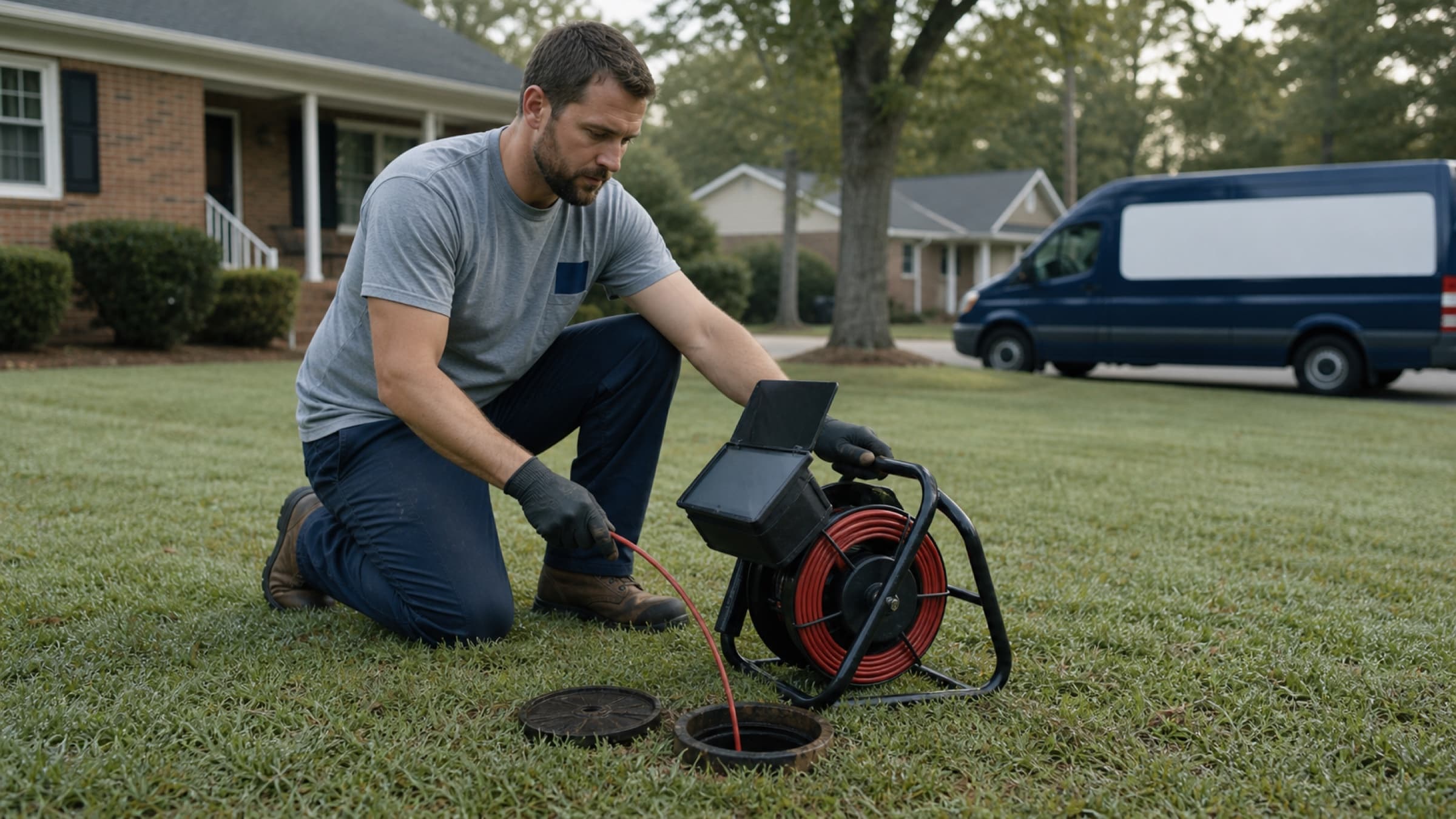
- Camera inspection of the line, with footage shared with you
- Trap and pop-up assembly cleaning and reassembly
- Cleanout installation where none exists, quoted separately
- A written note of what was found and what caused it
- Not included
- Sewer line replacement and excavation, which is quoted separately
- Septic tank pumping and drain field work
- Water mitigation and clean-up after a sewage backup
- Appliance repair on a dishwasher or washing machine
- Drain work inside a slab that requires breaking concrete
- Outdoor storm drains and French drains
- Brands serviced
- RIDGID, General Pipe Cleaners, Spartan, US Jetting
- Certifications
- NC Plumbing licence P.1-32095
- Permit required
- No permit is required for this work.
- Typical timeline
- Most blockages clear in a single visit under two hours. A camera inspection adds about half an hour.
What it costs
This is flat-priced, so you know the figure when you book. There is no diagnostic fee, because nothing is being diagnosed.
- Typical range
- $165 to $850
- After hours
- $150 between and , and on Sundays
- Financing
- Not availableFinancing starts at $3,000 and applies to projects rather than service calls.
What moves the price
- Which drain. A sink trap is minutes, a main line from a cleanout is a different machine
- Whether there is an accessible cleanout, since without one we work through a fixture or the roof vent
- How far the blockage is from the access point
- Whether a camera inspection is included, which we recommend on any repeat blockage
- Whether roots are the cause, since cutting them is slower than clearing grease or paper
What affects any Cedarline price
- How old the equipment is, and whether replacement parts are still manufactured
- How accessible the work area is: a crawlspace or a second-storey roof takes longer than a garage
- Whether a permit and an inspection are required
- Material grade, which on a roof or a deck moves the total more than labour does
- Whether the visit falls outside dispatch hours
Before we arrive
- Stop using the affected drain, and do not add more drain cleaner
- Clear the cupboard under the sink or the area around the cleanout
- Note whether one fixture is affected or several, since that tells us where the blockage is
- Say whether this drain has blocked before, and roughly how often
Typical timeline
Most blockages clear in a single visit under two hours. A camera inspection adds about half an hour.
Warranty
- Labour
- 12 months
- Parts
- 12 months
Thirty days on a cleared drain where a camera inspection was included, because then we know what we were dealing with. Without one we cannot warrant a line we have not seen.
Questions
Plumbing questions
Where is my main water shutoff?
Usually where the supply enters the house: a crawlspace, a garage, a basement or a utility closet. On a slab house it is sometimes only at the street meter, which needs a meter key. Find it now, turn it to check it actually moves, and turn it back. A seized shutoff discovered during a burst pipe is the difference between a wet floor and a flooded house, and we will point yours out on any visit if you ask.
One drain is slow. Is that the same as all of them backing up?
No, and the difference tells us where the blockage is. One slow fixture means the problem is local, in that trap or the branch behind it. Several fixtures on the same side of the house means the branch line serving them. Everything backing up, with the lowest fixture worst, means the main line out to the sewer. If flushing an upstairs toilet makes a downstairs shower gurgle, that is a main line blockage.
Why does my drain block at the same time every year?
Tree roots, almost certainly, and it is very common in older Raleigh and Durham neighbourhoods. Clay and cast iron laterals have joints, roots find the joints because that is where the moisture is, and they grow into the pipe as a fine mat that catches everything passing. Cutting them restores flow immediately but does not remove them, so it recurs on a cycle of a year or two. A camera inspection tells you whether the pipe itself has failed, which is the difference between an annual clearing you can live with and a lateral replacement you should plan for.
Should I use a chemical drain cleaner first?
Please do not. Consumer drain cleaner is caustic, it rarely clears anything more than a partial soap blockage, and it sits in the trap waiting for whoever opens it. It also makes our job more dangerous, so if you have used it, tell us when we arrive rather than after we have opened the trap. Enzyme-based maintenance products are a different thing and are genuinely useful on a kitchen line, used regularly rather than as a rescue.
My water heater is leaking. Can it be repaired?
If the tank itself is leaking, no, and not by anyone. A steel tank has a glass lining; when that lining fails the steel corrodes from the inside, and by the time water appears the wall has gone. There is no patch, no sealant and no weld that is safe on a vessel holding hot water under mains pressure. Water at the base is usually the tank. Water at a fitting on top, at the relief valve or at the drain valve is usually not, and those are all repairable.
How do I know if my water heater is still under warranty?
Photograph the label on the side of the tank and send it to us. It carries the model, the serial, and encoded in the serial the date of manufacture. Most tanks carry six to twelve years, and we replace a good number of tanks free under a warranty the owner did not know they had. That photograph also tells us which parts to bring, which is the difference between a same-day fix and a second appointment.
Should I switch to a tankless water heater?
It is the better long-term product and the wrong emergency purchase. Tankless never runs out, lasts roughly twice as long as a tank and takes a fraction of the space, but it needs new venting because it is a condensing appliance, and usually a larger gas supply line because it fires at several times the BTU. On electric, the load is frequently beyond what a domestic panel can carry. Replacing a failed tank on a Tuesday afternoon is not the moment; a planned replacement is.
Does a tankless water heater need maintenance?
Yes, annual descaling, and it is routine maintenance rather than a defect. A tankless heat exchanger runs water through narrow passages and Triangle water will scale them up over a few years. A unit that has never been descaled will underperform and eventually error out. Tankless units report error codes, so read the display and tell us the code when you book.
What is a slab leak and how would I know?
It is a supply line leaking in or under the concrete slab, which is how many Triangle houses are built. The signs are indirect: a warm patch on the floor, an unexplained jump in the water bill, the sound of running water with everything off, or damp appearing at the edge of a room. By the time flooring lifts it has usually been leaking a while. We locate it acoustically before opening anything, because the alternative is a series of holes until one is in the right place.
I have grey plastic pipe. Is that a problem?
If it is polybutylene, yes, eventually. It was installed widely between the late 1970s and mid 1990s and is common in Triangle housing of that era. It becomes brittle from the inside and fails at the fittings, so one failure means others are coming, and insurers are increasingly unwilling to cover a house that still has it. If you have had two or three supply leaks in a couple of years, the pattern is the diagnosis and repiping is the answer rather than a fourth repair.
Will I have to move out during a repipe?
No. Three to six days on site for a typical Triangle house, with water off during the working day and back on every evening, so you can stay throughout. We tell you the morning we will shut it off. Running new PEX from a crawlspace or a loft reaches most fixtures without touching a wall, and a good layout cuts the access holes by more than half. We patch the drywall ready for paint but we do not paint.
My outdoor tap burst over winter. Why?
An ordinary outdoor tap holds water in the pipe right at the wall, and a hard Triangle freeze splits it. You usually find out in spring, when you turn it on and water appears inside the crawlspace. A frost-free sillcock puts the valve seat well inside the heated envelope so the exposed section drains, and replacing one is the cheapest burst-pipe prevention available. Disconnect the hose in winter either way, because a connected hose defeats even a frost-free tap.
Is a gas leak at my meter your job or the utility's?
The gas meter is the dividing line. Everything on the house side of it is ours; everything on the utility side, including the meter itself and the service line from the street, belongs to the gas company and they will attend it free of charge. If the smell is outside near the meter or in the street, that is the utility and only the utility. Whatever the location, leave the building and call the gas utility first; the safety procedure is the same and it is set out in full in our emergency questions.
Common questions
How long is the arrival window?
Most visits carry a two hour arrival window, and roofing and construction visits carry three. We quote a window rather than an exact time because a trades crew genuinely cannot promise a minute, and we would rather be accurate than optimistic. We text you when the crew is on the way.
Is the diagnostic fee waived if I go ahead with the repair?
Yes. The diagnostic fee covers the technician's time and a written fault report, and it is waived when you approve the repair. Installation and replacement quotes carry no diagnostic fee at all, because nothing is being diagnosed on an estimate visit.
Is a slot confirmed as soon as I request it?
Not quite. A request is not a held slot. We confirm within 30 minutes during dispatch hours, and first thing the next dispatch day if you request outside them. The availability shown on the site reflects how full a day usually is rather than a live view of the dispatch board.
How can I pay?
We accept Visa, Mastercard, American Express, Discover, ACH bank transfer, and financing on qualifying projects. Payment is due on completion for service work, and on a staged schedule set out in the quote for larger projects. There are two payment methods we cannot take, which are covered in our billing questions.
What happens if I need to cancel?
Give us 24 hours notice and there is no charge. One call or one text is enough to reschedule, and we would much rather move you than charge you. Cancelling inside that window, or nobody being home when the crew arrives, carries a no-show fee.
What happens if nobody is home when the crew arrives?
There is a no-show fee, and it is the same figure as the late cancellation fee. It covers the slot another customer could have used and the crew's drive. If you are running late rather than absent, call us and we will usually wait or come back later the same day at no charge.
What actually happens on a service call?
A technician arrives inside the arrival window, diagnoses the fault, tells you the repair price before touching anything, and completes the work if you approve it. You get a written report either way. Nothing is added to the invoice without your approval first, and we do not carry out extra work while you are out of the room.
What are your hours?
The office is open Monday to Friday from 07:30, and Saturday mornings. Crews dispatch on a wider window, from 07:00 to 19:00 on weekdays and 08:00 to 16:00 on Saturday. There is no scheduled dispatch on Sunday. Emergency coverage runs 24 hours a day, every day, including holidays.
Do you cover my area?
We cover Raleigh, Durham, Cary and the wider Triangle, with coverage recorded city by city because it is not uniform. Most cities have every trade and no travel fee, two have a limited set of trades and a travel fee, one is emergency coverage only, and some adjacent zip codes are outside the service radius entirely. Enter your zip code on our service areas page for a definitive answer.
Do you work on commercial buildings?
No. We are residential only, including multifamily buildings up to four units. A four-unit building is the ceiling and it is a real one rather than a preference: our crews, our insurance and our licences are all sized for residential work. For anything larger, or for any commercial or industrial property, you need a commercial general contractor.
Do you install pool heaters, septic systems, or solar?
No to all three, and we will point you at the right trade for each. Pool and spa equipment sits under a separate licence, so you need a pool service company. Septic systems need a licensed septic contractor, and Wake County keeps a list of permitted installers. Solar needs a solar installer, though we will happily reroof around an existing array. We publish the full list of work we do not take on rather than making you ask.
Do you have Spanish-speaking technicians?
Yes, Monday through Friday. We do not staff Spanish-speaking crews at weekends. If you need one, ask when you book and we will schedule you on a weekday rather than send someone who cannot explain the work to you.
Are you licensed and insured?
Yes. We hold five North Carolina licences covering HVAC, general contracting, roofing, plumbing and electrical, and every licence number is published on our site rather than available on request. We carry general liability cover and workers compensation cover, and we are bonded. Certificates go to your adjuster or your HOA the same day you ask.
What warranty do you give?
Twelve months on labour and parts is the standard, and several services carry considerably longer. Roof replacements carry ten years on workmanship, repiping ten years, structural repair five years, and cabinetry five years. Manufacturer warranties on equipment run separately and are often longer still, and we register them in your name before we leave.
What if I am not happy with the work?
We come back and put it right at no charge. There is no time limit on a workmanship complaint about a repair we performed. Call the office rather than the crew directly, so it gets logged and scheduled rather than depending on one person remembering.
What should I do with my pets?
Secure them away from the work area before we arrive. This is genuinely for their safety rather than ours: crews prop doors open, carry sharp and heavy things through the house, and use tools that frighten animals. Tell us when you book if you have a dog that needs handling carefully, and we will note it on the job.
Do I need to be home?
For most visits, no, provided we can get in and reach the work. Inspections, maintenance visits and outdoor work frequently happen with nobody home. You do need to be there for anything where we will be quoting work, making decisions with you, or entering occupied rooms. We will tell you which yours is when you book.
What access do you need?
A clear path to the work area, clear parking for a van near the house, and unlocked side gates where the job is round the back. Roofing and outdoor work need the driveway, sometimes for a skip. If parking is difficult where you are, tell us when you book, because a crew circling for twenty minutes is time on your job.
What is the difference between emergency and scheduled work?
Two separate operations with separate rules. Scheduled work runs inside published dispatch hours, is booked into an arrival window, and carries the ordinary diagnostic fee. Emergency work runs around the clock on a fixed shortlist of eight services, targets a 90 minute response, and carries a call-out fee on top. Ringing the emergency line about something outside that shortlist does not upgrade it; you get booked into the next ordinary window instead. Our emergency questions list exactly which eight services qualify and set out what to do while you wait.
How long is a written quote valid?
Thirty days from the date on it. Beyond that we will re-price rather than honour a figure that no longer covers the materials, and material prices on roofing and lumber in particular move enough that a quarter-old quote is not meaningful. Re-pricing an expired quote is quick, because the survey work is already done.
Is a maintenance plan worth it?
It depends on how much work you expect to need. The plans bundle seasonal visits with priority dispatch and a standing discount on repairs, billed monthly, and the discount alone pays for the cheapest tier if you have one significant repair a year. If you rarely call anyone out, paying per visit is the better arithmetic and we will say so.
Is Cedarline Home Services a real company?
No. Cedarline Home Services is a fictional company used for demos. Every price, policy, licence number and phone number on this site is invented for that purpose, and none of it should be relied on as a real quotation or a real business record.
Related services
- Leak Detection and RepairWe find leaks inside walls, under slabs and in supply lines, and repair them once located, with 24/7 cover on an active leak.
- Fixture InstallationFaucets, toilets, sinks, disposals and shower valves fitted at a flat price per fixture, with the shutoff valves replaced as standard.
- Sump Pump ServiceSump pump repair, replacement and battery backup, with 24/7 cover when a pump has failed and water is rising.
- RepipingReplacing the whole supply system in a house whose pipework is failing as a system rather than at a point.
Book a visit
Next available: monday,
Arrival window 2 hours. A request is not a held slot yet; we confirm it during dispatch hours.