OUTDOOR
Winterising an irrigation system in the Triangle
Our winters are mild enough that people skip this and cold enough that skipping it breaks the backflow assembly.
By Darnell Jessup, Outdoor Lead. Published , updated .
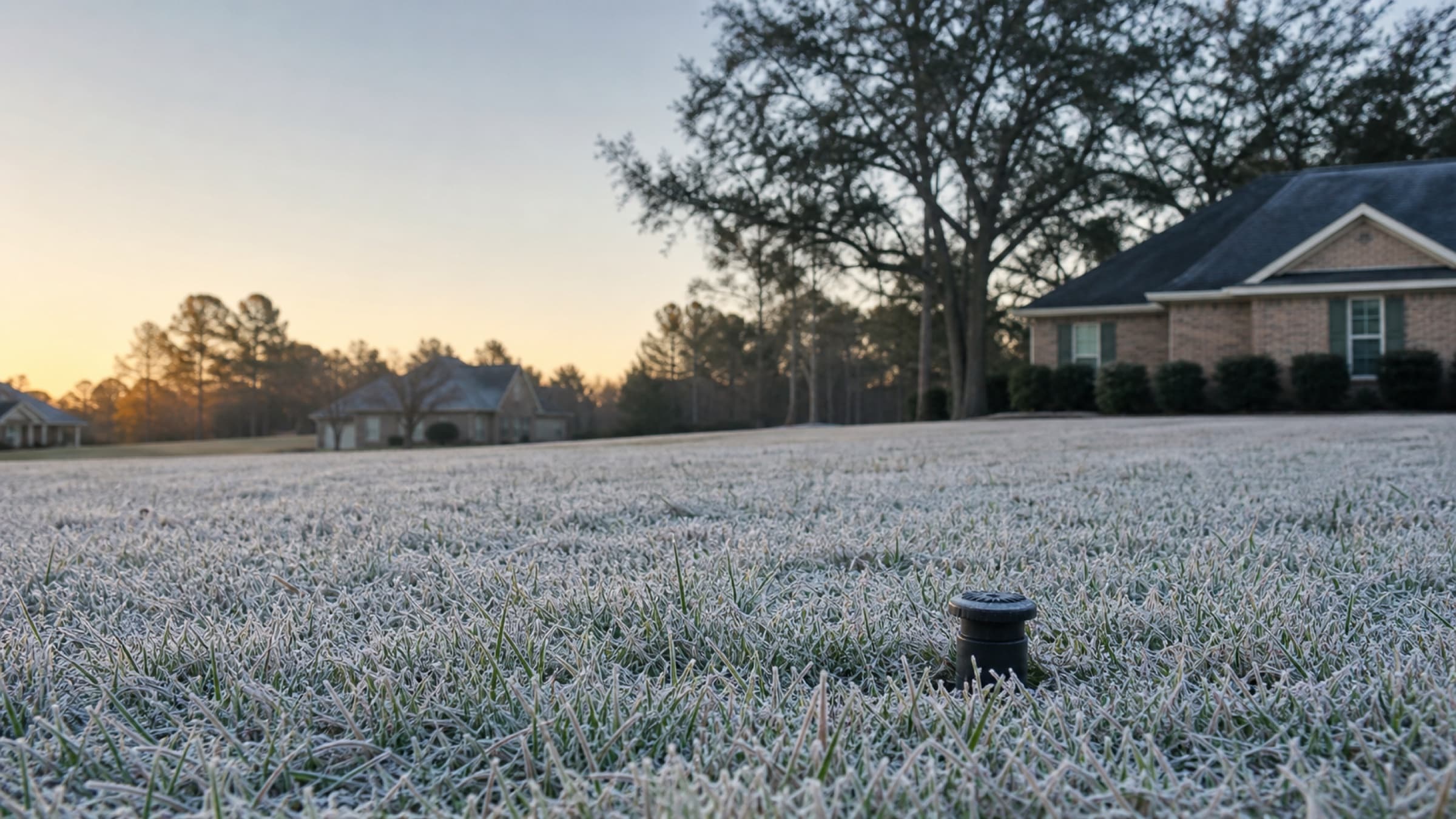
The Triangle problem
In Minnesota nobody argues about winterising an irrigation system, because the ground freezes solid and everybody knows it.
Here it is genuinely marginal, and that is exactly why it gets skipped. Most Triangle winters deliver a handful of nights below freezing and a couple of genuine cold snaps. Plenty of people go three winters without blowing their system out and conclude it is unnecessary.
Then a hard freeze arrives in January, and the repair bill is not the pipe in the ground, which is mostly below frost depth and mostly fine. It is the backflow prevention assembly, which sits above ground, is made of brass, is full of water, and cracks.
That assembly is the single most expensive component in a residential irrigation system, and replacing it also means a certified test afterwards. It is the whole argument.
When to do it
Late October to mid November in most of the Triangle. Before the first hard freeze, and after the lawn's last genuine watering need.
Watch the forecast rather than the calendar. The first freeze that matters is the first night forecast to hold below freezing for several hours rather than dipping there at dawn.
If you have missed it and a hard freeze is coming tonight, there is a stopgap at the end of this article.
What a proper winterisation involves
Shut off and isolate. The supply to the irrigation system is closed at the main isolation valve, not just at the controller.
Drain what will drain. Manual drain valves at the low points, and the test cocks on the backflow assembly opened.
Blow out, zone by zone, with a compressor. This is the part that separates a real winterisation from a token one. Compressed air is run through each zone in turn until the heads produce mist rather than water, then that zone is closed and the next one opened.
Two details matter here and both are ways of doing damage:
Volume is what clears a line, not pressure. A high pressure, low volume compressor, which is what most people own, will not push water out of a long lateral and can damage seals trying. The pressure has to stay under the manufacturer's limit for the pipe and the heads, and it is lower for polythene than for PVC.
Never run a zone dry for long. The water passing through a rotor is what lubricates and cools its gear drive. A zone left blowing after it has cleared cooks the gears.
Controller. Set to the off or rain position, which keeps the clock and the programme but stops it running. Leave the transformer powered unless you are removing the controller for the winter, because some controllers lose their programme after a long period unpowered.
Insulate the assembly. The backflow preventer gets an insulated cover, and the exposed supply pipe below it gets wrapped.
Which parts freeze first
In order:
- The backflow prevention assembly. Above ground, brass, holds water, cracks. Almost every freeze failure we are called to is this.
- Exposed supply pipe between the ground and the assembly.
- Heads and laterals in shallow or disturbed ground, particularly where a landscaper has back filled a trench loosely.
- Valve boxes that hold water, if the drainage into them has silted up.
Main lines below frost depth are rarely the problem, which is why people conclude that nothing froze and their system was fine.
What we check while we are there
A winterisation visit is the best opportunity of the year to find things, because every zone gets run individually with somebody watching:
- Heads that have sunk below grade or been knocked out of vertical by a mower.
- Zones with poor head-to-head coverage, which is why one strip of the lawn is always browner.
- Leaks that show as a soggy patch that never dries.
- A backflow assembly that has failed its test or is due one.
- Controller programmes still set to the schedule from a previous season.
Fixing those in November is far cheaper than discovering them in June when the lawn is already suffering.
Spring start-up is the other half
Do not simply turn the water back on. Reopening a system at full pressure sends a hammer down a line full of air and can break fittings and heads.
Open the main slowly, let each zone fill and purge with the heads open, then run the system zone by zone and walk it, watching every head. Reset the controller for the season, and adjust it again as the weather turns. Detail is on the irrigation page.
The stopgap, if a freeze is tonight
Shut the water off at the isolation valve. Open the test cocks and any manual drains. Wrap the backflow assembly in insulation and cover it, or wrap it in towels and a bin bag if that is what is in the house.
That is not a winterisation and it will not clear the laterals, but it will usually save the assembly, which is the part you did not want to buy.
Then book the real thing, and put it in the calendar for next October alongside the autumn clean-up.
The work this article is about
- Lawn Care ProgramsA recurring seven-visit program timed to the Triangle growing season, with each visit in a named month and a text before every one.
- Irrigation ServiceSprinkler repair, controller programming, backflow testing and winterisation, on systems we did not have to install.
- Seasonal CleanupTwo scheduled cleanups a year, in March and November, timed to when Triangle oaks and pines actually finish dropping.
Jobs where this came up
- Cedar deck and pergola replacing a failed deck in ApexA twenty year old pressure-treated deck with rotten framing replaced with cedar, cable railing and a pergola over the dining end.
- Paver patio, seat wall and fence line in ClaytonA cracked and settling concrete slab replaced with a bluestone paver patio on a rebuilt base, plus a cedar privacy fence.