Electrical Safety Inspection
A written inspection of the panel, grounding, protection and wiring, with findings prioritised by actual risk rather than by what we could sell you.
Is this an emergency?
No. Electrical Safety Inspection is scheduled work and is not covered by our emergency service, which runs 24 hours, 7 days, including holidays. We will book you into an ordinary dispatch window rather than charge an emergency rate for a job that can wait for one.
About Electrical Safety Inspection
What you get
Two hours in the house and a written report within two working days.
The report lists every finding with a photograph, and each one is prioritised into one of three bands: urgent, meaning fix it now; this year, meaning plan and budget for it; and monitor, meaning it is not right but it is not dangerous.
That prioritisation is the point. Any electrician can produce a list of everything in an older house that would not pass today's code, and it will be long and it will be frightening. Very little of it is actually dangerous. Telling you which is which is the service.
The report is yours. Take it to another electrician for a second quote if you want to.
What it costs
Flat priced between $289 and $689, set by house size, circuit count and how many panels there are. You know the figure when you book, and there is no diagnostic fee because the inspection is the diagnosis.
Not financing eligible.
When it is worth doing
Before buying a house. The most valuable two hours available on this page. A general home inspection touches the electrical system lightly, and "no visible defects" from a generalist is not the same thing. A panel needing replacement is a five-figure item and it is negotiable before closing and not after. Tell us your due diligence date when you book.
If the house was built before about 1980. Old enough for aluminium branch wiring, ungrounded circuits and panels since found wanting.
Before adding a large load. An EV charger, a heat pump, a hot tub or a generator all need headroom you may not have.
If something is behaving oddly. Breakers that trip without an obvious cause, lights that dim when an appliance starts, an outlet that feels warm. Those are symptoms and they are worth investigating before they are events.
If your insurer has asked. Increasingly they do, particularly about panel brands.
The two panel brands worth knowing about
Federal Pacific Stab-Lok and Zinsco, both installed widely across the Triangle in the 1950s through 1980s.
Both have documented failure modes where a breaker fails to trip under fault conditions, which means the protection you are relying on may not operate. There are no reliable replacement breakers for either, so the fix is replacing the panel.
If you have one, that goes in the urgent band and we will say so plainly. It is also, straightforwardly, the finding most likely to cost you money, so it is worth saying that we would rather you knew than did not.
What we actually test
Every accessible outlet for correct polarity and for whether a ground is genuinely present, which on a three-prong receptacle in an older house is frequently not.
GFCI and AFCI protection: whether it exists where it should, and whether the devices actually trip when tested. A GFCI that does not trip is worse than none, because you believe you are protected.
Grounding and bonding. Boring, invisible, and the thing most often wrong in an older installation.
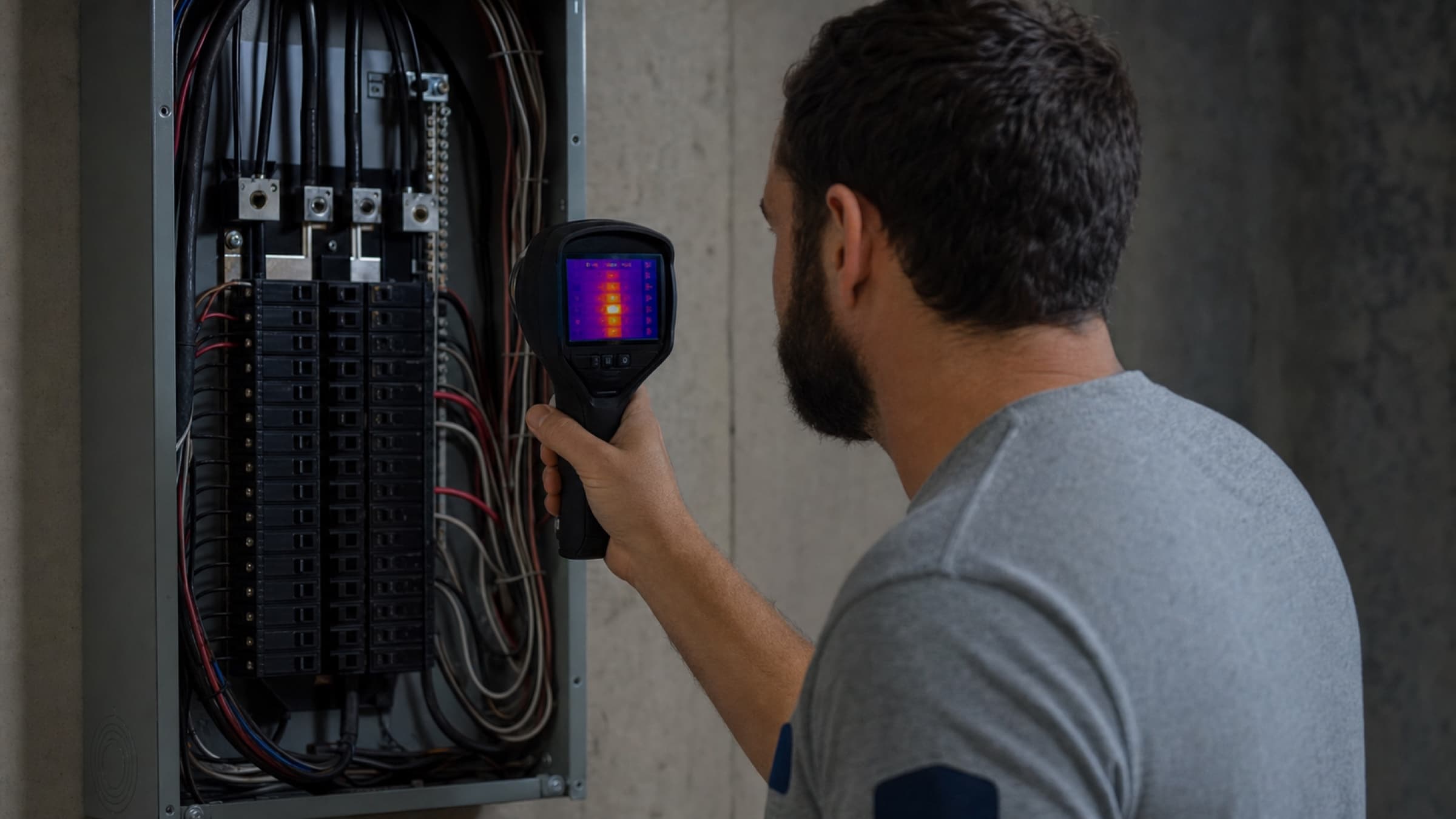
Thermal imaging of the panel under load, which finds hot terminations before they become scorched ones. A warm breaker is a loose connection, and a loose connection is the beginning of most electrical fires.
Smoke and carbon monoxide alarms: presence, placement, and age. Alarms expire, typically at ten years, and a great many houses have detectors older than that quietly not working.
We also map and label the circuits, and leave you a schedule. Most people have never had one.
What we will not do
We will not carry out any repair on this visit without quoting it and getting your approval first. Nothing gets added to the invoice while you make coffee.
We do not open walls or ceilings, so concealed wiring is assessed from what is visible and from the ends of it. Where we cannot see something, the report says so rather than implying we checked.
We do not issue code compliance certification for a sale or a permit. That is the county inspector, not us, and an inspection report from a contractor is not a substitute.
What is included
- Included
- Panel inspection, including bus condition, breaker fit and evidence of heat
- Identification of obsolete panels with documented failure modes
- Grounding electrode and bonding verification
- Testing of every accessible outlet for correct polarity and ground
- GFCI and AFCI presence and function testing
- Identification of wiring types, including aluminium branch and knob-and-tube
- Smoke and carbon monoxide alarm presence, age and placement check
- Circuit mapping and a labelled schedule left with you
- Thermal imaging of the panel under load
- A written report with findings prioritised as urgent, this year, or monitor
- Not included
- Any repair, which is quoted separately and never carried out without approval
- Opening walls or ceilings to inspect concealed wiring
- Code compliance certification for a sale or a permit
- Appliance and equipment testing beyond the circuit serving them
- Low-voltage, alarm and network systems
- Solar photovoltaic equipment
- Brands serviced
- Square D, Eaton, Siemens, Federal Pacific, Zinsco
- Certifications
- NC Electrical licence EL-27750
- Permit required
- No permit is required for this work.
- Typical timeline
- Two hours on site for a typical house. The written report reaches you within two working days.
What it costs
This is flat-priced, so you know the figure when you book. There is no diagnostic fee, because nothing is being diagnosed.
- Typical range
- $289 to $689
- After hours
- $150 between and , and on Sundays
- Financing
- Not availableFinancing starts at $3,000 and applies to projects rather than service calls.
What moves the price
- House size and the number of circuits, since every circuit is tested and recorded
- Number of panels and subpanels, including any in a garage or outbuilding
- Whether the property is a purchase and needs the report inside a due diligence window
- Whether outbuildings, a workshop or a detached garage are included
- Age of the house, since older wiring types take longer to identify and document
What affects any Cedarline price
- How old the equipment is, and whether replacement parts are still manufactured
- How accessible the work area is: a crawlspace or a second-storey roof takes longer than a garage
- Whether a permit and an inspection are required
- Material grade, which on a roof or a deck moves the total more than labour does
- Whether the visit falls outside dispatch hours
Before we arrive
- Clear the space in front of every panel, since code requires clear working space to open one
- Unlock any outbuilding, garage or crawlspace that has power to it
- Note anything that has ever tripped, flickered, buzzed or felt warm
- Say if this is for a purchase and when your due diligence period ends
Typical timeline
Two hours on site for a typical house. The written report reaches you within two working days.
Warranty
- Labour
- 12 months
- Parts
- 12 months
An inspection is a report rather than work, so there is nothing to warrant. Any repair arising from it carries the standard cover.
Questions
Electrical questions
One outlet has stopped working. What should I check first?
Find every GFCI in the house and check whether one has tripped, then check the breaker properly. GFCI outlets protect other outlets downstream of them, and those can be in completely different rooms, so a dead dining room outlet is regularly caused by a tripped GFCI in a garage or bathroom. A tripped breaker often does not look obviously off; push it fully off first, then back on. If the GFCI will not reset or the breaker trips straight back, stop and call, because both are telling you something.
An outlet feels warm. Is that dangerous?
Yes, and it should be treated as urgent. Electrical devices should be at room temperature. Warmth means resistance, resistance means heat, and heat at a connection is how fires start. The same goes for a burning smell, brown or black discolouration around a socket, or sparking beyond the tiny momentary arc normal with a heavy load. Switch that circuit off at the panel and tell us when you call, because it gets escalated to a person rather than into a booking queue.
Why did a whole row of outlets stop working at once?
Almost always one failed connection upstream, and usually a back-stab. Most receptacles allow the conductor to be pushed into a hole in the back rather than wrapped around the screw terminal; it is faster to install, it is a worse connection, and after twenty years of thermal cycling it loosens. Outlets are daisy-chained, so a failure at one box kills everything downstream. Telling us which outlets are affected turns an hour of hunting into ten minutes.
My house has three-prong outlets but the wiring is old. Are they grounded?
Often not, and it is very common in older Triangle houses where someone replaced a two-prong receptacle with a three-prong one without a ground being present. It looks safe and it is not: anything relying on that ground has none. The correct fixes are running a ground where a route exists, or fitting GFCI protection and labelling it as code requires. Swapping in another three-prong outlet is not one of them.
Is my Federal Pacific or Zinsco panel a problem?
Yes, and it should be replaced. Both brands were installed widely across the Triangle from the 1950s through the 1980s, and both have documented failure modes where a breaker fails to trip under fault conditions, which means the protection you are relying on may not operate. There are no reliable replacement breakers for either, so replacing the panel is the only fix. Insurers increasingly ask about them.
How long will my power be off for a panel upgrade?
Six to eight hours, on one day. The work has to be scheduled around a utility disconnect, which we book with the power company rather than choose, and the county has to inspect before the utility will reconnect. We sequence both so the panel is signed off and the power comes back the same day. Expect two to four weeks from accepting the quote to the work happening, driven by the permit and the disconnect appointment.
My breaker keeps tripping. Can I just fit a bigger one?
No, and it is one of the most dangerous things a homeowner can do. The breaker is sized to protect the cable behind it, not the appliance in front of it. Fit a 30 amp breaker on cable rated for 20 and you have not solved anything, you have removed the protection and left the cable free to overheat inside a wall where nobody will see it. A breaker that trips is doing its job and reporting a fault: an overloaded circuit, a failing appliance, a short, or a genuinely undersized circuit that needs a new one run. Which of those it is takes twenty minutes to establish. A total loss of power is a different question and is answered in our emergency set.
Can my panel handle an EV charger?
That is the first thing we work out, and the answer changes the whole job. A Level 2 charger is one of the largest continuous loads in a house, so it is not about whether there is a spare slot but whether the service has headroom once your existing loads are counted. With plenty of headroom it is a straightforward circuit. Tight but workable means a load management device, which throttles the charger when the house is busy and is far cheaper than an upgrade. No headroom means a panel upgrade first.
Do I need the fastest EV charger available?
For most Triangle households, no. If you drive a normal commute and charge overnight, a 32 amp charger replaces your entire daily range several times over while you sleep, and a 48 amp unit needs heavier cable, a larger breaker and more panel headroom at every step. The faster unit earns its cost for high-mileage drivers and two-EV households. There is also a hard limit: your car's onboard charger caps what it can accept, so a bigger circuit on a car that cannot use it buys nothing.
Can I just plug a portable generator into a wall socket?
No, never. That backfeeds power out onto the utility lines, where it can electrocute the line worker restoring your street, and it is what a transfer switch exists to prevent. Portable generators also produce carbon monoxide in quantities that kill, so they must run outdoors only, well away from the house, never in a garage even with the door open, and never near a window or air intake.
Do I need a generator that runs the whole house?
Usually not, and choosing essential circuits instead is frequently half the cost. An essential-circuits system feeds a subpanel carrying what you actually need in an outage, which in the Triangle is typically the fridge, the freezer, some lighting, internet, a well or sump pump, and one HVAC system. The difference in lived experience during a two-day outage is small. Air conditioning is the decision point, because a heat pump is a large starting load that often pushes you into the next generator size.
Why do my LED lights flicker or buzz on a dimmer?
Almost never a faulty fitting. It is a dimmer designed for incandescent bulbs driving an LED load: old dimmers expect a resistive load of a few hundred watts, and a room of LEDs might draw thirty, so the dimmer cannot regulate that low and you get flicker at the bottom of the range. The fix is an LED-compatible dimmer matched to the specific fittings, which manufacturers publish compatibility lists for.
Can I hang a ceiling fan where a light fitting is now?
Only on a fan-rated brace, and a standard ceiling box is not one. A fan weighs a good deal and, unlike a light, it moves. A standard box is rated to hold a static fixture, and a fan hung from one works the box loose over months of vibration until the whole fan comes down. A fan already hanging from an unrated box is the most common unsafe thing we find in this category, usually where a previous owner swapped a light for a fan themselves.
Common questions
How long is the arrival window?
Most visits carry a two hour arrival window, and roofing and construction visits carry three. We quote a window rather than an exact time because a trades crew genuinely cannot promise a minute, and we would rather be accurate than optimistic. We text you when the crew is on the way.
Is the diagnostic fee waived if I go ahead with the repair?
Yes. The diagnostic fee covers the technician's time and a written fault report, and it is waived when you approve the repair. Installation and replacement quotes carry no diagnostic fee at all, because nothing is being diagnosed on an estimate visit.
Is a slot confirmed as soon as I request it?
Not quite. A request is not a held slot. We confirm within 30 minutes during dispatch hours, and first thing the next dispatch day if you request outside them. The availability shown on the site reflects how full a day usually is rather than a live view of the dispatch board.
How can I pay?
We accept Visa, Mastercard, American Express, Discover, ACH bank transfer, and financing on qualifying projects. Payment is due on completion for service work, and on a staged schedule set out in the quote for larger projects. There are two payment methods we cannot take, which are covered in our billing questions.
What happens if I need to cancel?
Give us 24 hours notice and there is no charge. One call or one text is enough to reschedule, and we would much rather move you than charge you. Cancelling inside that window, or nobody being home when the crew arrives, carries a no-show fee.
What happens if nobody is home when the crew arrives?
There is a no-show fee, and it is the same figure as the late cancellation fee. It covers the slot another customer could have used and the crew's drive. If you are running late rather than absent, call us and we will usually wait or come back later the same day at no charge.
What actually happens on a service call?
A technician arrives inside the arrival window, diagnoses the fault, tells you the repair price before touching anything, and completes the work if you approve it. You get a written report either way. Nothing is added to the invoice without your approval first, and we do not carry out extra work while you are out of the room.
What are your hours?
The office is open Monday to Friday from 07:30, and Saturday mornings. Crews dispatch on a wider window, from 07:00 to 19:00 on weekdays and 08:00 to 16:00 on Saturday. There is no scheduled dispatch on Sunday. Emergency coverage runs 24 hours a day, every day, including holidays.
Do you cover my area?
We cover Raleigh, Durham, Cary and the wider Triangle, with coverage recorded city by city because it is not uniform. Most cities have every trade and no travel fee, two have a limited set of trades and a travel fee, one is emergency coverage only, and some adjacent zip codes are outside the service radius entirely. Enter your zip code on our service areas page for a definitive answer.
Do you work on commercial buildings?
No. We are residential only, including multifamily buildings up to four units. A four-unit building is the ceiling and it is a real one rather than a preference: our crews, our insurance and our licences are all sized for residential work. For anything larger, or for any commercial or industrial property, you need a commercial general contractor.
Do you install pool heaters, septic systems, or solar?
No to all three, and we will point you at the right trade for each. Pool and spa equipment sits under a separate licence, so you need a pool service company. Septic systems need a licensed septic contractor, and Wake County keeps a list of permitted installers. Solar needs a solar installer, though we will happily reroof around an existing array. We publish the full list of work we do not take on rather than making you ask.
Do you have Spanish-speaking technicians?
Yes, Monday through Friday. We do not staff Spanish-speaking crews at weekends. If you need one, ask when you book and we will schedule you on a weekday rather than send someone who cannot explain the work to you.
Are you licensed and insured?
Yes. We hold five North Carolina licences covering HVAC, general contracting, roofing, plumbing and electrical, and every licence number is published on our site rather than available on request. We carry general liability cover and workers compensation cover, and we are bonded. Certificates go to your adjuster or your HOA the same day you ask.
What warranty do you give?
Twelve months on labour and parts is the standard, and several services carry considerably longer. Roof replacements carry ten years on workmanship, repiping ten years, structural repair five years, and cabinetry five years. Manufacturer warranties on equipment run separately and are often longer still, and we register them in your name before we leave.
What if I am not happy with the work?
We come back and put it right at no charge. There is no time limit on a workmanship complaint about a repair we performed. Call the office rather than the crew directly, so it gets logged and scheduled rather than depending on one person remembering.
What should I do with my pets?
Secure them away from the work area before we arrive. This is genuinely for their safety rather than ours: crews prop doors open, carry sharp and heavy things through the house, and use tools that frighten animals. Tell us when you book if you have a dog that needs handling carefully, and we will note it on the job.
Do I need to be home?
For most visits, no, provided we can get in and reach the work. Inspections, maintenance visits and outdoor work frequently happen with nobody home. You do need to be there for anything where we will be quoting work, making decisions with you, or entering occupied rooms. We will tell you which yours is when you book.
What access do you need?
A clear path to the work area, clear parking for a van near the house, and unlocked side gates where the job is round the back. Roofing and outdoor work need the driveway, sometimes for a skip. If parking is difficult where you are, tell us when you book, because a crew circling for twenty minutes is time on your job.
What is the difference between emergency and scheduled work?
Two separate operations with separate rules. Scheduled work runs inside published dispatch hours, is booked into an arrival window, and carries the ordinary diagnostic fee. Emergency work runs around the clock on a fixed shortlist of eight services, targets a 90 minute response, and carries a call-out fee on top. Ringing the emergency line about something outside that shortlist does not upgrade it; you get booked into the next ordinary window instead. Our emergency questions list exactly which eight services qualify and set out what to do while you wait.
How long is a written quote valid?
Thirty days from the date on it. Beyond that we will re-price rather than honour a figure that no longer covers the materials, and material prices on roofing and lumber in particular move enough that a quarter-old quote is not meaningful. Re-pricing an expired quote is quick, because the survey work is already done.
Is a maintenance plan worth it?
It depends on how much work you expect to need. The plans bundle seasonal visits with priority dispatch and a standing discount on repairs, billed monthly, and the discount alone pays for the cheapest tier if you have one significant repair a year. If you rarely call anyone out, paying per visit is the better arithmetic and we will say so.
Is Cedarline Home Services a real company?
No. Cedarline Home Services is a fictional company used for demos. Every price, policy, licence number and phone number on this site is invented for that purpose, and none of it should be relied on as a real quotation or a real business record.
Related services
- Panel UpgradeReplacing an undersized, obsolete or failed electrical panel, with the utility disconnect and reconnect coordinated for you.
- Outlet and Switch RepairDead outlets, tripping breakers, ungrounded receptacles and failing switches, diagnosed properly rather than swapped and hoped.
- EV Charger InstallationLevel 2 home charger installation, with a load calculation first so we know your panel can carry it before anything is ordered.
- Generator InstallationStandby generator installation with a transfer switch, sized to the circuits you actually need rather than to the whole house.
Book a visit
Next available: monday,
Arrival window 2 hours. A request is not a held slot yet; we confirm it during dispatch hours.