Roof Repair in the Triangle
We find and fix roof leaks, from a cracked pipe boot to failed step flashing, and we cover an active leak around the clock.
Is this an emergency?
Roof Repair is covered by our emergency service, 24 hours, 7 days, including holidays. Call the emergency line if any of these apply:
- Water actively entering the house through a ceiling or a wall
- A ceiling bulging or sagging with trapped water above it
- Shingles or decking torn open so the interior is exposed to the sky
- Water running onto an electrical fitting or into a consumer unit
- Call-out fee outside dispatch hours
- $189
- Response target
- 90 minutes
We put you straight through to a person, with no automated triage, if you report: Water is actively entering a finished ceiling; Water is reaching an electrical fitting or a distribution board; A tree or large limb is resting on the roof.
About Roof Repair
Water is coming in right now
That is an emergency and we cover it around the clock, including holidays. Call the emergency line rather than booking online, and we will get a crew out with a tarp.
The first job is always to stop more water getting in. Tarping is not the repair, it is the thing that buys you a dry night and stops a ceiling collapsing while we wait for weather good enough to work in. We do it on the first visit.
What counts as an emergency here is specific: water actively entering the house, a ceiling bulging with water above it, the roof torn open to the sky, or water reaching anything electrical. A stain that appeared last month and has not grown is not an emergency, and we will book you into an ordinary dispatch window rather than charge you an emergency rate for it.
If water is reaching a light fitting or a distribution board, switch that circuit off at the consumer unit if you can do so safely, and tell us when you call. That report goes straight to a person.
What it costs
Most roof repairs land between $350 and $2,800. A cracked pipe boot, which is the single most common leak we find in the Triangle, sits at the bottom. Failed step flashing at a chimney with rotten decking underneath sits at the top.
The visit starts with the standard diagnostic fee, waived when you approve the repair. Work outside dispatch hours carries the after-hours surcharge, and an emergency dispatch outside dispatch hours carries the call-out fee as well. All three are published rather than left for the invoice.
Repairs are not financing eligible. Financing is for projects, and it starts at $3,000 in any case.
Finding the leak is most of the work
The stain on your ceiling is almost never underneath the hole. Water enters at a failed detail, runs along a rafter or a decking seam, and drops somewhere else entirely, often several feet away and sometimes a floor down.
So the diagnosis is a real piece of work rather than a formality. We trace from inside where the loft allows, look for the daylight and the staining on the decking, then work the roof from outside. Where the source is not obvious we run a water test: one person on the roof with a hose working methodically up the slope, one inside watching for the drip.
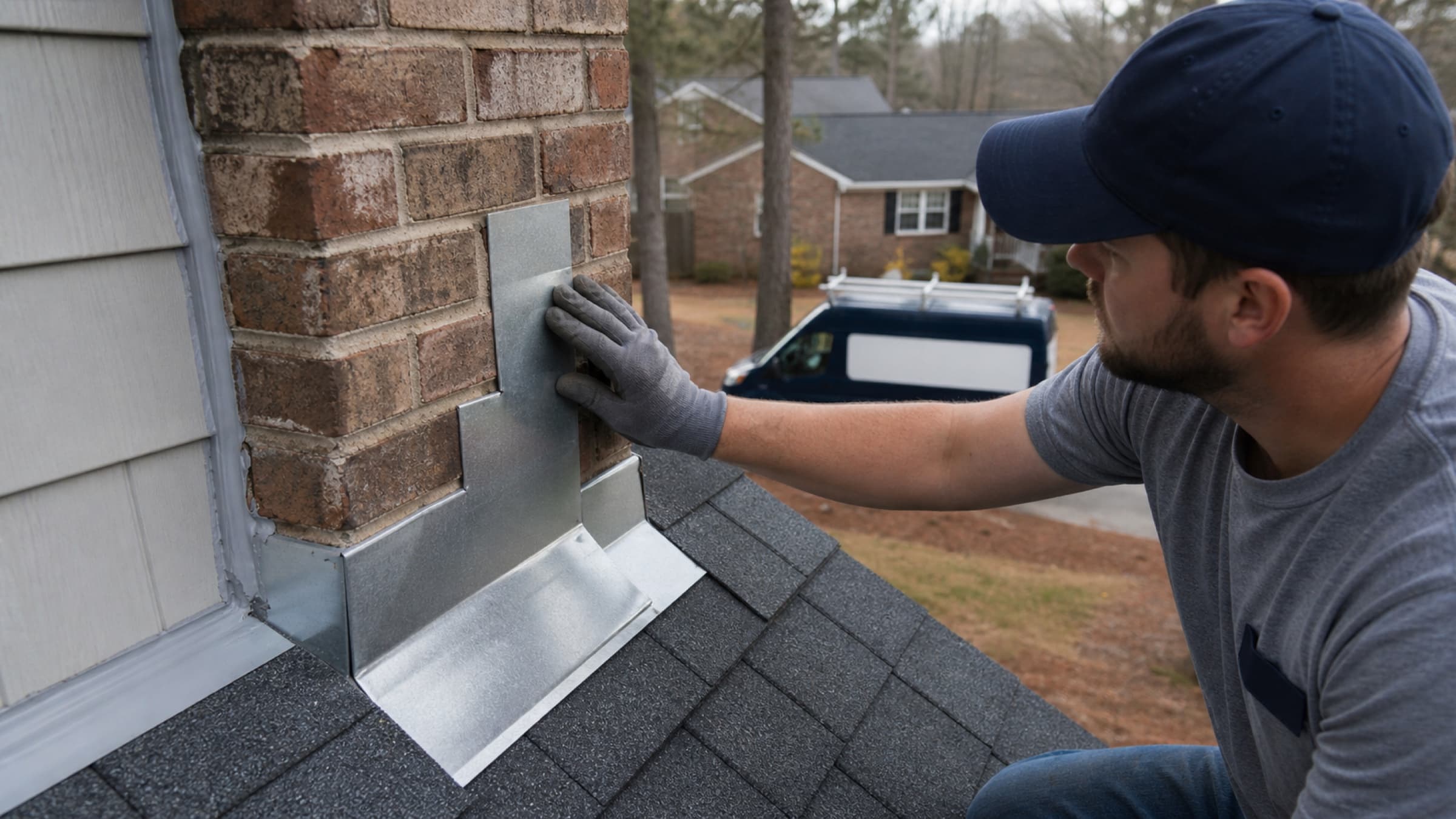
What we usually find, in rough order of frequency: cracked plastic pipe boots, step flashing that was never installed properly where a roof meets a wall, nail pops, failed sealant at a chimney, and valleys that have worn through. Field shingle failure is well down that list.
When a repair stops making sense
We will tell you when it does. A roof with general granule loss and shingles that crack when lifted is at the end of its life, and patching it is money that buys you months rather than years.
The honest test is whether the rest of the roof has the life to justify the repair. If it does, repair it. If it does not, a roof replacement quote is the better conversation, and we would rather have it once than sell you three repairs first.
If the damage came from a storm rather than from age, read storm damage and insurance claims before you do anything else. There are claim deadlines and the order you do things in matters.
What we do not do
We do not repair the ceiling afterwards. Drywall, insulation and paint are a different trade and we will tell you honestly that you need one rather than bodge it.
We do not remove trees or limbs. If something is resting on your roof, a certified arborist comes first and we come second; we will tarp the opening as soon as the load is off.
Before we arrive
Put a bucket under the drip and move furniture out from under the stain. Photograph the stain and note when it appears: a leak that only shows in driving rain from one direction is telling you something useful, and it narrows the search considerably. Clear the driveway so the ladder can be set safely, and clear the loft hatch if the leak can be traced from inside.
What is included
- Included
- Leak tracing from inside and outside, including a water test where the source is not obvious
- Pipe boot, vent collar and flashing replacement
- Step and counter flashing repair at chimneys and wall junctions
- Valley repair and shingle replacement in sections
- Ridge cap and hip replacement
- Rotten decking cut out and replaced in sections
- Emergency tarping to stop further water ingress
- Not included
- Full roof replacement, which is quoted after an on-site measurement
- Removal of trees or limbs resting on the roof
- Interior ceiling, drywall and paint repair after a leak
- Mould remediation
- Asbestos-containing roof felt, which requires an abatement contractor
- Brands serviced
- GAF, Owens Corning, CertainTeed, TAMKO, Atlas, Malarkey
- Certifications
- NC Roofing licence RC-11902, GAF certified
- Permit required
- No permit is required for this work.
- Typical timeline
- Most repairs complete in a single visit. Decking replacement or a discontinued shingle match adds two to five working days.
What it costs
This is a repair, so the visit starts with a diagnostic fee of $89. You are told the repair price before any work begins, and the diagnostic fee is waived when you approve it.
- Typical range
- $350 to $2,800
- Diagnostic fee
- $89Waived when you approve the repair
- After hours
- $150 between and , and on Sundays
- Financing
- Not availableFinancing starts at $3,000 and applies to projects rather than service calls.
What moves the price
- What has actually failed. A pipe boot is an hour, failed step flashing at a chimney is a day
- Whether the decking beneath has rotted and has to be cut out and replaced
- Roof pitch and height, which set how much fall protection and access the crew needs
- Whether matching shingles are still manufactured, since a discontinued colour changes the approach
- How far the water has travelled, because the stain is rarely under the hole
What affects any Cedarline price
- How old the equipment is, and whether replacement parts are still manufactured
- How accessible the work area is: a crawlspace or a second-storey roof takes longer than a garage
- Whether a permit and an inspection are required
- Material grade, which on a roof or a deck moves the total more than labour does
- Whether the visit falls outside dispatch hours
Before we arrive
- Put a bucket under the drip and move furniture out from under the stain
- Photograph the water stain and note the time it appears, since a leak that only shows in driving rain narrows the search
- Clear vehicles from the driveway so the ladder can be set safely
- Clear the loft hatch if the leak is traceable from inside
Typical timeline
Most repairs complete in a single visit. Decking replacement or a discontinued shingle match adds two to five working days.
Warranty
- Labour
- 12 months
- Parts
- 12 months
Twelve months on the repaired detail. A repair does not extend the life of the rest of the roof and we will not pretend it does.
Questions
Roofing questions
Do I need a repair or a whole new roof?
It depends on whether the rest of the roof has the life to justify the repair. A sound roof with one failed detail, a cracked pipe boot or failed step flashing, is a repair measured in hundreds. A roof with general granule loss and shingles that crack when lifted is at the end of its life, and patching it buys months rather than years. A roof inspection produces a written report that answers this properly, and we quote a good many repairs for people who expected to be told they needed a replacement.
Why can I not book a roof replacement online?
Because nobody can price one honestly without standing on the roof. Four things move the number by thousands and none are visible from an address: the area in squares and how steep it is, how many planes and valleys there are, how many existing layers have to come off, and how much decking has rotted underneath. Book a roof inspection instead, which is bookable online and flat-priced, and the replacement quote is built from it.
Where do roof leaks usually come from?
Flashing, not shingles. Flashing is the sheet metal sealing every place the roof meets something else: a chimney, a wall, a valley, a vent pipe or a skylight. On the roofs we inspect across the Triangle, failed flashing and cracked plastic pipe boots account for the large majority of active leaks, and field shingle failure is well down the list. That is good news, because a flashing repair is far cheaper than a roof.
The stain on my ceiling is in the middle of the room. Where is the leak?
Almost certainly not directly above it. Water enters at a failed detail, runs along a rafter or a decking seam, and drops somewhere else entirely, often several feet away and sometimes a floor down. That is why tracing the leak is a real piece of work rather than a formality, and why we water test when the source is not obvious rather than opening holes until one is in the right place.
Will you tarp my roof if it is raining?
Yes, on the first visit. Stopping more water getting in comes before the repair itself, because tarping buys you a dry night and stops a ceiling collapsing while we wait for weather good enough to work in. An active leak into the house is emergency-eligible and covered around the clock, so call the emergency line rather than booking online.
Can you roof over my existing shingles instead of tearing off?
We do not, and we would advise against anyone who offers to. Roofing over an existing layer is legal in some circumstances and it is always a false economy: you cannot inspect the decking underneath, the new shingles sit on an uneven surface, and the whole assembly runs hotter, which shortens its life. Every replacement we do is a full tear-off.
What happens if you find rotten decking after the tear-off?
Our quote states a decking allowance, and anything beyond it is itemised at cost rather than absorbed or hidden. How much of the deck has rotted is genuinely not fully knowable until the old roof is off, so a quote that promises a fixed total with no allowance is either padded or about to be revised. We show you the rotten sheets before they go in the skip.
Does my roof need ventilation?
Yes, and it is the part most often missed. Air should enter at the soffit, travel under the deck, and leave at the ridge vent. If the soffit has no vents, or they were painted shut, or insulation has blocked the eaves, the ridge vent has nothing to pull and the system does not work. The result is an attic that cooks in August, shingles ageing early from underneath, and condensation on the deck in winter that people mistake for a leak. Most manufacturer warranties are void without adequate ventilation.
Should I replace gutters at the same time as the roof?
Usually yes, and it costs less than doing it later. The crew and the access are already there, the drip edge and the gutter interact, and fascia rot found behind an old gutter is much cheaper to address while the roof edge is open. Gutters are quoted separately rather than bundled invisibly, so you can see what each part costs and decline one.
Do I need five inch or six inch gutters?
Six inch if you have a spot that sheets over the front edge in a heavy downpour, five inch is fine otherwise. Six inch carries roughly forty percent more water and pairs with a larger downspout. On a house with a steep roof, a large single plane, or valleys dumping into one run, five inch simply overflows no matter how clean it is, and cleaning will never fix a capacity problem.
Are gutter guards worth it?
They reduce cleaning; they do not eliminate it, and anyone telling you otherwise is selling. Under Triangle pines in particular, needles bridge most guard designs and shingle grit still settles. A good guard turns an annual clean into a check every few years, which is genuinely worth paying for on a three-storey where getting a ladder up is difficult, and less compelling on a single-storey ranch you can reach with a step ladder.
A tree has fallen on my roof. What do I do?
Call a certified arborist first and us second. We do not remove trees or limbs, and nothing can be assessed or repaired while the load is still on the structure. Once the tree is off we will tarp the opening to stop further water getting in, then survey the damage. If this is a storm event you intend to claim for, document everything before any repair beyond emergency tarping.
Common questions
How long is the arrival window?
Most visits carry a two hour arrival window, and roofing and construction visits carry three. We quote a window rather than an exact time because a trades crew genuinely cannot promise a minute, and we would rather be accurate than optimistic. We text you when the crew is on the way.
Is the diagnostic fee waived if I go ahead with the repair?
Yes. The diagnostic fee covers the technician's time and a written fault report, and it is waived when you approve the repair. Installation and replacement quotes carry no diagnostic fee at all, because nothing is being diagnosed on an estimate visit.
Is a slot confirmed as soon as I request it?
Not quite. A request is not a held slot. We confirm within 30 minutes during dispatch hours, and first thing the next dispatch day if you request outside them. The availability shown on the site reflects how full a day usually is rather than a live view of the dispatch board.
How can I pay?
We accept Visa, Mastercard, American Express, Discover, ACH bank transfer, and financing on qualifying projects. Payment is due on completion for service work, and on a staged schedule set out in the quote for larger projects. There are two payment methods we cannot take, which are covered in our billing questions.
What happens if I need to cancel?
Give us 24 hours notice and there is no charge. One call or one text is enough to reschedule, and we would much rather move you than charge you. Cancelling inside that window, or nobody being home when the crew arrives, carries a no-show fee.
What happens if nobody is home when the crew arrives?
There is a no-show fee, and it is the same figure as the late cancellation fee. It covers the slot another customer could have used and the crew's drive. If you are running late rather than absent, call us and we will usually wait or come back later the same day at no charge.
What actually happens on a service call?
A technician arrives inside the arrival window, diagnoses the fault, tells you the repair price before touching anything, and completes the work if you approve it. You get a written report either way. Nothing is added to the invoice without your approval first, and we do not carry out extra work while you are out of the room.
What are your hours?
The office is open Monday to Friday from 07:30, and Saturday mornings. Crews dispatch on a wider window, from 07:00 to 19:00 on weekdays and 08:00 to 16:00 on Saturday. There is no scheduled dispatch on Sunday. Emergency coverage runs 24 hours a day, every day, including holidays.
Do you cover my area?
We cover Raleigh, Durham, Cary and the wider Triangle, with coverage recorded city by city because it is not uniform. Most cities have every trade and no travel fee, two have a limited set of trades and a travel fee, one is emergency coverage only, and some adjacent zip codes are outside the service radius entirely. Enter your zip code on our service areas page for a definitive answer.
Do you work on commercial buildings?
No. We are residential only, including multifamily buildings up to four units. A four-unit building is the ceiling and it is a real one rather than a preference: our crews, our insurance and our licences are all sized for residential work. For anything larger, or for any commercial or industrial property, you need a commercial general contractor.
Do you install pool heaters, septic systems, or solar?
No to all three, and we will point you at the right trade for each. Pool and spa equipment sits under a separate licence, so you need a pool service company. Septic systems need a licensed septic contractor, and Wake County keeps a list of permitted installers. Solar needs a solar installer, though we will happily reroof around an existing array. We publish the full list of work we do not take on rather than making you ask.
Do you have Spanish-speaking technicians?
Yes, Monday through Friday. We do not staff Spanish-speaking crews at weekends. If you need one, ask when you book and we will schedule you on a weekday rather than send someone who cannot explain the work to you.
Are you licensed and insured?
Yes. We hold five North Carolina licences covering HVAC, general contracting, roofing, plumbing and electrical, and every licence number is published on our site rather than available on request. We carry general liability cover and workers compensation cover, and we are bonded. Certificates go to your adjuster or your HOA the same day you ask.
What warranty do you give?
Twelve months on labour and parts is the standard, and several services carry considerably longer. Roof replacements carry ten years on workmanship, repiping ten years, structural repair five years, and cabinetry five years. Manufacturer warranties on equipment run separately and are often longer still, and we register them in your name before we leave.
What if I am not happy with the work?
We come back and put it right at no charge. There is no time limit on a workmanship complaint about a repair we performed. Call the office rather than the crew directly, so it gets logged and scheduled rather than depending on one person remembering.
What should I do with my pets?
Secure them away from the work area before we arrive. This is genuinely for their safety rather than ours: crews prop doors open, carry sharp and heavy things through the house, and use tools that frighten animals. Tell us when you book if you have a dog that needs handling carefully, and we will note it on the job.
Do I need to be home?
For most visits, no, provided we can get in and reach the work. Inspections, maintenance visits and outdoor work frequently happen with nobody home. You do need to be there for anything where we will be quoting work, making decisions with you, or entering occupied rooms. We will tell you which yours is when you book.
What access do you need?
A clear path to the work area, clear parking for a van near the house, and unlocked side gates where the job is round the back. Roofing and outdoor work need the driveway, sometimes for a skip. If parking is difficult where you are, tell us when you book, because a crew circling for twenty minutes is time on your job.
What is the difference between emergency and scheduled work?
Two separate operations with separate rules. Scheduled work runs inside published dispatch hours, is booked into an arrival window, and carries the ordinary diagnostic fee. Emergency work runs around the clock on a fixed shortlist of eight services, targets a 90 minute response, and carries a call-out fee on top. Ringing the emergency line about something outside that shortlist does not upgrade it; you get booked into the next ordinary window instead. Our emergency questions list exactly which eight services qualify and set out what to do while you wait.
How long is a written quote valid?
Thirty days from the date on it. Beyond that we will re-price rather than honour a figure that no longer covers the materials, and material prices on roofing and lumber in particular move enough that a quarter-old quote is not meaningful. Re-pricing an expired quote is quick, because the survey work is already done.
Is a maintenance plan worth it?
It depends on how much work you expect to need. The plans bundle seasonal visits with priority dispatch and a standing discount on repairs, billed monthly, and the discount alone pays for the cheapest tier if you have one significant repair a year. If you rarely call anyone out, paying per visit is the better arithmetic and we will say so.
Is Cedarline Home Services a real company?
No. Cedarline Home Services is a fictional company used for demos. Every price, policy, licence number and phone number on this site is invented for that purpose, and none of it should be relied on as a real quotation or a real business record.
Emergency questions
I can smell gas. What should I do?
Leave the building first. Call the gas utility from outside. Then call us. Do not operate light switches, do not touch any appliance or control, and do not go looking for the source. The gas utility makes the property safe; we deal with the equipment afterwards. Our phone agents escalate any report of a gas smell to a person immediately and will not attempt a diagnosis while you are still in the house.
What counts as an emergency?
Eight services qualify, and they are the ones where waiting until morning does real damage. In HVAC: AC repair, furnace repair and heat pump service. In roofing: roof repair where a leak is active. In plumbing: leak detection and repair, sump pump service and gas line service. In electrical: a panel upgrade where power has been lost entirely. Nothing else on our catalogue is emergency-eligible at any hour.
Do you offer emergency service for a broken cabinet or a fence panel down?
No. Neither is emergency work and we will not dispatch a crew overnight for either. Emergency cover exists for eight specific services: AC repair, furnace repair, heat pump service, roof repair with an active leak, leak detection and repair, sump pump service, gas line service, and a panel upgrade with total loss of power. Cabinetry, fencing, decking, remodeling, lawn and patio work, and all cosmetic work are never emergency work, whatever time you call. We will book you into the next ordinary dispatch window instead, and we would rather say that plainly than charge you an emergency rate for a job that can wait.
What does an emergency call-out cost?
When we dispatch outside dispatch hours there is a call-out fee on top of the repair itself, and our target is to be with you within 90 minutes. That call-out fee is separate from the after-hours surcharge that applies to work carried out between 19:00 and 07:00 or on a Sunday. Both figures are published on our hours and pricing pages rather than left for the invoice, and both can apply to the same visit.
Are you available on holidays?
Yes, for emergencies. Emergency coverage runs 24 hours a day, 7 days a week, including every holiday on which the office and ordinary dispatch are closed. Scheduled work does not run on those dates, and our holiday closures are published in full with their dates so you can see exactly which days are affected.
How quickly will someone actually arrive?
Our target is 90 minutes for an emergency, and it is a target rather than a guarantee. Response times stretch during widespread events: a regional hailstorm or a hard freeze puts every crew in the region under the same demand at the same time. When that happens we tell you the realistic window rather than repeating the target, and we prioritise by severity rather than by call order.
My carbon monoxide alarm is sounding. What do I do?
Leave the building, call the gas utility from outside, and call us second. Treat it exactly as you would a gas smell: do not go looking for the source and do not assume it is a faulty alarm. Carbon monoxide has no smell, which is the whole reason the alarm exists. Once the property is safe we will find the cause, which is most often a cracked heat exchanger or a venting fault.
Water is pouring in. What should I do before you arrive?
Close the main water shutoff, usually where the supply enters the house, turning it clockwise until it stops. If you cannot find it or it will not move, tell us when you call and that report goes straight to a person while a crew is already moving. If water is reaching a light fitting or a distribution board, switch that circuit off at the consumer unit if you can do so safely, and tell us that too.
Water is coming through my ceiling. Is that an emergency?
Yes, if it is active. Water actively entering the house, a ceiling bulging with water above it, the roof torn open to the sky, or water reaching anything electrical are all emergency-eligible and covered around the clock. A stain that appeared last month and has not grown is not, and we will book that into an ordinary window rather than charge you an emergency rate. Put a bucket under the drip and move furniture out from under the stain before we arrive.
How cold does it have to be before no heat is an emergency?
Below 40F outdoors is the threshold we use for no heat, and above 85F indoors for no cooling. Those are the points at which a failure stops being uncomfortable and starts being a health risk, particularly for very young, elderly or unwell people in the house. Tell us if anyone in the household is vulnerable, because that changes how we prioritise regardless of the thermometer.
The power is out. Should I call you or the utility?
The utility, if your street is out too. Look at whether your neighbours are dark: if they are, only the power company can restore it and they will be faster than anyone, because there is nothing on your side of the meter to fix. If your neighbours have power and you do not, the fault is on your side, it is emergency-eligible, and it is ours.
What if you cannot finish the repair tonight?
Then we make it safe and come back. An overnight visit is about stopping the harm: isolating a circuit, capping a line, tarping an opening, getting the water off. A permanent repair needing a part nobody stocks at two in the morning waits for the supplier to open, and we book the return visit before we leave rather than asking you to ring again. You are told at the time which of the two you are getting, and you are not charged an emergency rate twice for the same fault.
I am in an emergency-only coverage area. What does that mean?
It means we will come out to you for the eight emergency-eligible services around the clock, but we do not schedule ordinary work there. Chapel Hill is our one emergency-only city. You get the same 90 minute response target and the same call-out fee as anywhere else in the coverage area; what you cannot book is a routine repair, a maintenance visit or a project. Enter your zip code on our service areas page for a definitive answer on your address.
Related services
- Roof InspectionAn hour on your roof with a written report and photographs of every plane, so you know what you are dealing with before you spend anything.
- Roof ReplacementA full roof replacement, quoted after an on-site measurement and a materials selection rather than over the phone.
- Storm Damage and Insurance ClaimsWe document storm damage properly, meet your adjuster on the roof, and carry out the approved work. We do not negotiate the claim for you.
- Skylight and FlashingSkylight replacement and the flashing details at chimneys, walls and valleys, which cause more leaks than shingles ever do.
Book a visit
Next available: monday,
Arrival window 3 hours. A request is not a held slot yet; we confirm it during dispatch hours.