Storm Damage Roof Repair and Insurance Claims
We document storm damage properly, meet your adjuster on the roof, and carry out the approved work. We do not negotiate the claim for you.
Is this an emergency?
No. Storm Damage and Insurance Claims is scheduled work and is not covered by our emergency service, which runs 24 hours, 7 days, including holidays. We will book you into an ordinary dispatch window rather than charge an emergency rate for a job that can wait for one.
If you have no heating or cooling at all, that is a repair and it is covered around the clock. Start with Roof Repair.
About Storm Damage and Insurance Claims
Where our role starts and stops, in one paragraph
We do not negotiate with your insurer on your behalf. We are not public adjusters and we are not licensed to act for you in a claim. What we do is document the damage properly, meet your adjuster on the roof, answer technical questions about what failed and why, and carry out the work your insurer approves. The claim itself stays between you and your insurer. If you want somebody to argue the claim for you, hire a licensed public adjuster, which is a real and regulated profession in North Carolina.
That line matters more than it sounds. A contractor who offers to "handle the whole claim" or "deal with the insurance for you" is either overstating what they can lawfully do or planning to do something you would not want your name on.
Do this first, in this order
One. Note the date of the storm. Every claim is filed against a specific weather event. If you cannot remember, the National Weather Service keeps records by county and we can help you find it.
Two. Stop further damage, but do not repair anything yet. Emergency tarping is fine and expected; insurers require you to prevent further loss. A full repair before documentation destroys the evidence your claim rests on.
Three. Get the roof documented. Book a roof inspection. This is the step people skip, and it is the one that decides most claims.
Four. Then file. With a dated photographic survey and a written scope in hand, you are filing a claim with evidence rather than a description.
If water is actively coming into the house, none of this is step one. Call the emergency line, get a roof repair crew out with a tarp, and start the claim once the house is dry.
What storm damage actually looks like
Most of it is invisible from the ground, which is why so much of it goes unclaimed until the roof starts leaking years later and the deadline has passed.
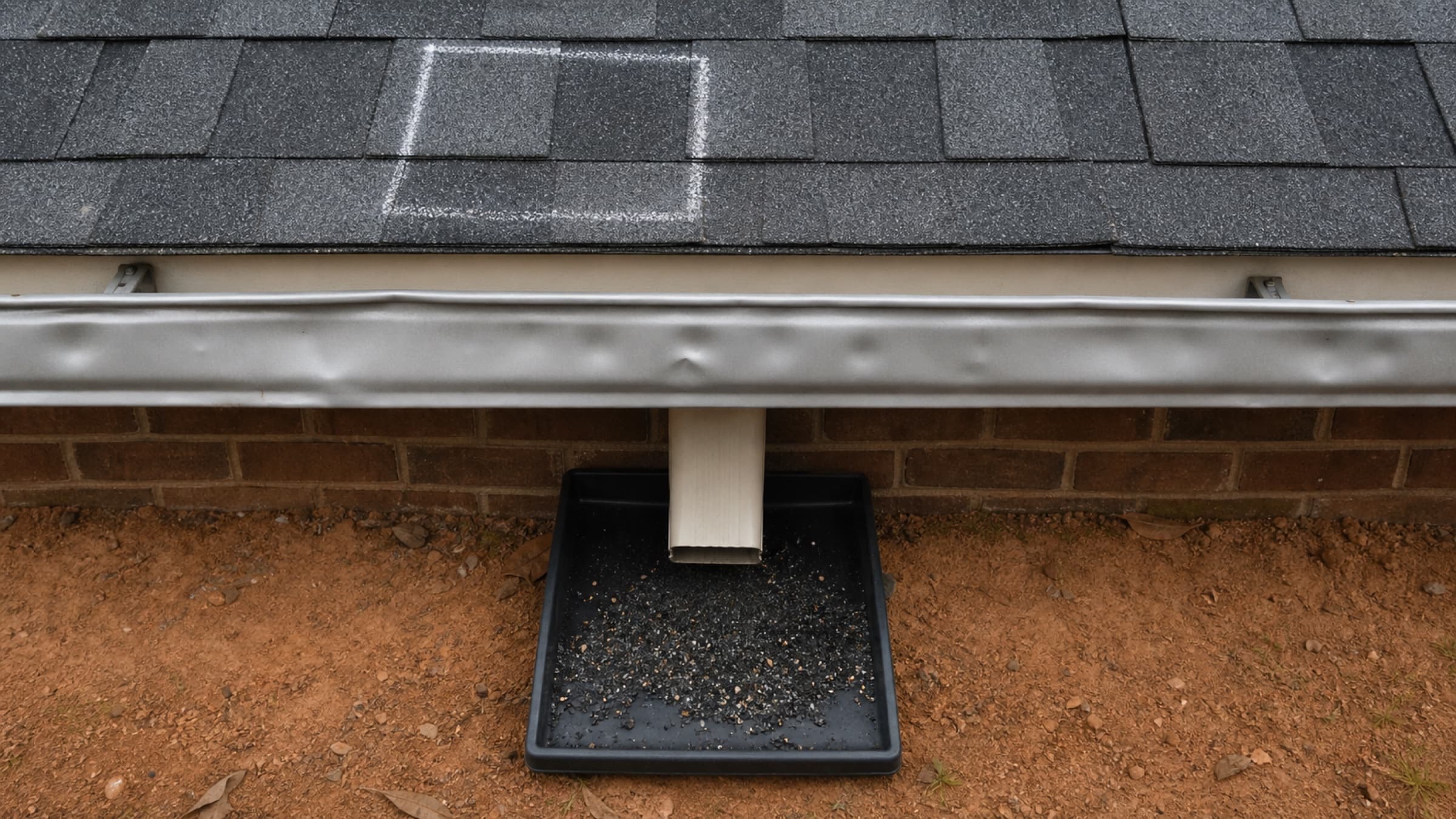
Hail does not usually punch holes. It bruises. A hail strike knocks the granules off a small circular area and fractures the mat underneath, and that spot then weathers several times faster than the shingle around it. From the ground the roof looks fine. From four feet away you can see the strikes, and you can feel the soft bruise through a glove.
Adjusters assess hail by counting strikes inside marked test squares on each slope, and whether a slope qualifies depends on that density. We count the same way, using the same square, which is why our documentation and theirs usually agree.
Wind lifts and creases. A shingle that has been folded back and dropped again looks seated but has a crease across it that will crack. Wind damage concentrates at rakes, ridges and eaves, and a single lifted tab can unzip a whole course in the next storm.
Collateral damage is the part people miss. Hail that dents your gutters and downspouts also hit the roof, and dented aluminium is the easiest evidence there is because it is at eye level. Check screens, vents, soffit, siding, the AC condenser fins, and the splash pan under each downspout, where a pile of granules is a straightforward sign the roof has been shedding.
What we give your adjuster
The documentation is the product here, and it is deliberately thorough because a claim is decided on evidence.
- A dated photographic survey, roof plane by roof plane, every photograph captioned with what it shows and where it was taken
- A hail strike density count per test square, to the standard adjusters use
- Wind damage documentation, including lifted and creased shingles
- A collateral damage survey covering gutters, downspouts, soffit, siding, screens and vents
- A written scope of work itemised by material and labour, so the adjuster is comparing like with like rather than a lump sum
- A moisture and decking condition report where the deck is compromised
- A copy of our licence and certificate of insurance for the adjuster's file
We also attend the adjuster's inspection. Two sets of eyes on the same roof at the same time settles most disagreements before they turn into a dispute, and it means technical questions get answered by somebody standing on the slope rather than by a phone call three days later.
Your deductible
Your deductible is yours to pay, and it is due to us on completion.
We will not absorb it, discount it, or inflate the scope to cover it. Contractors who offer to "waive your deductible" are committing insurance fraud, and they are exposing you to it too, because the homeowner signs the claim. It is also, straightforwardly, illegal in North Carolina.
The arithmetic is simple and worth understanding before you file. Your insurer settles the approved scope, less your deductible. You pay us the full approved amount; the settlement covers all of it except the deductible, which comes from you. If the approved scope comes in below your deductible, there is no point claiming at all and we will say so.
Most policies here settle on a replacement cost basis in two payments: an initial actual cash value payment, then the recoverable depreciation once the work is complete and invoiced. That second payment is why the paperwork at the end matters as much as the paperwork at the start, and we provide the final invoice and completion documentation your insurer needs to release it.
Typical timeline
Documentation reaches you within two working days of the survey. Adjuster inspections are scheduled by the insurer and usually land one to three weeks out, longer after a widespread event when every adjuster in the region is booked.
Once a scope is approved, the work follows the ordinary replacement lead time of two to four weeks for materials, the permit and a weather window. On site it is the same one to three days as any other replacement.
The whole arc, from storm to finished roof, is commonly six to ten weeks. Anyone promising you a new roof next week after a regional hailstorm is not telling you the truth about adjuster availability.
What it costs
The range here is unusually wide, from $1,200 to $32,000, because it spans a single-slope repair to a full replacement with collateral work. Which one you are having is decided by the approved scope, and that is not something we control.
This work is financing eligible, which matters in a specific situation: when the settlement arrives in two payments and you need to bridge the gap between starting the work and the depreciation being released. Both lender options are on our financing page.
Two warnings about the weeks after a storm
Storm chasers. After every significant hail event, out-of-state crews arrive, knock doors, offer free inspections and press for a signature that day. Some are fine. Many are gone by the time the warranty matters, and a ten year workmanship warranty from a company with no local address is worth nothing.
Assignment of benefits. If any contractor asks you to sign a document assigning your insurance benefits to them, read it very carefully and consider not signing. It hands them the right to deal with your insurer directly and to be paid directly, and it can leave you liable for the difference if the claim settles low. We never ask for one.
What is included
- Included
- Dated photographic survey of the damage, roof plane by roof plane
- Hail strike density count per test square, to the standard adjusters use
- Wind damage documentation, including lifted and creased shingles
- Collateral damage survey of gutters, downspouts, soffit, siding, screens and vents
- Written scope of work itemised by material and labour
- Moisture and decking condition report where the deck is compromised
- Attendance at the adjuster inspection on site
- A copy of our licence and certificate of insurance for your adjuster's file
- The approved repair or replacement work itself
- Not included
- Negotiating with your insurer on your behalf, which we are not licensed to do
- Filing the claim for you
- Absorbing, discounting or waiving your deductible
- Interior ceiling, drywall and contents restoration
- Tree removal
- Any work before the roof has been documented, other than emergency tarping
- Brands serviced
- GAF, Owens Corning, CertainTeed, TAMKO, Atlas, Malarkey
- Certifications
- NC Roofing licence RC-11902, GAF certified, HAAG certified inspector
- Permit required
- Yes. We pull the permit, book the inspection and meet the inspector.
- Typical timeline
- Documentation within two working days of the survey. Adjuster inspections are usually scheduled one to three weeks out by the insurer. Approved work follows the ordinary replacement lead time of two to four weeks.
What it costs
This is quoted rather than booked. An estimate visit is free and carries no diagnostic fee, and you get a fixed written quote at the end of it. The range below is what work of this kind usually costs, not a quote.$1,200 to $32,000
- After hours
- $150 between and , and on Sundays
- Financing
- Available from $3,000This work clears the minimum. See financing options.
What moves the price
- The scope your insurer approves, which is the single largest variable and not one we control
- Whether the damage is one slope or the whole roof, since matching rules differ by policy
- How much decking is compromised, which is only known once the old covering is off
- Whether gutters, siding, soffit and vents were also hit, as hail rarely damages only shingles
- Your deductible, which is deducted from the settlement and is payable to us on completion
What affects any Cedarline price
- How old the equipment is, and whether replacement parts are still manufactured
- How accessible the work area is: a crawlspace or a second-storey roof takes longer than a garage
- Whether a permit and an inspection are required
- Material grade, which on a roof or a deck moves the total more than labour does
- Whether the visit falls outside dispatch hours
Before we arrive
- Find the date of the storm, because every claim is filed against a specific weather event
- Photograph anything on the ground: dented gutters, granules in the splash pan, damaged screens
- Locate your policy and check the deductible and the claim deadline
- Do not have any repair carried out before the roof is documented, other than emergency tarping
- Clear the driveway so the roof can be reached from every elevation
Typical timeline
Documentation within two working days of the survey. Adjuster inspections are usually scheduled one to three weeks out by the insurer. Approved work follows the ordinary replacement lead time of two to four weeks.
Warranty
- Labour
- 120 months
- Parts
- 12 months
Approved replacement work carries the same ten year workmanship warranty as any other roof we install. Repairs carry twelve months.
Questions
Roofing questions
Do I need a repair or a whole new roof?
It depends on whether the rest of the roof has the life to justify the repair. A sound roof with one failed detail, a cracked pipe boot or failed step flashing, is a repair measured in hundreds. A roof with general granule loss and shingles that crack when lifted is at the end of its life, and patching it buys months rather than years. A roof inspection produces a written report that answers this properly, and we quote a good many repairs for people who expected to be told they needed a replacement.
Why can I not book a roof replacement online?
Because nobody can price one honestly without standing on the roof. Four things move the number by thousands and none are visible from an address: the area in squares and how steep it is, how many planes and valleys there are, how many existing layers have to come off, and how much decking has rotted underneath. Book a roof inspection instead, which is bookable online and flat-priced, and the replacement quote is built from it.
Where do roof leaks usually come from?
Flashing, not shingles. Flashing is the sheet metal sealing every place the roof meets something else: a chimney, a wall, a valley, a vent pipe or a skylight. On the roofs we inspect across the Triangle, failed flashing and cracked plastic pipe boots account for the large majority of active leaks, and field shingle failure is well down the list. That is good news, because a flashing repair is far cheaper than a roof.
The stain on my ceiling is in the middle of the room. Where is the leak?
Almost certainly not directly above it. Water enters at a failed detail, runs along a rafter or a decking seam, and drops somewhere else entirely, often several feet away and sometimes a floor down. That is why tracing the leak is a real piece of work rather than a formality, and why we water test when the source is not obvious rather than opening holes until one is in the right place.
Will you tarp my roof if it is raining?
Yes, on the first visit. Stopping more water getting in comes before the repair itself, because tarping buys you a dry night and stops a ceiling collapsing while we wait for weather good enough to work in. An active leak into the house is emergency-eligible and covered around the clock, so call the emergency line rather than booking online.
Can you roof over my existing shingles instead of tearing off?
We do not, and we would advise against anyone who offers to. Roofing over an existing layer is legal in some circumstances and it is always a false economy: you cannot inspect the decking underneath, the new shingles sit on an uneven surface, and the whole assembly runs hotter, which shortens its life. Every replacement we do is a full tear-off.
What happens if you find rotten decking after the tear-off?
Our quote states a decking allowance, and anything beyond it is itemised at cost rather than absorbed or hidden. How much of the deck has rotted is genuinely not fully knowable until the old roof is off, so a quote that promises a fixed total with no allowance is either padded or about to be revised. We show you the rotten sheets before they go in the skip.
Does my roof need ventilation?
Yes, and it is the part most often missed. Air should enter at the soffit, travel under the deck, and leave at the ridge vent. If the soffit has no vents, or they were painted shut, or insulation has blocked the eaves, the ridge vent has nothing to pull and the system does not work. The result is an attic that cooks in August, shingles ageing early from underneath, and condensation on the deck in winter that people mistake for a leak. Most manufacturer warranties are void without adequate ventilation.
Should I replace gutters at the same time as the roof?
Usually yes, and it costs less than doing it later. The crew and the access are already there, the drip edge and the gutter interact, and fascia rot found behind an old gutter is much cheaper to address while the roof edge is open. Gutters are quoted separately rather than bundled invisibly, so you can see what each part costs and decline one.
Do I need five inch or six inch gutters?
Six inch if you have a spot that sheets over the front edge in a heavy downpour, five inch is fine otherwise. Six inch carries roughly forty percent more water and pairs with a larger downspout. On a house with a steep roof, a large single plane, or valleys dumping into one run, five inch simply overflows no matter how clean it is, and cleaning will never fix a capacity problem.
Are gutter guards worth it?
They reduce cleaning; they do not eliminate it, and anyone telling you otherwise is selling. Under Triangle pines in particular, needles bridge most guard designs and shingle grit still settles. A good guard turns an annual clean into a check every few years, which is genuinely worth paying for on a three-storey where getting a ladder up is difficult, and less compelling on a single-storey ranch you can reach with a step ladder.
A tree has fallen on my roof. What do I do?
Call a certified arborist first and us second. We do not remove trees or limbs, and nothing can be assessed or repaired while the load is still on the structure. Once the tree is off we will tarp the opening to stop further water getting in, then survey the damage. If this is a storm event you intend to claim for, document everything before any repair beyond emergency tarping.
Billing, financing and insurance questions
Do you take personal cheques?
No, and we cannot take cash payments above $500 either. Both limits are firm and they apply to every job regardless of size. Everything else is open to you: Visa, Mastercard, American Express, Discover, ACH bank transfer, and financing on qualifying projects. If neither of those excluded methods being unavailable works for you, tell us before the crew arrives rather than at the door.
Is the diagnostic fee refundable if I decline the repair?
No. The diagnostic fee is not refundable, and it is a distinct thing from being waived. If you approve the repair, the fee is waived and does not appear on your invoice. If you decline, the fee is what you pay and it is all you pay, and the written fault report is yours to keep and to take to another contractor for a second quote. You are paying for the diagnosis and the report, and you receive both either way.
Can I get financing on a repair?
Only if the total is $3,000 or above, which most repairs are not. Financing starts at $3,000 and below that neither lender will write the paper, so a service call, a tune-up, an inspection or a diagnostic visit cannot be financed at any price. It applies to installation, replacement, remodeling, additions, roof replacement, and panel upgrades and generator installation. If your repair comes in under the minimum, the card and ACH options are the practical route.
What financing terms do you offer?
Two options through two lenders: 0% APR over 12 months, and 6.99% APR fixed over 60 months. The 0% offer is genuinely 0% if you clear the balance inside 12 months, but if a balance remains after month 12, interest is charged from the original purchase date rather than from month 13. That is how deferred-interest financing works everywhere and it is worth knowing before you choose it. The 60 month option is a plain fixed-rate loan with no early settlement penalty.
Does applying for financing affect my credit score?
No. The application runs a soft credit check, which does not affect your score, and it returns a decision in minutes. You can apply before you commit to the work, so the monthly figure is part of the decision rather than something you work out afterwards. Bring the quote reference and a photo ID; we can do the application with you at the kitchen table or over the phone.
When is payment due?
On completion for service work, and on a staged schedule set out in the quote for larger projects. We do not ask for payment before work starts on a service call. On a project, the stages are written into the quote before you sign, and the final payment is due after the snag list is cleared rather than before it, so you are never paying for work that is not finished.
Are permit fees included in the quote?
They are passed through at cost and itemised separately on your invoice, so you can see what went to the county and what came to us. We pull the permit, book the inspection and meet the inspector on site as part of the work. We do not mark permit fees up.
Will you handle my insurance claim for me?
No, and be careful of anyone who says they will. We are not public adjusters and we are not licensed to act for you in a claim. What we do is document the damage properly, meet your adjuster on the roof, answer technical questions about what failed and why, and carry out the work your insurer approves. The claim itself stays between you and your insurer. If you want somebody to argue the claim for you, hire a licensed public adjuster, which is a real and regulated profession in North Carolina.
Can you waive my insurance deductible?
No. Your deductible is yours to pay and it is due to us on completion. We will not absorb it, discount it, or inflate the scope to cover it. Contractors who offer to waive your deductible are committing insurance fraud and exposing you to it too, because the homeowner signs the claim, and it is straightforwardly illegal in North Carolina. If the approved scope comes in below your deductible there is no point claiming at all, and we will say so.
Why did my insurer only pay part of the settlement?
Most policies here settle on a replacement cost basis in two payments: an initial actual cash value payment, then the recoverable depreciation once the work is complete and invoiced. That second payment is why the paperwork at the end matters as much as the paperwork at the start. We provide the final invoice and completion documentation your insurer needs to release it, and financing can bridge the gap between starting the work and the depreciation arriving.
Will my insurance cover structural damage?
It depends on whether the cause was sudden or gradual, and structural claims are refused more often than any other kind we see. Standard policies generally cover a sudden event: a tree through the roof, a vehicle into the wall, a burst pipe that soaked the framing over a weekend. They generally exclude gradual causes: long-term water ingress, rot, termites, settlement and earth movement. Most of what we find in Triangle crawlspaces falls in the second category, and filing anyway usually produces a denial that sits on your claims history.
Should I sign an assignment of benefits?
Read it very carefully and consider not signing. It hands the contractor the right to deal with your insurer directly and to be paid directly, and it can leave you liable for the difference if the claim settles low. We never ask for one. After a significant hail event, out-of-state crews arrive, knock doors and press for a signature that day, and this is one of the documents they press for.
How is a maintenance plan billed, and can I cancel?
Billed monthly by card or ACH, and you can cancel any time with 30 days notice, with no exit fee. Visits already delivered in the plan year are not refunded. There is no minimum term and no automatic price escalation written into the plan.
Common questions
How long is the arrival window?
Most visits carry a two hour arrival window, and roofing and construction visits carry three. We quote a window rather than an exact time because a trades crew genuinely cannot promise a minute, and we would rather be accurate than optimistic. We text you when the crew is on the way.
Is the diagnostic fee waived if I go ahead with the repair?
Yes. The diagnostic fee covers the technician's time and a written fault report, and it is waived when you approve the repair. Installation and replacement quotes carry no diagnostic fee at all, because nothing is being diagnosed on an estimate visit.
Is a slot confirmed as soon as I request it?
Not quite. A request is not a held slot. We confirm within 30 minutes during dispatch hours, and first thing the next dispatch day if you request outside them. The availability shown on the site reflects how full a day usually is rather than a live view of the dispatch board.
How can I pay?
We accept Visa, Mastercard, American Express, Discover, ACH bank transfer, and financing on qualifying projects. Payment is due on completion for service work, and on a staged schedule set out in the quote for larger projects. There are two payment methods we cannot take, which are covered in our billing questions.
What happens if I need to cancel?
Give us 24 hours notice and there is no charge. One call or one text is enough to reschedule, and we would much rather move you than charge you. Cancelling inside that window, or nobody being home when the crew arrives, carries a no-show fee.
What happens if nobody is home when the crew arrives?
There is a no-show fee, and it is the same figure as the late cancellation fee. It covers the slot another customer could have used and the crew's drive. If you are running late rather than absent, call us and we will usually wait or come back later the same day at no charge.
What actually happens on a service call?
A technician arrives inside the arrival window, diagnoses the fault, tells you the repair price before touching anything, and completes the work if you approve it. You get a written report either way. Nothing is added to the invoice without your approval first, and we do not carry out extra work while you are out of the room.
What are your hours?
The office is open Monday to Friday from 07:30, and Saturday mornings. Crews dispatch on a wider window, from 07:00 to 19:00 on weekdays and 08:00 to 16:00 on Saturday. There is no scheduled dispatch on Sunday. Emergency coverage runs 24 hours a day, every day, including holidays.
Do you cover my area?
We cover Raleigh, Durham, Cary and the wider Triangle, with coverage recorded city by city because it is not uniform. Most cities have every trade and no travel fee, two have a limited set of trades and a travel fee, one is emergency coverage only, and some adjacent zip codes are outside the service radius entirely. Enter your zip code on our service areas page for a definitive answer.
Do you work on commercial buildings?
No. We are residential only, including multifamily buildings up to four units. A four-unit building is the ceiling and it is a real one rather than a preference: our crews, our insurance and our licences are all sized for residential work. For anything larger, or for any commercial or industrial property, you need a commercial general contractor.
Do you install pool heaters, septic systems, or solar?
No to all three, and we will point you at the right trade for each. Pool and spa equipment sits under a separate licence, so you need a pool service company. Septic systems need a licensed septic contractor, and Wake County keeps a list of permitted installers. Solar needs a solar installer, though we will happily reroof around an existing array. We publish the full list of work we do not take on rather than making you ask.
Do you have Spanish-speaking technicians?
Yes, Monday through Friday. We do not staff Spanish-speaking crews at weekends. If you need one, ask when you book and we will schedule you on a weekday rather than send someone who cannot explain the work to you.
Are you licensed and insured?
Yes. We hold five North Carolina licences covering HVAC, general contracting, roofing, plumbing and electrical, and every licence number is published on our site rather than available on request. We carry general liability cover and workers compensation cover, and we are bonded. Certificates go to your adjuster or your HOA the same day you ask.
What warranty do you give?
Twelve months on labour and parts is the standard, and several services carry considerably longer. Roof replacements carry ten years on workmanship, repiping ten years, structural repair five years, and cabinetry five years. Manufacturer warranties on equipment run separately and are often longer still, and we register them in your name before we leave.
What if I am not happy with the work?
We come back and put it right at no charge. There is no time limit on a workmanship complaint about a repair we performed. Call the office rather than the crew directly, so it gets logged and scheduled rather than depending on one person remembering.
What should I do with my pets?
Secure them away from the work area before we arrive. This is genuinely for their safety rather than ours: crews prop doors open, carry sharp and heavy things through the house, and use tools that frighten animals. Tell us when you book if you have a dog that needs handling carefully, and we will note it on the job.
Do I need to be home?
For most visits, no, provided we can get in and reach the work. Inspections, maintenance visits and outdoor work frequently happen with nobody home. You do need to be there for anything where we will be quoting work, making decisions with you, or entering occupied rooms. We will tell you which yours is when you book.
What access do you need?
A clear path to the work area, clear parking for a van near the house, and unlocked side gates where the job is round the back. Roofing and outdoor work need the driveway, sometimes for a skip. If parking is difficult where you are, tell us when you book, because a crew circling for twenty minutes is time on your job.
What is the difference between emergency and scheduled work?
Two separate operations with separate rules. Scheduled work runs inside published dispatch hours, is booked into an arrival window, and carries the ordinary diagnostic fee. Emergency work runs around the clock on a fixed shortlist of eight services, targets a 90 minute response, and carries a call-out fee on top. Ringing the emergency line about something outside that shortlist does not upgrade it; you get booked into the next ordinary window instead. Our emergency questions list exactly which eight services qualify and set out what to do while you wait.
How long is a written quote valid?
Thirty days from the date on it. Beyond that we will re-price rather than honour a figure that no longer covers the materials, and material prices on roofing and lumber in particular move enough that a quarter-old quote is not meaningful. Re-pricing an expired quote is quick, because the survey work is already done.
Is a maintenance plan worth it?
It depends on how much work you expect to need. The plans bundle seasonal visits with priority dispatch and a standing discount on repairs, billed monthly, and the discount alone pays for the cheapest tier if you have one significant repair a year. If you rarely call anyone out, paying per visit is the better arithmetic and we will say so.
Is Cedarline Home Services a real company?
No. Cedarline Home Services is a fictional company used for demos. Every price, policy, licence number and phone number on this site is invented for that purpose, and none of it should be relied on as a real quotation or a real business record.
Related services
- Roof InspectionAn hour on your roof with a written report and photographs of every plane, so you know what you are dealing with before you spend anything.
- Roof RepairWe find and fix roof leaks, from a cracked pipe boot to failed step flashing, and we cover an active leak around the clock.
- Roof ReplacementA full roof replacement, quoted after an on-site measurement and a materials selection rather than over the phone.
- Siding and SoffitSiding, soffit and fascia repair and replacement, including the hidden rot behind a failed gutter and the intake ventilation your roof depends on.
How to get a price
A storm claim is a process rather than a job, and it has to start with documentation before anyone can price the work. What the roof needs depends on what your insurer approves, and that depends on evidence gathered before anything is repaired. Book a roof inspection, which is bookable online and flat-priced, and we will produce the survey your claim is built on.