Siding, Soffit and Fascia Repair
Siding, soffit and fascia repair and replacement, including the hidden rot behind a failed gutter and the intake ventilation your roof depends on.
Is this an emergency?
No. Siding and Soffit is scheduled work and is not covered by our emergency service, which runs 24 hours, 7 days, including holidays. We will book you into an ordinary dispatch window rather than charge an emergency rate for a job that can wait for one.
If you have no heating or cooling at all, that is a repair and it is covered around the clock. Start with Roof Repair.
About Siding and Soffit
Why a roofer does this work
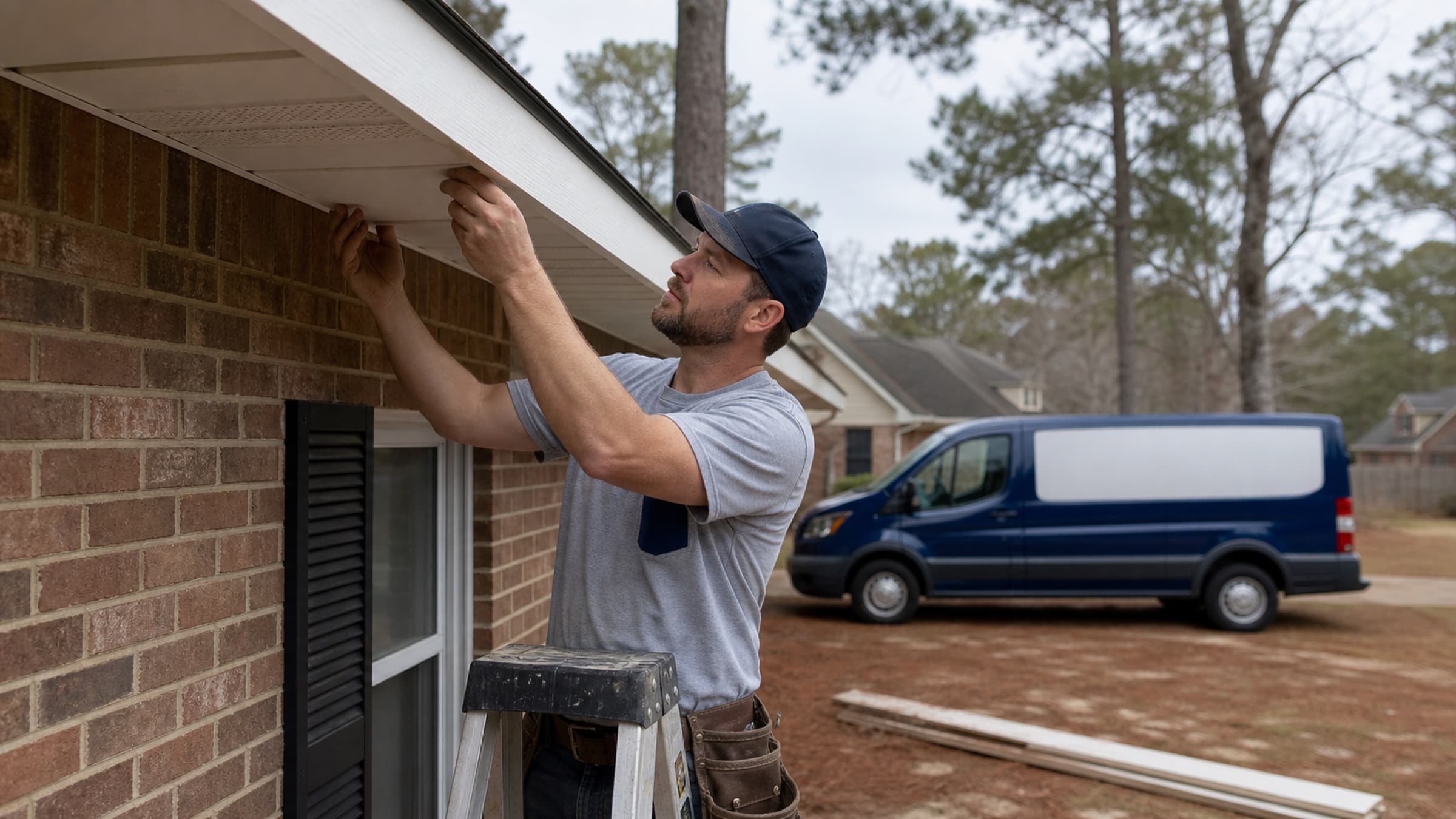
Soffit, fascia and the top courses of siding are roofing work in everything but name. They are where the roof meets the wall, they are what the gutter hangs on, and they are where almost all the hidden rot in a Triangle house lives.
The usual sequence: a gutter blocks or sags, water runs behind it instead of through it, and the fascia board takes that water for a couple of years without anyone seeing it. By the time paint bubbles or a squirrel gets in, the fascia has gone, the soffit is soft, and sometimes the rafter tail behind it has started to go too.
That is why we quote fascia replacement as an allowance on nearly every gutter installation: the odds of finding it are high enough that pretending otherwise would be dishonest pricing.
The ventilation nobody mentions
Your soffit is not trim. It is the intake half of your roof's ventilation.
Air is supposed to enter at the soffit, travel up under the deck, and leave at the ridge vent. If the soffit has no vents, or the vents were painted shut, or insulation has been pushed into the eaves and blocked them, then the ridge vent has nothing to pull and the system does not work.
The consequences arrive slowly and get blamed on other things. An attic that runs far hotter than it should in August. Shingles cooking from underneath and aging early, which voids most manufacturer warranties. Condensation on the underside of the deck in winter, which people mistake for a roof leak because it drips.
We check intake as part of any roof work, and adding soffit vents is often the cheapest meaningful improvement available on an older Triangle house.
What it costs
This work is charged hourly against the published roofing rate, and totals land between $480 and $18,000. A single rotten fascia board behind a gutter sits at the bottom. A full re-side of a two-storey elevation in fibre cement sits at the top.
Hourly is the honest model here because the scope genuinely is not knowable until the siding comes off. We estimate the hours before starting, we tell you what we find as we find it, and you decide.
Larger jobs are financing eligible where the total clears the financing minimum. Both lender options are on our financing page.
The three materials
Vinyl is the most common on newer Triangle housing. Cheap to repair, hard to match: colours fade and get discontinued, so a patch on a sun-facing wall will often be visible. We will tell you when replacing a whole elevation looks better than patching two boards.
Fibre cement, usually James Hardie here, is the premium replacement and holds up very well in this climate. It is heavy, it needs specific tools, and cutting it makes silica dust that has to be controlled properly.
Cedar is on the older and the more expensive houses. Beautiful, and a maintenance commitment rather than a finish; it needs to stay sealed.
Two things that stop us
Asbestos. Cement siding on houses built before about 1980 frequently contains it. If we suspect it, we stop and refer you to an abatement contractor. We do not cut it, we do not pressure wash it, and we do not guess.
Lead paint. On timber painted before 1978, disturbing the paint requires certified containment. We hold the EPA Lead-Safe certification and we will use it, but it changes the method and the price, and we would rather explain that up front than surprise you.
There is also a third, more mundane one: wasps and hornets in the soffit. It is extremely common here in late summer. We will not open a soffit bay with an active nest in it. Get a licensed pest operator in first and we will follow on.
If this is storm damage
Hail that dents your gutters usually also marks the siding, and wind damage to siding is straightforward to claim when it is documented alongside the roof. Read storm damage and insurance claims before repairing anything, because a repair before documentation removes the evidence.
Before we arrive
Photograph the affected elevation from the ground, once wide and once close. Move furniture, planters and bins away from the wall, and unlock the side gates so we can get around the house. If you have seen wasp activity at the eaves, tell us when you book rather than when we arrive with a ladder.
What is included
- Included
- Rotten fascia board replacement, including behind existing gutters
- Soffit repair and replacement, vented or solid
- Soffit vent installation to correct roof intake ventilation
- Vinyl, fibre cement and cedar siding repair and section replacement
- Sheathing replacement where rot is found behind the siding
- House wrap and flashing at windows and doors where siding is removed
- Trim, corner board and frieze board replacement
- Priming of bare timber before it is closed in
- Not included
- Full-house repainting, which is a decorating trade
- Window and door replacement
- Structural framing repair, which is a construction service
- Pest and wasp nest removal, which needs a licensed operator first
- Asbestos-containing cement siding, common before 1980, which requires an abatement contractor
- Lead paint disturbance on pre-1978 timber, which requires certified containment
- Brands serviced
- James Hardie, Certainteed, Mastic, LP SmartSide, Royal Building Products
- Certifications
- NC Roofing licence RC-11902, EPA Lead-Safe certified firm
- Permit required
- No permit is required for this work.
- Typical timeline
- A fascia and soffit repair is one to two days. A full elevation of siding is three to five days, after a one to two week lead time for material.
What it costs
This is charged hourly against the published rate for this trade, within the total range below. We tell you the estimated hours before starting.
- Typical range
- $480 to $18,000
- After hours
- $150 between and , and on Sundays
- Financing
- Available from $3,000This work clears the minimum. See financing options.
What moves the price
- How much of the run is repair and how much is replacement, since matching old siding is slow work
- Material. Vinyl, fibre cement and cedar all take different time and different tools
- Whether the sheathing behind has rotted, which is only visible once the siding is off
- Height and access, particularly a gable end above a conservatory or a steep bank
- Whether soffit vents are being added, which means cutting and screening every bay
What affects any Cedarline price
- How old the equipment is, and whether replacement parts are still manufactured
- How accessible the work area is: a crawlspace or a second-storey roof takes longer than a garage
- Whether a permit and an inspection are required
- Material grade, which on a roof or a deck moves the total more than labour does
- Whether the visit falls outside dispatch hours
Before we arrive
- Photograph the affected elevation from the ground, wide and close
- Move furniture, planters and bins away from the wall
- Note any wasp or hornet activity at the soffit, since we will not open it until that is dealt with
- Unlock side gates and clear a path around the house
Typical timeline
A fascia and soffit repair is one to two days. A full elevation of siding is three to five days, after a one to two week lead time for material.
Warranty
- Labour
- 24 months
- Parts
- 12 months
Two years on our workmanship. Manufacturer warranties on fibre cement and vinyl run separately and are considerably longer.
Questions
Roofing questions
Do I need a repair or a whole new roof?
It depends on whether the rest of the roof has the life to justify the repair. A sound roof with one failed detail, a cracked pipe boot or failed step flashing, is a repair measured in hundreds. A roof with general granule loss and shingles that crack when lifted is at the end of its life, and patching it buys months rather than years. A roof inspection produces a written report that answers this properly, and we quote a good many repairs for people who expected to be told they needed a replacement.
Why can I not book a roof replacement online?
Because nobody can price one honestly without standing on the roof. Four things move the number by thousands and none are visible from an address: the area in squares and how steep it is, how many planes and valleys there are, how many existing layers have to come off, and how much decking has rotted underneath. Book a roof inspection instead, which is bookable online and flat-priced, and the replacement quote is built from it.
Where do roof leaks usually come from?
Flashing, not shingles. Flashing is the sheet metal sealing every place the roof meets something else: a chimney, a wall, a valley, a vent pipe or a skylight. On the roofs we inspect across the Triangle, failed flashing and cracked plastic pipe boots account for the large majority of active leaks, and field shingle failure is well down the list. That is good news, because a flashing repair is far cheaper than a roof.
The stain on my ceiling is in the middle of the room. Where is the leak?
Almost certainly not directly above it. Water enters at a failed detail, runs along a rafter or a decking seam, and drops somewhere else entirely, often several feet away and sometimes a floor down. That is why tracing the leak is a real piece of work rather than a formality, and why we water test when the source is not obvious rather than opening holes until one is in the right place.
Will you tarp my roof if it is raining?
Yes, on the first visit. Stopping more water getting in comes before the repair itself, because tarping buys you a dry night and stops a ceiling collapsing while we wait for weather good enough to work in. An active leak into the house is emergency-eligible and covered around the clock, so call the emergency line rather than booking online.
Can you roof over my existing shingles instead of tearing off?
We do not, and we would advise against anyone who offers to. Roofing over an existing layer is legal in some circumstances and it is always a false economy: you cannot inspect the decking underneath, the new shingles sit on an uneven surface, and the whole assembly runs hotter, which shortens its life. Every replacement we do is a full tear-off.
What happens if you find rotten decking after the tear-off?
Our quote states a decking allowance, and anything beyond it is itemised at cost rather than absorbed or hidden. How much of the deck has rotted is genuinely not fully knowable until the old roof is off, so a quote that promises a fixed total with no allowance is either padded or about to be revised. We show you the rotten sheets before they go in the skip.
Does my roof need ventilation?
Yes, and it is the part most often missed. Air should enter at the soffit, travel under the deck, and leave at the ridge vent. If the soffit has no vents, or they were painted shut, or insulation has blocked the eaves, the ridge vent has nothing to pull and the system does not work. The result is an attic that cooks in August, shingles ageing early from underneath, and condensation on the deck in winter that people mistake for a leak. Most manufacturer warranties are void without adequate ventilation.
Should I replace gutters at the same time as the roof?
Usually yes, and it costs less than doing it later. The crew and the access are already there, the drip edge and the gutter interact, and fascia rot found behind an old gutter is much cheaper to address while the roof edge is open. Gutters are quoted separately rather than bundled invisibly, so you can see what each part costs and decline one.
Do I need five inch or six inch gutters?
Six inch if you have a spot that sheets over the front edge in a heavy downpour, five inch is fine otherwise. Six inch carries roughly forty percent more water and pairs with a larger downspout. On a house with a steep roof, a large single plane, or valleys dumping into one run, five inch simply overflows no matter how clean it is, and cleaning will never fix a capacity problem.
Are gutter guards worth it?
They reduce cleaning; they do not eliminate it, and anyone telling you otherwise is selling. Under Triangle pines in particular, needles bridge most guard designs and shingle grit still settles. A good guard turns an annual clean into a check every few years, which is genuinely worth paying for on a three-storey where getting a ladder up is difficult, and less compelling on a single-storey ranch you can reach with a step ladder.
A tree has fallen on my roof. What do I do?
Call a certified arborist first and us second. We do not remove trees or limbs, and nothing can be assessed or repaired while the load is still on the structure. Once the tree is off we will tarp the opening to stop further water getting in, then survey the damage. If this is a storm event you intend to claim for, document everything before any repair beyond emergency tarping.
Common questions
How long is the arrival window?
Most visits carry a two hour arrival window, and roofing and construction visits carry three. We quote a window rather than an exact time because a trades crew genuinely cannot promise a minute, and we would rather be accurate than optimistic. We text you when the crew is on the way.
Is the diagnostic fee waived if I go ahead with the repair?
Yes. The diagnostic fee covers the technician's time and a written fault report, and it is waived when you approve the repair. Installation and replacement quotes carry no diagnostic fee at all, because nothing is being diagnosed on an estimate visit.
Is a slot confirmed as soon as I request it?
Not quite. A request is not a held slot. We confirm within 30 minutes during dispatch hours, and first thing the next dispatch day if you request outside them. The availability shown on the site reflects how full a day usually is rather than a live view of the dispatch board.
How can I pay?
We accept Visa, Mastercard, American Express, Discover, ACH bank transfer, and financing on qualifying projects. Payment is due on completion for service work, and on a staged schedule set out in the quote for larger projects. There are two payment methods we cannot take, which are covered in our billing questions.
What happens if I need to cancel?
Give us 24 hours notice and there is no charge. One call or one text is enough to reschedule, and we would much rather move you than charge you. Cancelling inside that window, or nobody being home when the crew arrives, carries a no-show fee.
What happens if nobody is home when the crew arrives?
There is a no-show fee, and it is the same figure as the late cancellation fee. It covers the slot another customer could have used and the crew's drive. If you are running late rather than absent, call us and we will usually wait or come back later the same day at no charge.
What actually happens on a service call?
A technician arrives inside the arrival window, diagnoses the fault, tells you the repair price before touching anything, and completes the work if you approve it. You get a written report either way. Nothing is added to the invoice without your approval first, and we do not carry out extra work while you are out of the room.
What are your hours?
The office is open Monday to Friday from 07:30, and Saturday mornings. Crews dispatch on a wider window, from 07:00 to 19:00 on weekdays and 08:00 to 16:00 on Saturday. There is no scheduled dispatch on Sunday. Emergency coverage runs 24 hours a day, every day, including holidays.
Do you cover my area?
We cover Raleigh, Durham, Cary and the wider Triangle, with coverage recorded city by city because it is not uniform. Most cities have every trade and no travel fee, two have a limited set of trades and a travel fee, one is emergency coverage only, and some adjacent zip codes are outside the service radius entirely. Enter your zip code on our service areas page for a definitive answer.
Do you work on commercial buildings?
No. We are residential only, including multifamily buildings up to four units. A four-unit building is the ceiling and it is a real one rather than a preference: our crews, our insurance and our licences are all sized for residential work. For anything larger, or for any commercial or industrial property, you need a commercial general contractor.
Do you install pool heaters, septic systems, or solar?
No to all three, and we will point you at the right trade for each. Pool and spa equipment sits under a separate licence, so you need a pool service company. Septic systems need a licensed septic contractor, and Wake County keeps a list of permitted installers. Solar needs a solar installer, though we will happily reroof around an existing array. We publish the full list of work we do not take on rather than making you ask.
Do you have Spanish-speaking technicians?
Yes, Monday through Friday. We do not staff Spanish-speaking crews at weekends. If you need one, ask when you book and we will schedule you on a weekday rather than send someone who cannot explain the work to you.
Are you licensed and insured?
Yes. We hold five North Carolina licences covering HVAC, general contracting, roofing, plumbing and electrical, and every licence number is published on our site rather than available on request. We carry general liability cover and workers compensation cover, and we are bonded. Certificates go to your adjuster or your HOA the same day you ask.
What warranty do you give?
Twelve months on labour and parts is the standard, and several services carry considerably longer. Roof replacements carry ten years on workmanship, repiping ten years, structural repair five years, and cabinetry five years. Manufacturer warranties on equipment run separately and are often longer still, and we register them in your name before we leave.
What if I am not happy with the work?
We come back and put it right at no charge. There is no time limit on a workmanship complaint about a repair we performed. Call the office rather than the crew directly, so it gets logged and scheduled rather than depending on one person remembering.
What should I do with my pets?
Secure them away from the work area before we arrive. This is genuinely for their safety rather than ours: crews prop doors open, carry sharp and heavy things through the house, and use tools that frighten animals. Tell us when you book if you have a dog that needs handling carefully, and we will note it on the job.
Do I need to be home?
For most visits, no, provided we can get in and reach the work. Inspections, maintenance visits and outdoor work frequently happen with nobody home. You do need to be there for anything where we will be quoting work, making decisions with you, or entering occupied rooms. We will tell you which yours is when you book.
What access do you need?
A clear path to the work area, clear parking for a van near the house, and unlocked side gates where the job is round the back. Roofing and outdoor work need the driveway, sometimes for a skip. If parking is difficult where you are, tell us when you book, because a crew circling for twenty minutes is time on your job.
What is the difference between emergency and scheduled work?
Two separate operations with separate rules. Scheduled work runs inside published dispatch hours, is booked into an arrival window, and carries the ordinary diagnostic fee. Emergency work runs around the clock on a fixed shortlist of eight services, targets a 90 minute response, and carries a call-out fee on top. Ringing the emergency line about something outside that shortlist does not upgrade it; you get booked into the next ordinary window instead. Our emergency questions list exactly which eight services qualify and set out what to do while you wait.
How long is a written quote valid?
Thirty days from the date on it. Beyond that we will re-price rather than honour a figure that no longer covers the materials, and material prices on roofing and lumber in particular move enough that a quarter-old quote is not meaningful. Re-pricing an expired quote is quick, because the survey work is already done.
Is a maintenance plan worth it?
It depends on how much work you expect to need. The plans bundle seasonal visits with priority dispatch and a standing discount on repairs, billed monthly, and the discount alone pays for the cheapest tier if you have one significant repair a year. If you rarely call anyone out, paying per visit is the better arithmetic and we will say so.
Is Cedarline Home Services a real company?
No. Cedarline Home Services is a fictional company used for demos. Every price, policy, licence number and phone number on this site is invented for that purpose, and none of it should be relied on as a real quotation or a real business record.
Related services
- Gutter InstallationSeamless gutters formed on site to your rooflines, with downspouts sized and routed to take water away from the foundation.
- Roof ReplacementA full roof replacement, quoted after an on-site measurement and a materials selection rather than over the phone.
- Roof InspectionAn hour on your roof with a written report and photographs of every plane, so you know what you are dealing with before you spend anything.
- Storm Damage and Insurance ClaimsWe document storm damage properly, meet your adjuster on the roof, and carry out the approved work. We do not negotiate the claim for you.
Book a visit
Next available: monday,
Arrival window 3 hours. A request is not a held slot yet; we confirm it during dispatch hours.