ROOF
Five signs of a roof leak before it reaches the ceiling
A ceiling stain is the last symptom of a roof leak, not the first, and the earlier signs are all visible from inside the house.
By Tomás Reyes, Roofing Lead. Published , updated .
The stain is the last symptom, not the first
By the time water marks a ceiling, it has usually been entering the roof for months. It has soaked insulation, run along a rafter, crossed to somewhere else entirely, and finally saturated enough drywall to show.
That delay is why roof leaks are expensive. The repair on the roof is often small. The damage underneath it is not.
Every sign below appears before the stain, and four of the five are visible without going anywhere near the roof.
One: the attic smells different
Go into the attic on a dry day and use your nose before your torch.
A damp attic smells earthy and slightly sweet. Insulation holds water long after a leak has stopped, so the smell persists between rains, which makes it a better indicator than a wet patch you have to be lucky to catch.
While you are up there, look at the underside of the decking with a torch held low and along the surface rather than pointed straight at it. Water staining on plywood shows as dark tide lines that follow the grain, and old stains have crisp edges while active ones are diffuse. Rusty nail points are the other tell: nails that have condensation or leak water running past them rust from the tip downwards, and a scatter of rusted points in one area is a map of where the water is.
Two: nail pops and a wavy ridge line
Look at the roof from across the street on a bright day with the light raking across it.
A ridge line that dips or waves is a decking problem, and decking that has softened is decking that has been wet. Shingle nails backing out is the same story: the deck loses its grip as it delaminates and pushes the nail up, which lifts the shingle above it and creates the next entry point.
Neither is subtle once you know to look, and both are years ahead of a ceiling stain.
Three: granules in the gutter and the splash pan
Asphalt shingles are protected by the mineral granules bonded to their surface. Losing them is normal in the first few months after installation and abnormal after that.
The splash pan under a downspout is the best place to look, because water sorts them there. A handful of granules in the pan means the shingle surface is wearing out and the mat underneath is being exposed to ultraviolet light, which is what makes it brittle.
Hail accelerates this dramatically, and a hail-damaged roof often looks completely normal from the ground while shedding granules heavily. That is one of the reasons hail claims get denied: nobody documented the granule loss at the time. Our storm damage page covers what documentation actually needs to look like.
Four: the flashing, not the field
Most roofs do not leak in the middle. They leak at the interruptions.
Chimneys, sidewall junctions, skylights, vent pipes and valleys are where water is forced to change direction, and every one of them relies on flashing rather than on the shingles themselves. Look for:
- A dark line of sealant along a chimney or a sidewall. Sealant is not flashing. Where you can see a bead of it doing structural work, someone has patched over a detail rather than rebuilt it, and it will fail again within a few years.
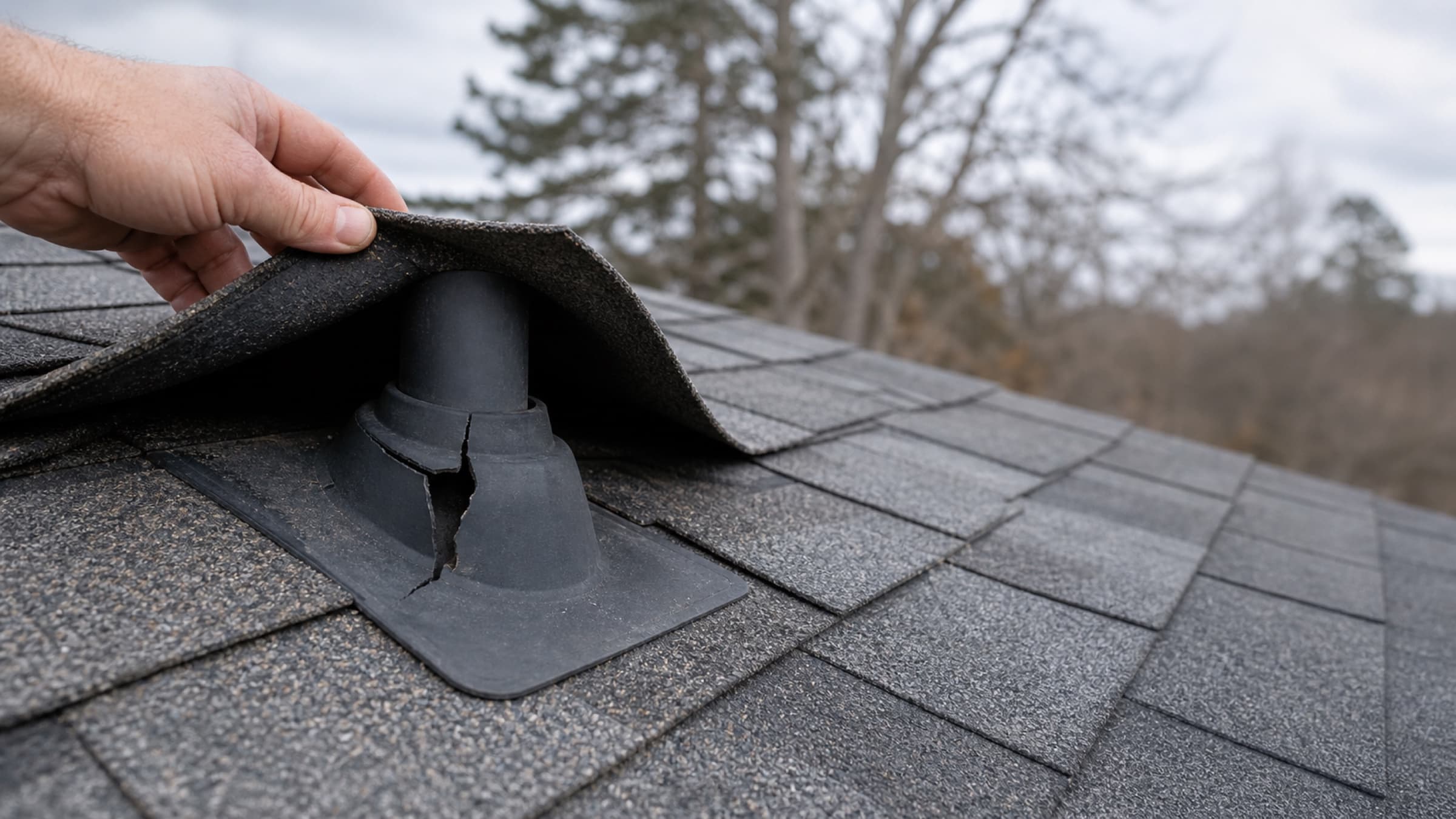
- Rubber pipe boots that have cracked in a ring around the pipe. These are the single most common cause of the leaks we repair. The rubber has a life of ten to fifteen years in North Carolina sun, and it is usually shorter than the life of the shingles around it.
- Rust streaks below a valley or a vent, which say metal is corroding where it should be sealed.
Skylights deserve their own mention. Almost every leaking skylight we are called to was installed with a surface-mounted apron and sealant instead of step flashing woven into the shingle courses. It always fails, and it always fails at the head.
Five: the exterior tells on the roof
Peeling paint under an eave, a stained or sagging soffit, or a section of siding that is darker than the rest usually means water is getting behind the fascia rather than into the room.
That is still a roof leak. It is a drip edge that is missing or installed under the underlayment rather than over it, or a gutter that has come loose and is dumping water behind itself. Left alone it rots the fascia, then the rafter tails, and then it becomes a carpentry job on top of a roofing one.
What to do next
If you have one of these, book a roof inspection. It is flat priced, it takes about an hour, and you get a written report with photographs whether or not we find anything.
If you have water actively entering a room, that is different. Active water coming through a finished ceiling is on our emergency list, day or night, and it is on the list precisely because the ceiling is what fails next. Relieve the bulge into a bucket if you can safely reach it, move what is underneath, and call the emergency line.
If you have none of these and your roof is over fifteen, get it looked at anyway before autumn. The cheapest roof repair is the one done in September rather than the one done in a February ice storm.
The work this article is about
- Roof InspectionAn hour on your roof with a written report and photographs of every plane, so you know what you are dealing with before you spend anything.
- Roof RepairWe find and fix roof leaks, from a cracked pipe boot to failed step flashing, and we cover an active leak around the clock.
- Skylight and FlashingSkylight replacement and the flashing details at chimneys, walls and valleys, which cause more leaks than shingles ever do.
Jobs where this came up
- Hail claim and full roof replacement in Five Points, RaleighA hail-damaged roof documented plane by plane for an adjuster, then torn off and replaced in four working days.
- Overnight roof leak stabilised in Chapel HillAn ice storm drove water through failed skylight flashing at night, and an emergency crew stabilised it before the ceiling came down.