HVAC
How to prepare your home for a service visit
Ten minutes of preparation is the difference between a job finished today and a second visit next week.
By Curtis Boyd, Dispatch Lead. Published , updated .
Why this is worth ten minutes
I run the dispatch board, so I see the same four things turn a one visit job into two, every week.
None of them are complicated. All of them are avoidable. Here is the list, in the order they cost us time.
One: access
The technician needs to reach the thing that is broken, and to have room to work on it.
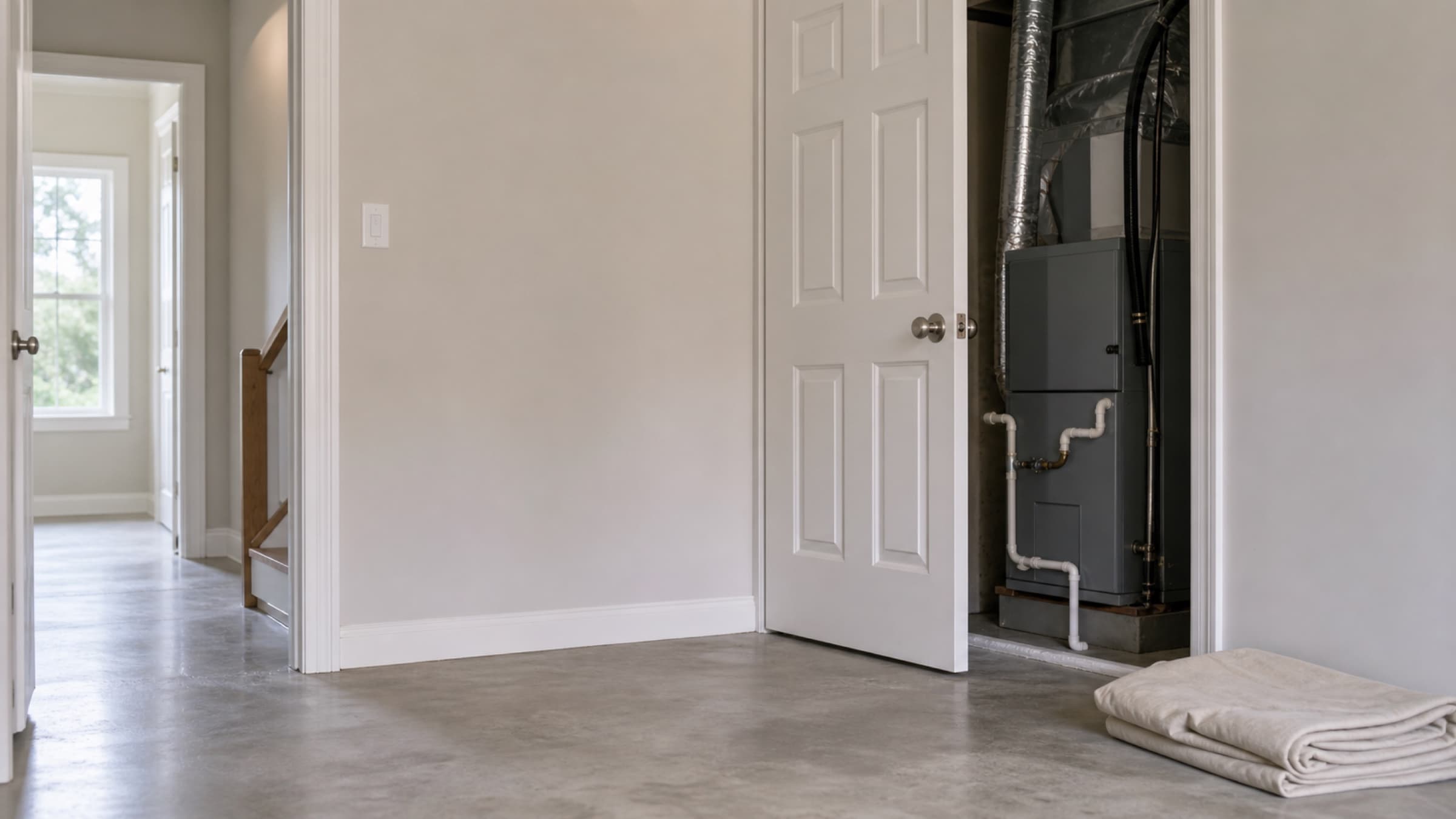
For heating and cooling that means a clear path to the indoor unit and to the outdoor unit, and about a metre of clear space around each. Utility rooms accumulate storage, and a water heater or an air handler boxed in behind eighteen months of boxes turns a ninety minute call into a two hour one, half of which is your technician moving your possessions.
Outdoors, cut back anything growing against the condenser and clear the route to it. Shrubs against a coil are a service problem and an efficiency problem both.
For plumbing, clear under the sink and in front of the water heater. For electrical, clear access to the panel. For roofing, clear a place to set a ladder and move cars off the drive where a load might come off the roof.
Crawlspaces and attics. Tell us when you book if access is through a hatch in a wardrobe, if the crawlspace door is locked, or if the ladder to the attic is not in the house. That is the single most common reason we cannot finish.
Two: pets and children
Not because they are a nuisance. Because doors get propped open, tools get left on the floor, and refrigerant lines and electrical panels are genuinely dangerous.
Secure pets somewhere away from the work area and away from the door the technician will be carrying equipment through. Tell us if there is a dog, even a friendly one, and especially if there is a dog in the garden where the outdoor unit is.
Three: know the symptom, and be honest about the history
The most useful five minutes of any service call is the conversation at the door.
Have ready:
- What it is doing, in your own words. "It runs but the air is not cold" is a completely different fault from "it does not come on at all".
- When it started, and whether it is constant or intermittent.
- What changed just before. A storm, a power cut, a filter change, someone else working in the house.
- What has been done to it before, including by another company. Nobody is being judged. A previous repair is diagnostic information.
Intermittent faults are where this matters most. If it only does it in the morning, or only after heavy rain, say so, because the technician will not see it happen and needs to work backwards.
Photographs and short videos help enormously, especially of something that has since stopped. Send them when you book.
Four: be reachable
The arrival window is a window, not an appointment time, because a job before yours can turn out to be worse than it looked. That is the honest constraint in this trade and pretending otherwise just makes the day worse for everybody.
What we do about it: you get a call before we arrive, and you get a call if we are running late. What we ask in return is a phone number that reaches somebody. The next available window is shown live at the top of every page on this site, and it is calculated from the same dispatch hours the crews actually work.
If nobody will be home, tell us when you book. Some work can be done unattended and some genuinely cannot, and it is better to sort that out in advance than at the door.
The money conversation, before it happens
Diagnostic first. Most repair work starts with a diagnosis, and the fee for that is published on our pricing page rather than discovered at the door. It is waived when you approve the repair.
You get the price before the work. Always, in writing on the technician's tablet, and nothing is touched until you say yes.
If you need to cancel, give us a day's notice and it costs nothing. Inside that, or if nobody is home when the crew arrives, there is a no-show fee of $65. That covers a slot another customer could have had and the crew's drive, and one text is enough to avoid it.
Payment is by card or ACH. We do not take personal cheques, and there is a limit on cash.
What we bring, and what we do not
Vans carry the parts that fail most often, which is why a large proportion of repairs finish on the first visit. What they do not carry is every part for every system ever made, so an unusual component on an older system may mean an order and a second visit. You will be told that at the point we find it, along with the timescale.
We put down floor protection, we wear covers indoors, and the work area gets left as we found it. If that does not happen, tell us, because we would rather hear it from you than not hear it.
A short checklist
- Clear the path and the space around the equipment.
- Unlock the crawlspace, the attic and the gate.
- Secure the pets.
- Have the symptom, the timing and the history ready.
- Keep your phone with you.
- Know where your main water shutoff and your electrical panel are. Not for us. For you.
That last one is not really about the visit. It is the thing most people go looking for on the worst night of their year, in the dark, which is not the time to be learning it.
The work this article is about
- AC RepairWe diagnose and repair air conditioning systems that have stopped cooling, usually in a single visit.
- Drain CleaningFlat-priced clearing of blocked and slow drains, with a camera inspection where the same drain keeps coming back.
- Roof InspectionAn hour on your roof with a written report and photographs of every plane, so you know what you are dealing with before you spend anything.
- Outlet and Switch RepairDead outlets, tripping breakers, ungrounded receptacles and failing switches, diagnosed properly rather than swapped and hoped.
Jobs where this came up
- Heat pump changeout and duct repair in Wake ForestA failed twenty year old heat pump replaced, with the attic ductwork sealed and two runs resized rather than reused as found.
- Two-system AC replacement and humidity fix in Fuquay-VarinaA house that never dried out in summer, fixed with correctly sized equipment, sealed ducts and a whole-home dehumidifier.