Structural Repair in the Triangle
Framing, joist, beam and foundation repair, carried out to a licensed engineer's specification rather than to a guess.
Is this an emergency?
No. Structural Repair is scheduled work and is not covered by our emergency service, which runs 24 hours, 7 days, including holidays. We will book you into an ordinary dispatch window rather than charge an emergency rate for a job that can wait for one.
About Structural Repair
Permits: case by case
Unlike everything else in this section, structural repair does not always need a permit, and we will not pretend otherwise to pad an invoice.
Sistering a single rotten joist in a crawlspace generally does not. Replacing a main girder, altering a load path, or adding piers generally does. The line is whether the repair changes how load moves through the building, and we tell you which side of it your job sits on at the survey, with the reason.
Where a permit is required, we pull it, book the inspection and meet the inspector.
An engineer, not an opinion
For most work on this page, a licensed structural engineer writes the specification and we build to it.
That order matters. A contractor who diagnoses a structural problem and then sells you the repair for it has an obvious conflict of interest, and the trade has a poor reputation here for exactly that reason. An engineer has no stake in how large the repair turns out to be.
We coordinate the engineer, we build to the stamped specification, and you get both documents. The engineer's fee is separate from our quote and is paid to them directly, so nobody is marking it up.
If the survey shows the problem is straightforward and does not need an engineer, we will say that too.
What it costs
The range on this page is unusually wide, from $2,500 to $42,000, because it covers everything from a single sistered joist to a main girder replacement with shoring and finish reinstatement.
Structural work is financing eligible where the total clears the financing minimum, which the larger repairs do. Both lender options are on our financing page. This is one of the few places where financing genuinely helps rather than merely spreads: structural problems get worse and more expensive if they are left, so the arithmetic of borrowing to fix one now is usually favourable.
What we actually find in Triangle houses
Rotten band joist and sill plate. The band joist runs around the perimeter at the top of the foundation. In a house with a crawlspace, poor ventilation and a leaking gutter above, it takes on water for years. It is the most common structural repair we do here.
Joists notched or drilled by an earlier trade. Somebody ran a drain, a duct or a cable through a joist in a place the code does not allow, usually decades ago during a bathroom remodel. The floor above develops a bounce. It is remarkably common and it is straightforward to repair.
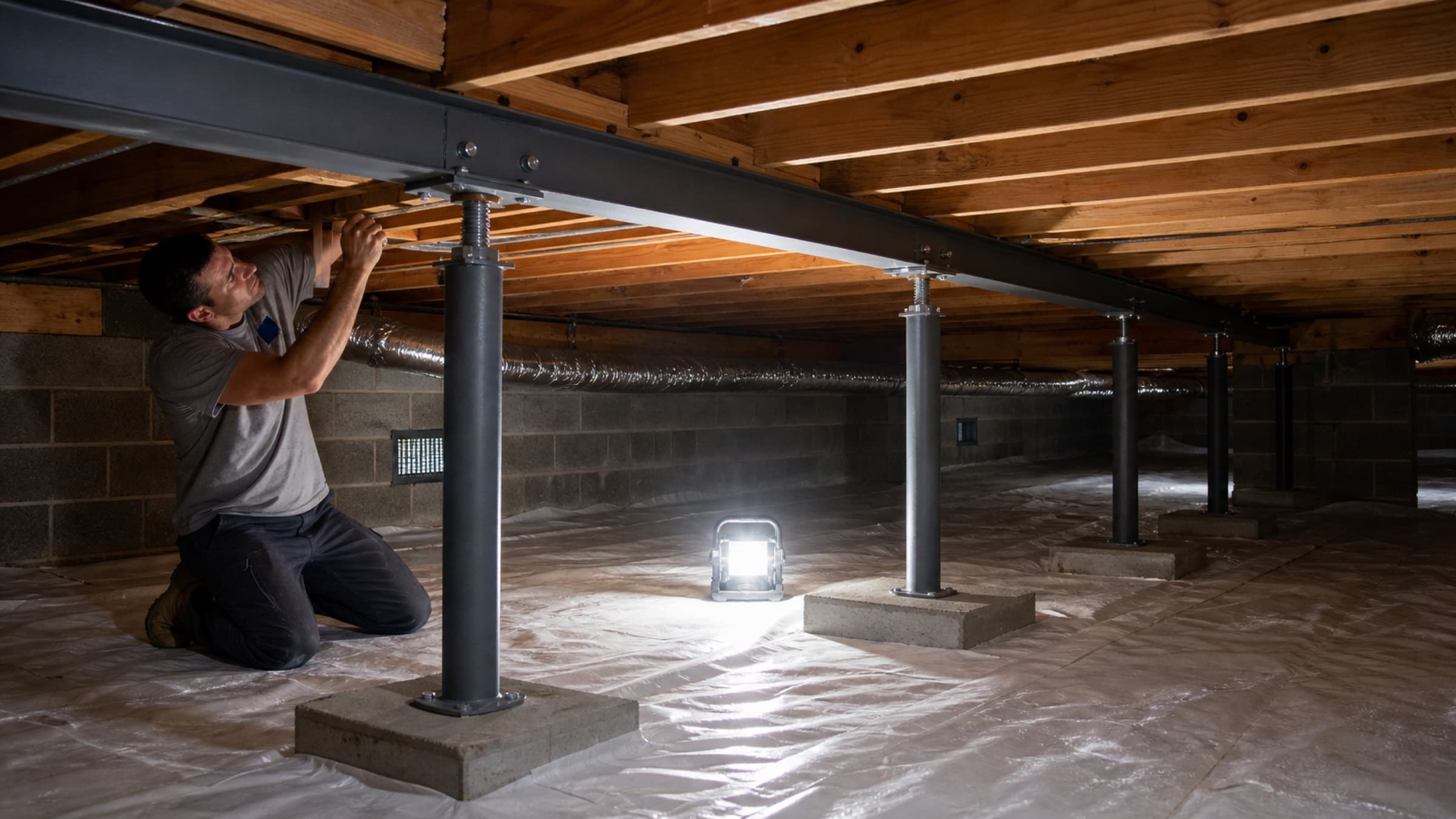
Crawlspace pier and column failure. Piers settle, shim stacks compress, and adjustable columns that were never adjusted end up carrying nothing while the joist above them sags.
Sagging floors that are not structural at all. Sometimes the floor is fine and the subfloor has delaminated from moisture. Cheaper, and we will tell you.
Foundation cracks, most of which are not urgent. Vertical hairline cracking in a poured wall is common and usually harmless shrinkage. What matters is horizontal cracking, stair-step cracking in block, and any crack that is actively widening. Those need an engineer.
Is it moving, or has it already moved
This is the question that decides urgency, and you can help answer it before we arrive.
Mark the crack. Draw a pencil line across each end, write the date next to it, and photograph it with a coin or a ruler for scale. A crack that has not moved in three months is a very different proposition from one that has moved in three weeks.
Most cracking in Triangle houses is historic. The clay soils here swell and shrink dramatically between a wet spring and a dry August, houses move seasonally, and a great many cracks opened years ago and stopped. Repairing the cosmetic effect of movement that finished a decade ago is usually wasted money, and we will say so.
What we treat as urgent: a floor, ceiling or roof that is visibly deflecting, anything making noise under load, a crack that has widened measurably in days, and any structure hit by a vehicle or a tree. Those get escalated to a person immediately rather than booked as a routine survey.
Fixing the cause, not just the effect
A sistered joist under a rotten band joist is a repair that will fail again, on the same schedule as the first one.
So the assessment always covers why. Usually it is water: a gutter discharging next to the foundation, grading that falls toward the house, a crawlspace with no vapour barrier and no ventilation, or a long-running plumbing leak. Sometimes it is termites, which is a licensed pest operator's job before ours.
Our quote will name the cause and say what has to happen to stop it. Occasionally that means the first thing you need is not us at all, and we would rather tell you that than do a repair we know will come back.
Warranty
Five years on structural workmanship, longer than the two years our general construction work carries.
The reason is simple: once the finishes go back you cannot see any of it. You are being asked to take it on trust, and a longer warranty is the only meaningful way we can offer something better than trust.
What your insurance will and will not cover
Worth knowing before you file, because structural claims are refused more often than any other kind we see.
Standard homeowner policies generally cover structural damage from a sudden event: a tree through the roof, a vehicle into the wall, a burst pipe that soaked the framing over a weekend. They generally exclude damage from gradual causes: long-term water ingress, rot, termites, settlement and earth movement. Most of what we find in Triangle crawlspaces falls squarely in the second category.
The practical implication is about timing. A pipe that burst last Tuesday and rotted a band joist is plausibly a claim. The same band joist rotted by a leaking gutter over nine years is not, and filing it anyway usually produces a denial that sits on your claims history.
We document what we find either way, with photographs and written findings, and we will tell you honestly which category we think you are in. What we will not do is characterise gradual damage as sudden to help a claim succeed. See storm damage and insurance claims for how we work with an adjuster where a claim is genuine.
The crawlspace question
Most structural repair we do in the Triangle happens in a crawlspace, and most of it traces back to how that crawlspace is managed.
A crawlspace with bare earth, no vapour barrier and vents that were closed years ago is a humidity chamber sitting directly beneath your floor. Warm moist air enters in summer, meets cooler surfaces, and condenses on the joists and subfloor. Over a decade that produces exactly the rot we are called out to repair.
Correcting it is not expensive relative to the repair: a sealed vapour barrier over the earth, the right approach to ventilation for the specific space, and gutters and grading that stop water arriving in the first place. When our assessment finds an active moisture cause, that work is quoted alongside the repair rather than left for you to arrange, because the two only make sense together.
What is included
- Included
- On-site structural assessment with written findings and photographs
- Coordination with a licensed structural engineer where a stamp is required
- Temporary shoring while a permanent repair is made
- Joist and rafter sistering, and replacement of rotten members
- Beam and girder replacement, timber or steel
- Pier and column replacement or addition in crawlspaces
- Sill plate and band joist replacement where rot or termite damage is found
- Repair of joists notched or drilled through by earlier trades
- Subfloor replacement over repaired framing
- Reinstatement of finishes removed to reach the structure
- Not included
- Structural engineering assessments and stamps, which come from a licensed engineer we coordinate with
- Foundation underpinning and helical pier installation, which is a specialist foundation contractor
- Termite treatment, which requires a licensed pest control operator
- Mould remediation
- Exterior foundation waterproofing
- Asbestos and lead paint work
- Brands serviced
- Simpson Strong-Tie, Tiger Brand, USP Structural Connectors
- Certifications
- NC General Contractor licence 78341, EPA Lead-Safe certified firm
- Permit required
- No permit is required for this work.
- Typical timeline
- Assessment within a week. Where an engineer is required, allow one to three weeks for their report. Repairs run from two days for a single sistered joist to four weeks for a beam replacement with shoring.
What it costs
This is quoted rather than booked. An estimate visit is free and carries no diagnostic fee, and you get a fixed written quote at the end of it. The range below is what work of this kind usually costs, not a quote.$2,500 to $42,000
- After hours
- $150 between and , and on Sundays
- Financing
- Available from $3,000This work clears the minimum. See financing options.
What moves the price
- Whether an engineer's assessment and stamp are required, which on most jobs of this kind they are
- Access. Sistering a joist in an open basement is straightforward, doing it in an eighteen inch crawlspace is not
- How much of the structure is affected, which is rarely fully known until the finishes come off
- Whether the cause is still active, since repairing the effect without fixing the cause guarantees a repeat
- Whether temporary shoring is needed while the permanent repair is made
- Whether finishes have to be removed and reinstated to reach the structure
What affects any Cedarline price
- How old the equipment is, and whether replacement parts are still manufactured
- How accessible the work area is: a crawlspace or a second-storey roof takes longer than a garage
- Whether a permit and an inspection are required
- Material grade, which on a roof or a deck moves the total more than labour does
- Whether the visit falls outside dispatch hours
Before we arrive
- Photograph every crack with a ruler or a coin against it for scale
- Mark the ends of any crack in pencil and date it, so movement can be measured
- Clear access to the crawlspace or basement, and to the affected floor from below
- Find any previous engineer report or repair paperwork
Typical timeline
Assessment within a week. Where an engineer is required, allow one to three weeks for their report. Repairs run from two days for a single sistered joist to four weeks for a beam replacement with shoring.
Warranty
- Labour
- 60 months
- Parts
- 12 months
Five years on structural workmanship, longer than our general cover because this work is not visible once finishes go back and you should not have to take it on trust.
Questions
Remodeling and construction questions
How long does a kitchen remodel take?
Ten to twelve weeks from signature to a finished kitchen: three to five weeks of design and permitting, then four to seven weeks on site. Anyone quoting four weeks in total is either not pulling a permit or has not counted the design phase. You are without a kitchen for the on-site portion, so plan a temporary setup with a microwave and a kettle somewhere else in the house.
Why can I not get a price over the phone?
Because a remodel price depends on what is behind your walls, what the county will permit, what you choose to put back, and how much of the existing structure is worth keeping. Two identical-looking 1990s kitchens in Cary can differ by tens of thousands once the cabinets come off. Every project starts with a free design and survey visit that produces a fixed written quote with every allowance stated.
What is an allowance in a quote?
An allowance is the sum we have budgeted for something you have not chosen yet, such as tile, fixtures or cabinetry. Every quote states its allowances plainly. Choose above one and the difference is itemised; choose below it and you get the difference back. Quotes without stated allowances are how a fixed price turns into a moving one.
What makes one remodel cost more than another?
Whether the layout changes, more than anything else. Moving a sink means moving a drain, and a drain needs fall, which on a slab-on-grade house can mean cutting concrete. Keeping the wet wall where it is saves more money than any other decision available to you. After that it is cabinetry level, whether a wall is load bearing, and whether your electrical panel can carry a modern kitchen.
Can you start before the permit comes through?
No. A contractor who offers to start before the permit is issued is offering to do unpermitted work, which becomes your problem when you sell the house. Wake and Durham counties both run one to two weeks for a residential kitchen at present, longer after a storm event when the permit desk is loaded with roof work. We pull the permit, book the inspections, and meet the inspector on site.
Can I live in the house during the work?
For most projects yes, and most clients do. On an addition the majority of the work happens outside your walls, with two disruptive phases: excavation week, when you lose the driveway, and the tie-in, when we open the existing exterior wall. On a kitchen or bathroom you lose that room for the on-site phase. Water and power stay on throughout, with brief planned interruptions we tell you about the day before.
Can I build an addition anywhere on my lot?
No, and three site constraints decide what is buildable. Setbacks are required distances from every boundary, and in much of Wake and Durham County the side setback is the binding one, which frequently pushes an addition to the back rather than the side you wanted. Lot coverage caps the proportion of the lot under roof and hard standing, and an existing patio counts toward it. Utility and drainage easements cannot be built over at all. All three are on your plot survey.
Do I need HOA approval?
In most Triangle subdivisions, yes, for anything visible from the street or from a neighbour. The architectural review committee meets on its own schedule and it is frequently the single longest wait in an addition project, so start it early. We prepare and submit the package, but we cannot make the committee meet sooner.
Can you just finish my basement without dealing with the damp?
No. Framing over a moisture problem is the most expensive mistake in basement finishing, because drywall and insulation in a below-grade room that takes water is not a room that needs repair later, it is a room that has to be demolished and rebuilt. We assess moisture first and put the findings in writing before anything is designed. Sometimes the answer is nothing at all, because plenty of Triangle basements are genuinely dry.
Can I put a bedroom in my basement?
Only if it has a compliant egress window: minimum opening size, maximum sill height, and a window well big enough to climb out of. In a poured or block foundation that means cutting and shoring the wall and excavating outside, and it is one of the larger single line items on a basement quote. Without it the room can be an office or a den, but it cannot be called a bedroom, and calling it one anyway causes problems at sale.
Am I allowed to convert my garage?
Not always, and it is worth checking before you pay for drawings. Some Triangle subdivisions restrict garage conversions outright through HOA covenants, and some counties require a minimum number of off-street or covered parking spaces per dwelling, which losing your garage can put you below. If the plan involves its own entrance, kitchen and bathroom, that is an accessory dwelling unit rather than a conversion, with different rules that in much of the Triangle do not permit it.
When do I need a structural engineer?
Whenever a project removes or alters a load-bearing element, and for most structural repair work. The engineer writes the specification and we build to it, which matters because a contractor who diagnoses a structural problem and then sells you the repair has an obvious conflict of interest. We coordinate the engineer, their fee is separate and paid to them directly so nobody is marking it up, and you get both documents.
I have a crack in my foundation. Is it urgent?
Usually not, but the way to find out is to measure it rather than guess. Draw a pencil line across each end of the crack, write the date beside it, and photograph it with a coin for scale. A crack that has not moved in three months is very different from one that has moved in three weeks. Most Triangle cracking is historic, because clay soils swell and shrink seasonally and a great many cracks opened years ago and stopped. What does need attention is horizontal cracking, stair-step cracking in block, and anything actively widening.
Common questions
How long is the arrival window?
Most visits carry a two hour arrival window, and roofing and construction visits carry three. We quote a window rather than an exact time because a trades crew genuinely cannot promise a minute, and we would rather be accurate than optimistic. We text you when the crew is on the way.
Is the diagnostic fee waived if I go ahead with the repair?
Yes. The diagnostic fee covers the technician's time and a written fault report, and it is waived when you approve the repair. Installation and replacement quotes carry no diagnostic fee at all, because nothing is being diagnosed on an estimate visit.
Is a slot confirmed as soon as I request it?
Not quite. A request is not a held slot. We confirm within 30 minutes during dispatch hours, and first thing the next dispatch day if you request outside them. The availability shown on the site reflects how full a day usually is rather than a live view of the dispatch board.
How can I pay?
We accept Visa, Mastercard, American Express, Discover, ACH bank transfer, and financing on qualifying projects. Payment is due on completion for service work, and on a staged schedule set out in the quote for larger projects. There are two payment methods we cannot take, which are covered in our billing questions.
What happens if I need to cancel?
Give us 24 hours notice and there is no charge. One call or one text is enough to reschedule, and we would much rather move you than charge you. Cancelling inside that window, or nobody being home when the crew arrives, carries a no-show fee.
What happens if nobody is home when the crew arrives?
There is a no-show fee, and it is the same figure as the late cancellation fee. It covers the slot another customer could have used and the crew's drive. If you are running late rather than absent, call us and we will usually wait or come back later the same day at no charge.
What actually happens on a service call?
A technician arrives inside the arrival window, diagnoses the fault, tells you the repair price before touching anything, and completes the work if you approve it. You get a written report either way. Nothing is added to the invoice without your approval first, and we do not carry out extra work while you are out of the room.
What are your hours?
The office is open Monday to Friday from 07:30, and Saturday mornings. Crews dispatch on a wider window, from 07:00 to 19:00 on weekdays and 08:00 to 16:00 on Saturday. There is no scheduled dispatch on Sunday. Emergency coverage runs 24 hours a day, every day, including holidays.
Do you cover my area?
We cover Raleigh, Durham, Cary and the wider Triangle, with coverage recorded city by city because it is not uniform. Most cities have every trade and no travel fee, two have a limited set of trades and a travel fee, one is emergency coverage only, and some adjacent zip codes are outside the service radius entirely. Enter your zip code on our service areas page for a definitive answer.
Do you work on commercial buildings?
No. We are residential only, including multifamily buildings up to four units. A four-unit building is the ceiling and it is a real one rather than a preference: our crews, our insurance and our licences are all sized for residential work. For anything larger, or for any commercial or industrial property, you need a commercial general contractor.
Do you install pool heaters, septic systems, or solar?
No to all three, and we will point you at the right trade for each. Pool and spa equipment sits under a separate licence, so you need a pool service company. Septic systems need a licensed septic contractor, and Wake County keeps a list of permitted installers. Solar needs a solar installer, though we will happily reroof around an existing array. We publish the full list of work we do not take on rather than making you ask.
Do you have Spanish-speaking technicians?
Yes, Monday through Friday. We do not staff Spanish-speaking crews at weekends. If you need one, ask when you book and we will schedule you on a weekday rather than send someone who cannot explain the work to you.
Are you licensed and insured?
Yes. We hold five North Carolina licences covering HVAC, general contracting, roofing, plumbing and electrical, and every licence number is published on our site rather than available on request. We carry general liability cover and workers compensation cover, and we are bonded. Certificates go to your adjuster or your HOA the same day you ask.
What warranty do you give?
Twelve months on labour and parts is the standard, and several services carry considerably longer. Roof replacements carry ten years on workmanship, repiping ten years, structural repair five years, and cabinetry five years. Manufacturer warranties on equipment run separately and are often longer still, and we register them in your name before we leave.
What if I am not happy with the work?
We come back and put it right at no charge. There is no time limit on a workmanship complaint about a repair we performed. Call the office rather than the crew directly, so it gets logged and scheduled rather than depending on one person remembering.
What should I do with my pets?
Secure them away from the work area before we arrive. This is genuinely for their safety rather than ours: crews prop doors open, carry sharp and heavy things through the house, and use tools that frighten animals. Tell us when you book if you have a dog that needs handling carefully, and we will note it on the job.
Do I need to be home?
For most visits, no, provided we can get in and reach the work. Inspections, maintenance visits and outdoor work frequently happen with nobody home. You do need to be there for anything where we will be quoting work, making decisions with you, or entering occupied rooms. We will tell you which yours is when you book.
What access do you need?
A clear path to the work area, clear parking for a van near the house, and unlocked side gates where the job is round the back. Roofing and outdoor work need the driveway, sometimes for a skip. If parking is difficult where you are, tell us when you book, because a crew circling for twenty minutes is time on your job.
What is the difference between emergency and scheduled work?
Two separate operations with separate rules. Scheduled work runs inside published dispatch hours, is booked into an arrival window, and carries the ordinary diagnostic fee. Emergency work runs around the clock on a fixed shortlist of eight services, targets a 90 minute response, and carries a call-out fee on top. Ringing the emergency line about something outside that shortlist does not upgrade it; you get booked into the next ordinary window instead. Our emergency questions list exactly which eight services qualify and set out what to do while you wait.
How long is a written quote valid?
Thirty days from the date on it. Beyond that we will re-price rather than honour a figure that no longer covers the materials, and material prices on roofing and lumber in particular move enough that a quarter-old quote is not meaningful. Re-pricing an expired quote is quick, because the survey work is already done.
Is a maintenance plan worth it?
It depends on how much work you expect to need. The plans bundle seasonal visits with priority dispatch and a standing discount on repairs, billed monthly, and the discount alone pays for the cheapest tier if you have one significant repair a year. If you rarely call anyone out, paying per visit is the better arithmetic and we will say so.
Is Cedarline Home Services a real company?
No. Cedarline Home Services is a fictional company used for demos. Every price, policy, licence number and phone number on this site is invented for that purpose, and none of it should be relied on as a real quotation or a real business record.
Billing, financing and insurance questions
Do you take personal cheques?
No, and we cannot take cash payments above $500 either. Both limits are firm and they apply to every job regardless of size. Everything else is open to you: Visa, Mastercard, American Express, Discover, ACH bank transfer, and financing on qualifying projects. If neither of those excluded methods being unavailable works for you, tell us before the crew arrives rather than at the door.
Is the diagnostic fee refundable if I decline the repair?
No. The diagnostic fee is not refundable, and it is a distinct thing from being waived. If you approve the repair, the fee is waived and does not appear on your invoice. If you decline, the fee is what you pay and it is all you pay, and the written fault report is yours to keep and to take to another contractor for a second quote. You are paying for the diagnosis and the report, and you receive both either way.
Can I get financing on a repair?
Only if the total is $3,000 or above, which most repairs are not. Financing starts at $3,000 and below that neither lender will write the paper, so a service call, a tune-up, an inspection or a diagnostic visit cannot be financed at any price. It applies to installation, replacement, remodeling, additions, roof replacement, and panel upgrades and generator installation. If your repair comes in under the minimum, the card and ACH options are the practical route.
What financing terms do you offer?
Two options through two lenders: 0% APR over 12 months, and 6.99% APR fixed over 60 months. The 0% offer is genuinely 0% if you clear the balance inside 12 months, but if a balance remains after month 12, interest is charged from the original purchase date rather than from month 13. That is how deferred-interest financing works everywhere and it is worth knowing before you choose it. The 60 month option is a plain fixed-rate loan with no early settlement penalty.
Does applying for financing affect my credit score?
No. The application runs a soft credit check, which does not affect your score, and it returns a decision in minutes. You can apply before you commit to the work, so the monthly figure is part of the decision rather than something you work out afterwards. Bring the quote reference and a photo ID; we can do the application with you at the kitchen table or over the phone.
When is payment due?
On completion for service work, and on a staged schedule set out in the quote for larger projects. We do not ask for payment before work starts on a service call. On a project, the stages are written into the quote before you sign, and the final payment is due after the snag list is cleared rather than before it, so you are never paying for work that is not finished.
Are permit fees included in the quote?
They are passed through at cost and itemised separately on your invoice, so you can see what went to the county and what came to us. We pull the permit, book the inspection and meet the inspector on site as part of the work. We do not mark permit fees up.
Will you handle my insurance claim for me?
No, and be careful of anyone who says they will. We are not public adjusters and we are not licensed to act for you in a claim. What we do is document the damage properly, meet your adjuster on the roof, answer technical questions about what failed and why, and carry out the work your insurer approves. The claim itself stays between you and your insurer. If you want somebody to argue the claim for you, hire a licensed public adjuster, which is a real and regulated profession in North Carolina.
Can you waive my insurance deductible?
No. Your deductible is yours to pay and it is due to us on completion. We will not absorb it, discount it, or inflate the scope to cover it. Contractors who offer to waive your deductible are committing insurance fraud and exposing you to it too, because the homeowner signs the claim, and it is straightforwardly illegal in North Carolina. If the approved scope comes in below your deductible there is no point claiming at all, and we will say so.
Why did my insurer only pay part of the settlement?
Most policies here settle on a replacement cost basis in two payments: an initial actual cash value payment, then the recoverable depreciation once the work is complete and invoiced. That second payment is why the paperwork at the end matters as much as the paperwork at the start. We provide the final invoice and completion documentation your insurer needs to release it, and financing can bridge the gap between starting the work and the depreciation arriving.
Will my insurance cover structural damage?
It depends on whether the cause was sudden or gradual, and structural claims are refused more often than any other kind we see. Standard policies generally cover a sudden event: a tree through the roof, a vehicle into the wall, a burst pipe that soaked the framing over a weekend. They generally exclude gradual causes: long-term water ingress, rot, termites, settlement and earth movement. Most of what we find in Triangle crawlspaces falls in the second category, and filing anyway usually produces a denial that sits on your claims history.
Should I sign an assignment of benefits?
Read it very carefully and consider not signing. It hands the contractor the right to deal with your insurer directly and to be paid directly, and it can leave you liable for the difference if the claim settles low. We never ask for one. After a significant hail event, out-of-state crews arrive, knock doors and press for a signature that day, and this is one of the documents they press for.
How is a maintenance plan billed, and can I cancel?
Billed monthly by card or ACH, and you can cancel any time with 30 days notice, with no exit fee. Visits already delivered in the plan year are not refunded. There is no minimum term and no automatic price escalation written into the plan.
Related services
- Basement FinishingWe finish basements, starting with moisture and egress rather than with drywall, because a finished basement that gets wet is finished twice.
- Home AdditionsRoom additions, primary suites and second storeys, from foundation through to final inspection.
- Kitchen RemodelingA full kitchen remodel, from layout and cabinetry through to the final inspection, quoted fixed after a design and survey visit.
- Garage ConversionTurning an attached garage into heated, insulated living space, with the zoning and parking questions answered before design starts.
How to get a price
Structural work cannot be priced from a description, and it should not be. What is wrong, why it is happening and whether it is still moving all have to be assessed on site, and most repairs of this kind need a licensed engineer's specification before anyone can quote them. Book a free survey visit and we will tell you what we find and whether an engineer is required.