ELEC
Why your breaker keeps tripping
A breaker that trips is doing its job; the question is which of four faults it is protecting you from.
By Nathan Kwon, Electrical Lead. Published , updated .
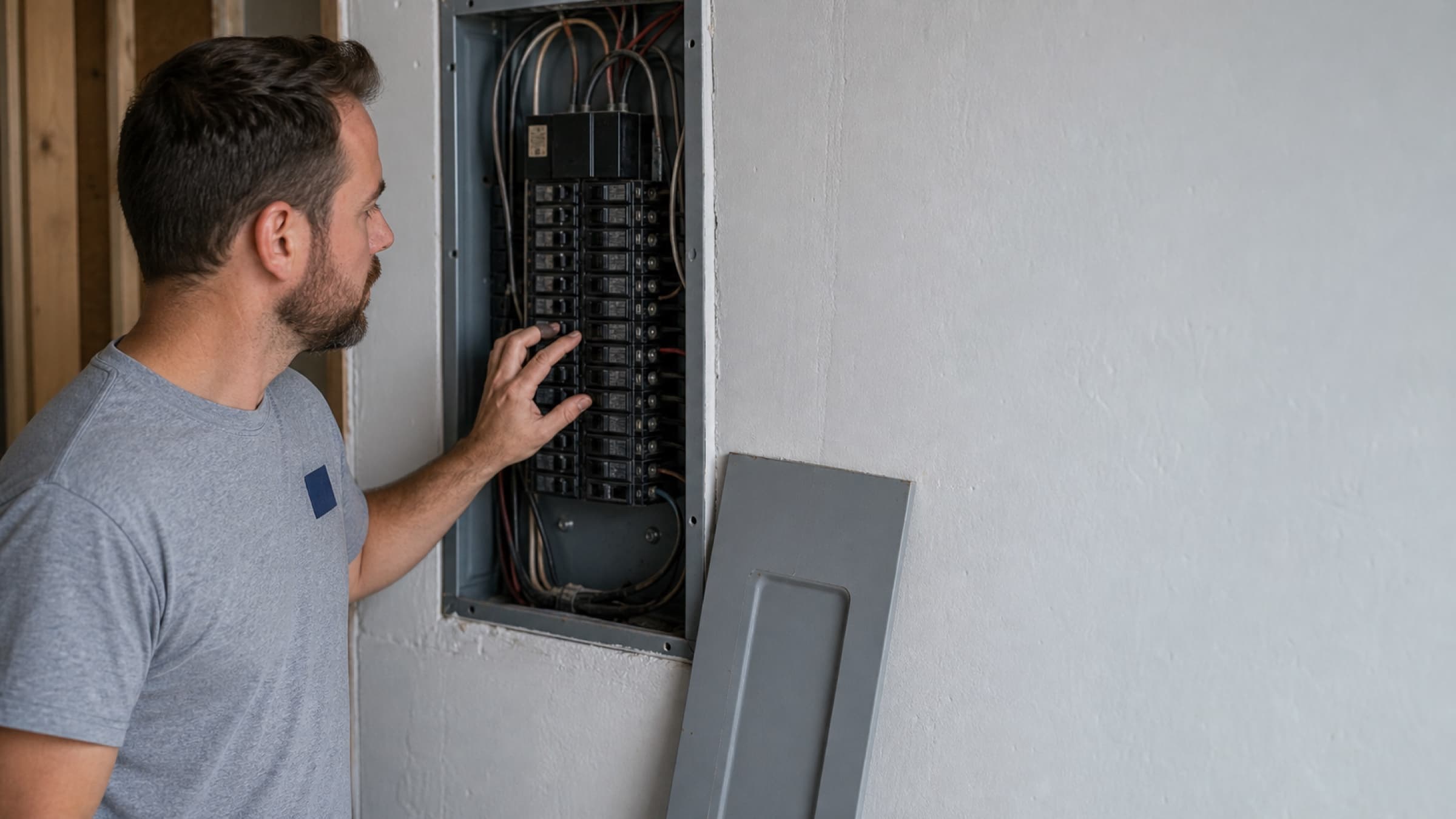
A tripping breaker is not a faulty breaker
Almost everyone's first assumption is that the breaker has gone bad. It is occasionally true and it is usually not.
A breaker is a deliberate weak point. It exists to open the circuit before the wire in your wall gets hot enough to start a fire. When it opens, the useful question is not how to make it stop, it is which of four things it is telling you.
One: overload
The most common cause, and the least alarming.
Overload means the total draw on that circuit exceeds its rating for long enough for the breaker's thermal element to react. It usually trips after a delay rather than instantly: the kettle goes on, and a minute later the lights go out.
The signature is repeatability with the same combination of appliances. Space heater plus microwave on the same kitchen circuit is the classic in January. Hair dryer plus a second bathroom on the same circuit is the classic in the morning.
What to do. Move something to another circuit. If you cannot, because a modern room genuinely needs more capacity than a 1970s circuit provides, the answer is a new dedicated circuit rather than a bigger breaker.
What never to do. Fit a larger breaker. The breaker is sized to the wire, not to your appliances. A twenty ampere breaker on wire rated for fifteen removes the protection and leaves the hazard. We find this in older houses regularly and it is one of the few things that makes an electrician go quiet.
Two: short circuit
A hot conductor touching a neutral or a ground. The trip is instant, hard, and often accompanied by a bang, a flash or a smell.
Common causes: a damaged flex crushed under furniture, a nail or a screw driven into a cable, a failed appliance, water in a fitting, or a wire that has come loose inside a box and is touching the metal enclosure.
What to do. Unplug everything on the circuit and reset once. If it holds, plug things back one at a time and you will find the appliance. If it trips again with nothing plugged in, the fault is in the fixed wiring and it needs an electrician.
Do not keep resetting it. Each reset re-energises a fault that is throwing an arc somewhere you cannot see.
Three: ground fault
Current leaking out of the intended path, usually to ground through water or through a person.
This is what a GFCI device protects against, and it trips at a tiny fraction of the current an ordinary breaker responds to, because the threshold is set by what will hurt a person rather than by what will heat a wire.
The signature is location: bathrooms, kitchens, garages, basements, crawlspaces and anything outdoors. The trigger is often weather. An outdoor receptacle that trips every time it rains has water getting into it, and a freezer in a damp garage that trips the GFCI every few weeks usually has a failing compressor winding.
Test buttons exist for a reason. Press them monthly. A GFCI device that does not trip on its own test button has failed and is providing no protection at all while looking perfectly normal.
Four: arc fault
The newest of the four, and the one that confuses people, because the circuit is not obviously overloaded and nothing has obviously shorted.
An AFCI breaker looks for the electrical signature of an arc: the intermittent, chaotic waveform produced by a loose connection or a damaged conductor. Arcs are what actually start electrical fires, and they can burn for months at a level no ordinary breaker will ever notice.
They also nuisance trip. Some motors and some older equipment produce signatures that early AFCI designs read as arcs, and that is a real limitation rather than something to dismiss a homeowner's frustration over.
The most common genuine cause we find is a backstab connection: a device wired by pushing the conductor into a hole in the back rather than looping it under the screw terminal. They loosen over decades. That is exactly what we found behind a refrigerator in Wake Forest, and re-terminating the device solved it.
The pattern that tells you the most
Keep a note for a week. Three columns: when it tripped, what was running, and how long after switching on.
- Same appliances every time, trips after a delay: overload.
- Instant trip, sometimes with a bang: short circuit.
- Wet weather, outdoor or wet-room circuits: ground fault.
- Random, no obvious load, AFCI breaker: arc fault, or a nuisance trip, and you need somebody to tell the difference.
When to stop resetting and call
Stop immediately and call if any of these are true:
- There is a burning smell, or any scorching or discolouration at a device or the panel.
- The breaker or the panel is warm to the touch.
- The breaker will not reset at all, or trips instantly on reset with nothing plugged in.
- Lights across the house dim and brighten, which can indicate a failing neutral and is a genuine hazard.
- You have a fuse panel, or a panel from a brand with a known recall history.
Those last two are the point where the conversation usually turns to a panel upgrade rather than a repair.
What we do
An electrical safety inspection is the systematic version of the note you kept: every circuit mapped and labelled, every device tested, and the panel thermal imaged under load, which finds a loose lug that looks entirely normal with the cover off.
If it is one bad device, we replace it. If it is a circuit that was never designed for what the room now does, we say so, and adding a circuit is a smaller job than most people expect.
The work this article is about
- Panel UpgradeReplacing an undersized, obsolete or failed electrical panel, with the utility disconnect and reconnect coordinated for you.
- Outlet and Switch RepairDead outlets, tripping breakers, ungrounded receptacles and failing switches, diagnosed properly rather than swapped and hoped.
- Electrical Safety InspectionA written inspection of the panel, grounding, protection and wiring, with findings prioritised by actual risk rather than by what we could sell you.
Jobs where this came up
- EV charger and garage rewire in CaryA level 2 charger installed without the panel upgrade two other companies had insisted on, plus a garage lighting and outlet rewire.
- Fuse panel to modern service, plus a standby generator, in RaleighA sixty year old fuse panel replaced with a modern service and a standby generator on an automatic transfer switch.